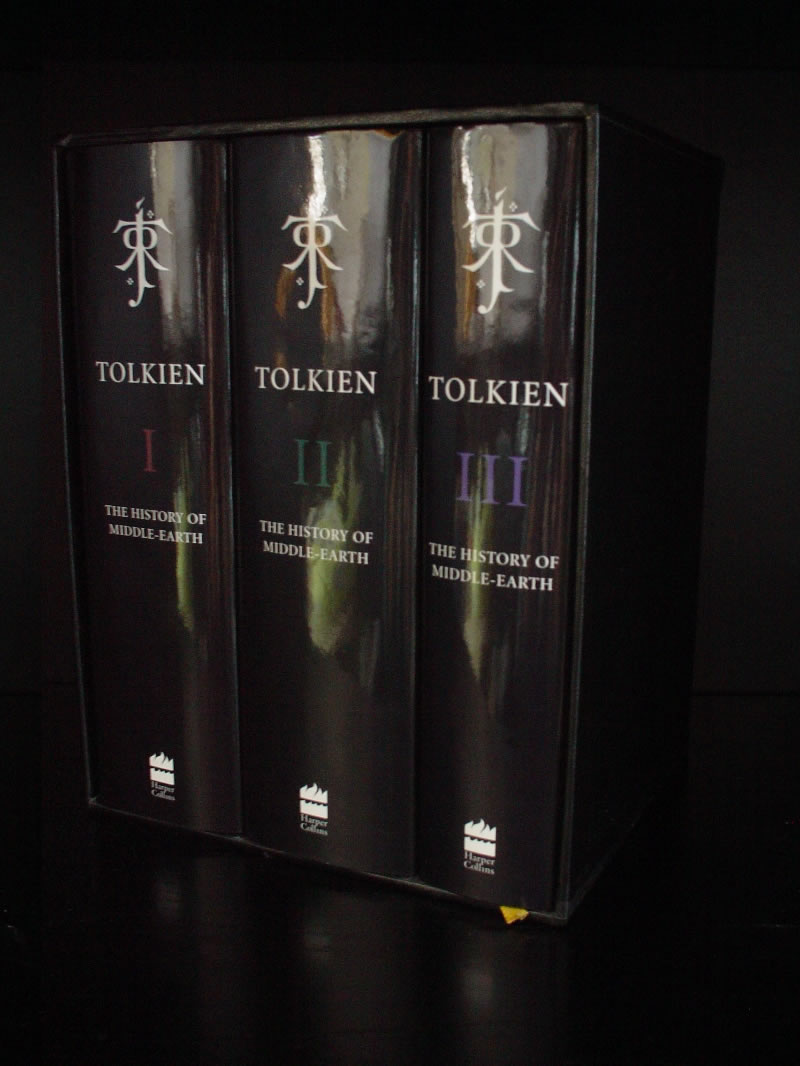
Although J.R.R. Tolkien is well known for The Hobbit, The Lord of the Rings and The Silmarillion, the material which laid the groundwork for what must be the most fully realised sub-creation ever to spring from a single imagination was begun many years before the publication of The Hobbit, and indeed Tolkien continued to work upon its completion until his death in 1973.
The History of Middle-Earth is one of the largest works of 'literary archeology', and was marvellously undertaken by J.R.R Tolkien's son Christopher Tolkien. During the 1980s and 1990s, Christopher Tolkien edited the vast collection of manuscripts together with maps and illustrations and published most of his father's Middle-Earth writings as the 12-volume History of Middle-earth series. In addition to the source material and earlier drafts of several portions of The Lord of the Rings, these books greatly expand on the original material published in The Silmarillion, and in many cases diverge from it. To give the 1977 Silmarillion a continuous narrative, Christopher Tolkien had to make editorial choices between different writings. The History makes it possible to examine those decisions beside the surviving texts, rather than treating every difference as an editorial error. These later books also reveal which parts of The Silmarillion Tolkien developed more than others.
The first five volumes talk about the early history of The Silmarillion, composed from the manuscripts from 1920 till 1930.
The next 4 volumes concentrate on the The Lord of the Rings, its creation, including early drafts and alternate versions of events, maps, illustrations and explanations not found in the book.
The last three volumes tell the later history of The Silmarillion, written after Tolkien had completed The Lord of the Rings and in these works the historical structure of the Ages that link The Lord of the Rings with The Silmarillion actually emerges.
Where to follow the story of Beren and Lúthien
Readers coming from Beren and Lúthien (2017) can continue the investigation in two volumes of this series. The Book of Lost Tales, Part Two opens with the early Tale of Tinúviel and Christopher’s commentary. The Lays of Beleriand prints the unfinished Lay of Leithian in Part III and its later rewriting in Part IV. The 2017 book provides a selected route through this material, moving between prose and verse. These volumes let us stay longer with a particular text, including its variants and the editorial discussion. They are useful companions to the later book, rather than earlier editions that it replaces.1
1. J.R.R. Tolkien, The Book of Lost Tales, Part Two, chapter I; The Lays of Beleriand, Parts III–IV; Beren and Lúthien (2017), Preface and pp. 132–133, where Christopher changes from the Lay to the Quenta Noldorinwa. ↩
Following Gondolin through its versions
The Fall of Gondolin (2018) offers another route into this record. Christopher gathers the principal tellings of one story, then discusses their evolution. His Preface explains why he had arranged the History more broadly across the developing mythology. The later book is a useful companion when a reader wants to remain with Tuor and Gondolin; the larger series gives the surrounding textual history. Neither approach makes the early narrative a draft to be discarded once a later account has been read.2
2. Christopher Tolkien, Preface to The Fall of Gondolin (2018), discussion of the arrangement of The History of Middle-earth and the later single-tale editions; “The Evolution of the Story”, comparison of the Lost Tale, the Sketch, the Quenta and the Last Version. ↩
A beginning before the Lost Tales
The Story of Kullervo offers a useful starting point before entering this series. Tolkien’s October 1914 letter to Edith records his work on the adaptation; Flieger’s separate edition prints the surviving story, names, plot notes and Kalevala essays. Its facsimile list of names shows alternatives still being tested. It is a companion to the History, with a different source and editorial history, rather than an additional volume of the twelve-volume sequence.3
3. Tolkien, Letters, no. 1, [October 1914]; The Story of Kullervo (2015), Flieger’s Introduction, Foreword and facsimile “Draft list of character names”, Bodleian MS Tolkien B 64/6, fol. 6 recto. ↩