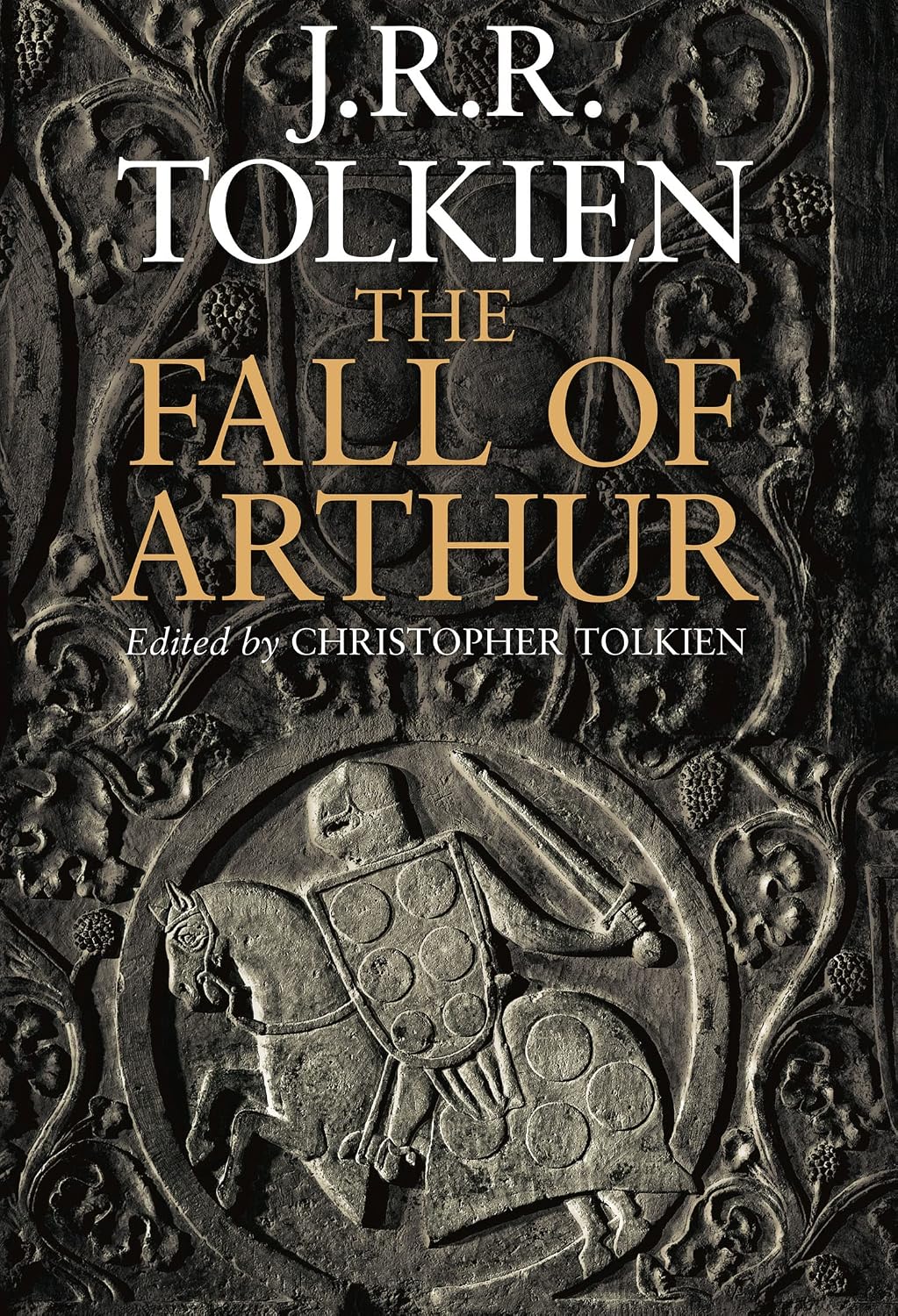
Arthur wants to walk on the grass. He has crossed the sea, defeated the ships opposing him and returned within sight of his kingdom. Yet the coast is held against him. In the opening of the fifth canto, he imagines the smell of salt mingled with clover, the sound of bells and the possibility of ruling in peace. Between the king and that ordinary happiness stand his own rebellious subjects.
I would begin a reading of The Fall of Arthur with that moment. The battles are magnificent, but here Tolkien allows the cost of another victory to become almost unbearable. Arthur knows whose lives he will have to spend to reach the shore. He calls Gawain and proposes another landing. A few lines later the surviving poem stops.1
That stopping place has to be understood before buying the book. Christopher Tolkien did not complete his father’s poem. He published its latest surviving form, followed by notes, discussions of its sources, material for the unwritten continuation and an account of its development. We are given both a work of poetry and the evidence of work still to be done.
A short poem inside a substantial book
The poem runs to a little under a thousand lines in five cantos, the last much shorter than the others. It begins with Arthur and Gawain campaigning in the East. A messenger brings news of Mordred’s treason, and Arthur turns towards Britain. Elsewhere Mordred prepares to meet him, Guinevere escapes from Camelot, and Lancelot remains in Benwick, torn between the people he has failed and the help he could still give.
These separate places matter. A king, a queen and an absent knight try to decide what to do while the weather moves between them. The sea carries ships and messages, but also keeps people apart. The reader often knows what one character urgently needs from another, without being able to bring them together.
Read the five cantos first, using the short notes for unfamiliar names and words. Christopher places the longer commentaries afterwards, leaving us free to return to the poem with a better understanding of how it was made.2
How to hear the verse
The first line provides a useful entrance: “Arthur eastward in arms purposed”. The language is modern English, although some words and turns of syntax are old-fashioned. Purposed means that Arthur intended or planned his expedition. Tolkien has chosen an older English verse-form to carry a new treatment of the story.
There is a pause within the line, dividing it into two half-lines. Each has two principal stresses. The important sounds bind the halves together: in this opening, the stressed words beginning with vowels can answer one another even though their initial letters differ. Elsewhere consonants perform that work. The system concerns sound and stress, rather than counting a fixed number of syllables or arranging end-rhymes.
It helps to speak the lines, leaving the words enough weight without turning every syllable into a march. The verse can hurry, hesitate or fall quiet. In the appendix, Tolkien explains how compact phrases are balanced against one another and how their head-rhyme connects them. His examples are worth reading beside the poem. They make the technique understandable without requiring a course in Old English.3
For other uses of this verse, turn to The Battle of Maldon and The Collected Poems of J.R.R. Tolkien. Here we can follow it through a sustained narrative.
Arthur at the edge of Mirkwood
The first canto leads the army into a landscape of immense trees, dark rivers, cold hills and storm. Arthur reaches Mirkwood’s margin. Readers of The Hobbit will recognise the name, but this does not place Arthur in Bilbo’s forest. A familiar name and a related imaginative vocabulary can work in different stories.
What matters here is the confidence of an army reaching something it cannot master. Earlier, its advance has left people fleeing and the country wasted. Then the trees stand beyond the soldiers, the daylight fails and their banners are stripped by the wind. The eastern forest does not become smaller because Gawain answers it with a splendid challenge.
This is one reason the poem belongs in our reading of Tolkien and the North. Its northern character lies in the verse, the weather, the scale of the wilderness and the resistance of human courage to approaching loss. At the same time, the cause Arthur defends is specifically British and Christian. As Christopher explains, Tolkien transforms the inherited eastern campaign: this Arthur defends the Roman realm instead of making war against Rome.4
Guinevere has very little time
Mordred is given more than the function of a traitor waiting for his king. We see him unable to separate his political ambition from his desire for Guinevere. News of Arthur’s return should occupy him completely. Instead he climbs towards the queen’s room, determined to turn the moment of danger into possession.
His offer of marriage soon becomes an explicit threat. Whether she accepts him or refuses, he intends to have her. Guinevere asks for time, speaks cautiously and uses the respite to escape with a few faithful companions. The fading lights of Camelot behind the riders make the change in her circumstances visible: the queen who seemed secure is now a woman being hunted.
Tolkien’s portrait is often harsh. The narrator repeatedly connects her beauty with coldness, acquisitiveness and danger to men. I do not think a review should smooth that away. But neither should it overlook her practical intelligence in this scene. Mordred’s appetite does not make his account of her trustworthy, and the poem gives us her calculation, fear and flight as well as its severe judgments.
Christopher’s comparison with Malory is particularly useful here. The circumstances of her escape have changed, and Tolkien develops the confrontation in his own way. Guinevere is an active presence in the collapse of this kingdom, although the poem allows her little generosity of motive. That uncomfortable combination deserves more attention than a simple description of a doomed love affair.5
The knight who waits for a message
Canto III is the part I would ask a hesitant reader to stay with. Lancelot looks across the sea from Benwick. He has betrayed Arthur for love, then tried to repair the betrayal by returning Guinevere. She has recovered her place as queen. He has recovered neither his king’s trust nor his former happiness.
His absence is already important in the first canto, when Arthur speaks of the swords he lacks. Gawain will not urge the king to send for Lancelot. If Lancelot means to help, he should come without being summoned. In Benwick, meanwhile, Lancelot thinks he could go if Arthur called him, or if Guinevere asked for rescue. The help Arthur wants remains in Benwick.
This is a tragedy of failed action as well as violent action. Lancelot’s courage in battle has not supplied the courage to set out under these circumstances. Pride, penitence, uncertainty and love hold him in place. The poem makes us wait with him long enough to understand that hesitation can have consequences as final as a blow.
Then the storm passes. The morning shines; birds call; the world seems renewed. Lancelot’s heart lifts, and he sings. We would like that relief to be deserved. Tolkien immediately tells us that the opportunity has passed. The improvement in the weather has brought him no understanding of what he has lost. The scene is devastating because hope returns at precisely the wrong moment.6
Gawain in the sunlight
Gawain moves where Lancelot hesitates. His loyalty to Arthur is firm, his courage unmistakable, and his golden brightness repeatedly set against the darkening world. On the return voyage his ship leads the attack. Its sail bears a rising sun and its banner a golden griffon. In the fighting he seems to give Arthur’s cause a visible centre.
But his loyalty has also helped to keep Lancelot away. The poem allows us to admire Gawain while seeing the limits of a response which will accept only help offered on its own terms. Arthur’s longing for the absent knight and Gawain’s refusal to summon him are not resolved by the splendour of the ships.
The sea-battle is a good place to hear the force of Tolkien’s diction. Warriors become smiths of battle, their weapons ringing against shields and helmets like hammers on anvils. The appendix explains why such an expression gives both a sound and a picture. In the fighting itself the explanation becomes unnecessary: we hear the blows.7
At the end of the canto, broken ships and bodies remain on the shore. Victory has been won, but the poem keeps the wreckage in sight. That prepares us for Arthur’s desire, in the next canto, to find a way home that will spare the people he still loves.
An ending in notes, not in finished verse
Readers familiar with Arthurian legend will expect Camlan, the encounter of Arthur and Mordred, and the king’s departure towards Avalon. None of these is reached in the latest text printed at the front of this book. The fifth canto ends while Arthur is speaking about moving west along the coast.
Christopher then shows what can be recovered from outlines and fragments. In one projected continuation Gawain presses the landing, reaches Mordred and is killed. There are rough words for Arthur’s lament, notes for the last battle and for the ship which will carry the wounded king away. These are valuable evidence, but their handwriting, gaps and competing possibilities remain part of that evidence.
The distinction becomes especially important with Lancelot. Tolkien considered a continuation in which he comes too late, meets Guinevere and asks where Arthur has gone. He then sails west in search of the king and never returns. It is a different end from a summary of Malory’s story, and Christopher carefully follows the difference. We can discuss Tolkien’s intention here without pretending that the corresponding cantos survive.8
Avalon and the western sea
Among these papers are verses concerning Eärendel and another fragment concerning Arthur’s grave. Their shared language brings Arthurian departure close to Tolkien’s own western seas. Christopher connects them with the name Avallon used for Tol Eressëa and with the upheaval caused by the emerging Númenórean story.
This is an established part of Christopher’s argument, not a connection newly discovered in this review. It is also an argument with limits which he states openly. The notes do not give us a completed explanation of how Arthur’s Avalon and the geography of The Silmarillion were to fit together. The dating of the different scraps is not precise enough to make every idea contemporaneous.
The western voyage remains an experiment. The History of Middle-earth preserves the changing mythology behind Christopher’s discussion; The Fall of Númenor gathers Second Age material. These are useful companions when reading his argument, while the Arthurian ending remains unwritten.9
What Christopher lets us see
The commentary on the poem’s evolution contains a discovery that changes a second reading. The eastern expedition, which now opens the poem so decisively, was added after work on other parts was well advanced. Earlier drafts began with the storm and the news reaching Mordred. The beginning of the final narrative was not the beginning of its composition.
Reading those alternatives, we can see how differently the reader is placed. Start with Mordred and the immediate danger gathers around his castle. Start with Arthur and we first accompany the king whose absence Mordred will exploit. The long journey through the East also gives the homeward turn its force. This is my reading of the effect of the rearrangement; the sequence of drafts is Christopher’s documented finding.
His account draws on about 120 pages of drafting before the latest text. He selects the changes needed to understand the poem, rather than reproducing every alteration. Some passages of this commentary require patient reading, especially around Lancelot. They reward it by showing how much thought lies behind the order in which the finished lines reach us.10
When was it written, and which edition to choose?
The poem was far enough advanced for R. W. Chambers to read it and urge Tolkien to finish it in December 1934. Christopher discusses an August 1937 annotation whose meaning is puzzling. In 1955 Tolkien still expressed the hope of completing the poem. Those pieces of evidence should survive any convenient description of it as a work simply begun and abandoned on two known dates.
Christopher suggests that the changing mythology and other imaginative demands helped draw Tolkien away. It is his explanation of the evidence, rather than Tolkien’s own account of his reasons.11
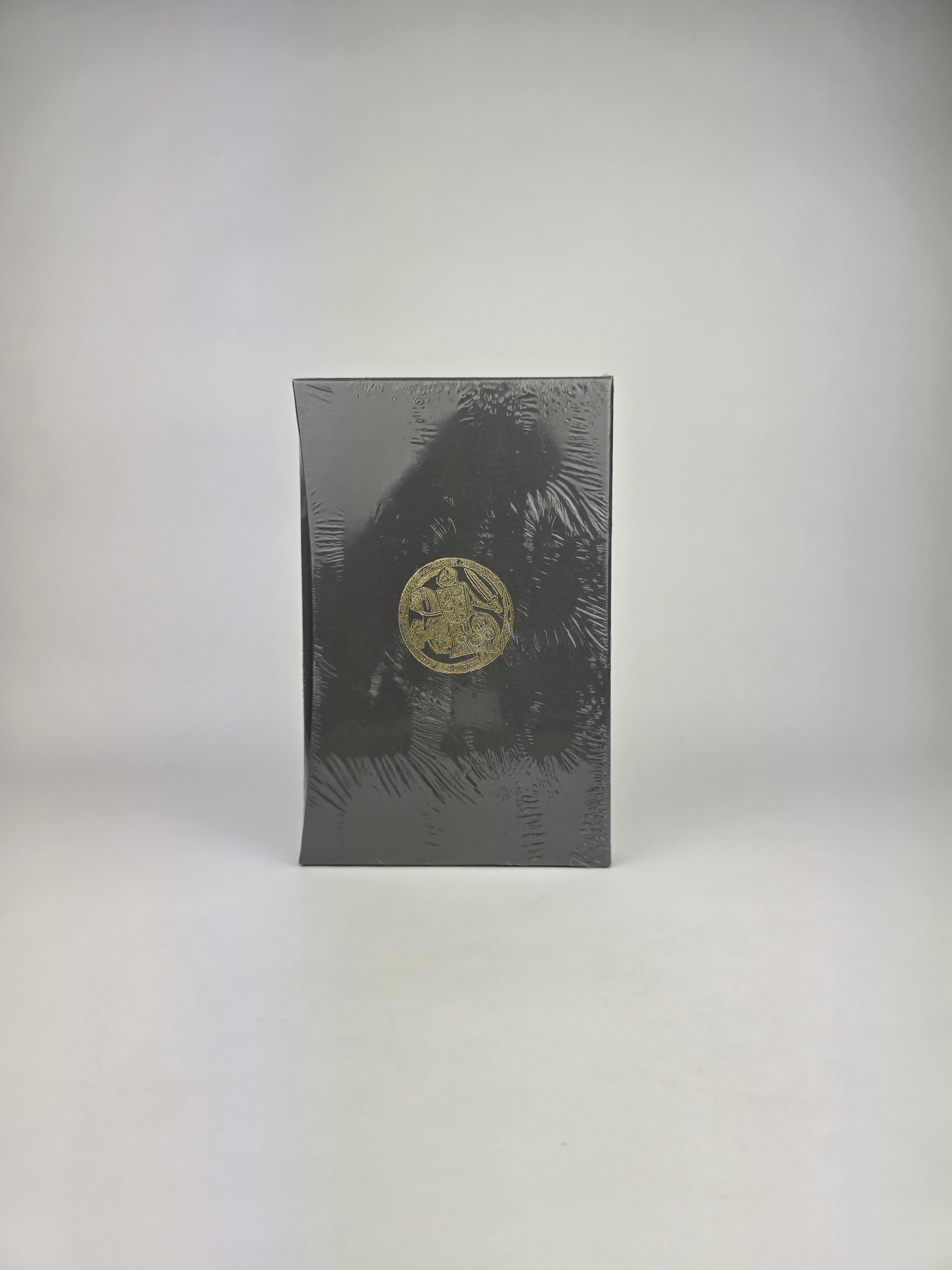
The UK hardback appeared on 23 May 2013, edited by Christopher Tolkien, ISBN 9780007489947. The US Houghton Mifflin Harcourt hardback is ISBN 9780544115897. The slipcased UK deluxe edition has ISBN 9780007489893. Our archive photographs show the sealed deluxe copy PC0106; that particular copy is sold. Its publisher’s band describes the colour manuscript frontispiece and ribbon marker, but the wrapping prevents inspection of the concealed impression statement.12
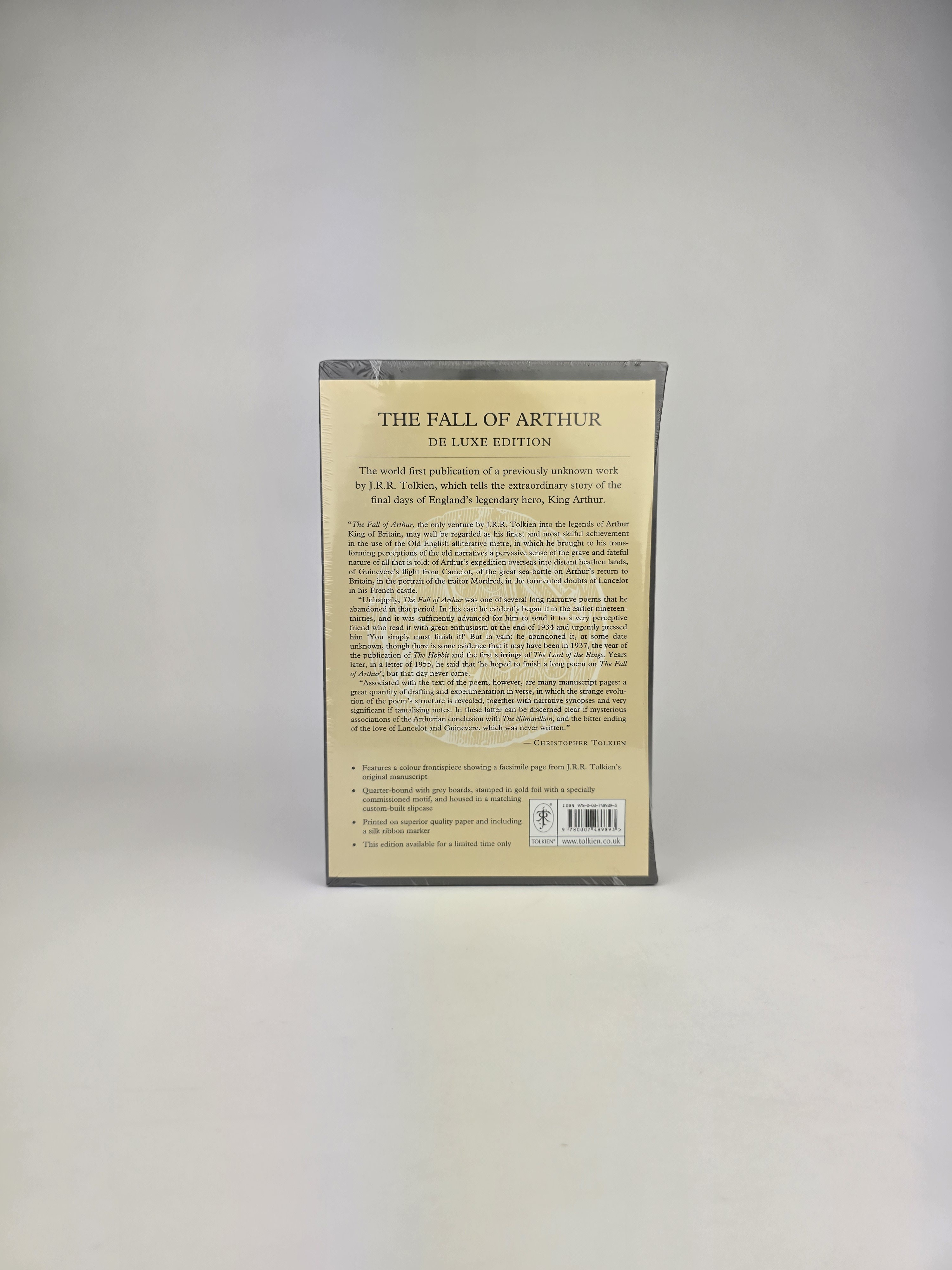
For reading, I would choose a sound ordinary edition before paying extra for the binding. For collecting, the slipcase, band, wrapping and condition are separate questions from the text. A shared ISBN or a bookseller’s stock publication date cannot by itself identify the impression of the copy offered.
The book will not satisfy a reader who needs the last battle brought to its end. What it offers is a powerful surviving poem and unusually revealing access to its making. Arthur has come home, his finest knight has failed to come, and his loyal companion wants to press the attack. Arthur’s feet have still not touched the grass.
Notes and sources
- J.R.R. Tolkien, The Fall of Arthur, ed. Christopher Tolkien (HarperCollins, 2013), V.1–63. The sixteen final lines are introduced separately by the editor as a more hastily written continuation on a slip of paper. The review’s reading of Arthur’s longing and hesitation refers to this printed latest text. ↩
- Christopher Tolkien, “Foreword”, especially the explanation of the commentaries’ optional position after the poem. The contents distinguish the poem, short textual notes, three longer commentaries and the appendix. An abridged version of the Foreword is available from the Tolkien Estate. ↩
- Tolkien, The Fall of Arthur, I.1; Appendix, “Old English Verse”, especially the examples of two-stress phrase patterns and the explanation of sound-linking between half-lines. The vowel alliteration in the opening is an application of that explanation. The appendix prints extracts from a later lecture related to, but distinct from, the 1938 BBC broadcast “Anglo-Saxon Verse”. ↩
- Tolkien, poem, I.1–9, 39–135; Christopher Tolkien, “The Poem in Arthurian Tradition”, concluding comparison of the reshaped eastern campaign with the chronicle tradition. Mirkwood in this poem is not identified here with the geographical forest of The Hobbit. ↩
- Tolkien, poem, II.110–213, III.39–62, 95–109 and IV.25–35; Christopher Tolkien, “The Poem in Arthurian Tradition”, discussion of Mordred’s encounter with Guinevere, the escape in Malory and the flight towards Wales in Tolkien’s poem. The assessment of Guinevere’s agency and of the poem’s severe portrait is my reading. ↩
- Tolkien, poem, I.180–220 and III.143–228. Compare Christopher Tolkien, “The Evolution of the Poem”, the three prose synopses for the Lancelot and Guinevere story, especially the account of Lancelot waiting for a summons and then welcoming the clearing weather. ↩
- Tolkien, poem, IV.137–230, especially IV.180–185; Appendix, “Old English Verse”, explanation of battle-smith imagery in the discussion of kennings. Gawain’s role in opposing a summons to Lancelot is in I.190–220. ↩
- Christopher Tolkien, “The Unwritten Poem and its Relation to The Silmarillion”, opening outlines for the continuation, the rough lament for Gawain, and the notes on Camlan, Arthur’s departure and Lancelot’s western voyage. These are not additional completed cantos. ↩
- Christopher Tolkien, “The Unwritten Poem and its Relation to The Silmarillion”, the “Eärendel passage”, the fragment discussed as “Arthur’s Grave”, and the discussion of Avallon, Tol Eressëa and the changing Númenórean mythology. His caution about dating and combining ideas concludes the discussion of the two fragments. The book already documents and argues for these connections. ↩
- Christopher Tolkien, “The Evolution of the Poem”, opening account of approximately 120 pages of drafts, the manuscripts labelled IIa–IIc, and the following account of Canto III. The interpretation of how changing the opening affects the reader is my own. ↩
- Christopher Tolkien, Foreword, quoting R. W. Chambers’s letter of 9 December 1934; “The Unwritten Poem and its Relation to The Silmarillion”, discussion of the annotation “Aug 1937”. Tolkien, Letters, no. 165, notes sent to the Houghton Mifflin Co., 30 June 1955, states the continuing hope of finishing the poem. Christopher’s proposed reasons for abandonment remain qualified. ↩
- HarperCollins UK hardback record, ISBN 9780007489947, on sale 23 May 2013; CiNii Books catalogue record, London, HarperCollins, 2013. US hardback ISBN 9780544115897 is recorded in Houghton Mifflin Harcourt’s Spring 2013 catalogue and verified against the current US product record. Deluxe ISBN 9780007489893 is visible on PC0106’s publisher’s band. This archive copy is sold, and its concealed impression statement has not been inspected. ↩