J.R.R. Tolkien & his works » Tolkien’s fiction and scholarly work » Books written by J.R.R. Tolkien » A Middle English Vocabulary
A Middle English Vocabulary
By J.R.R. Tolkien (1922)
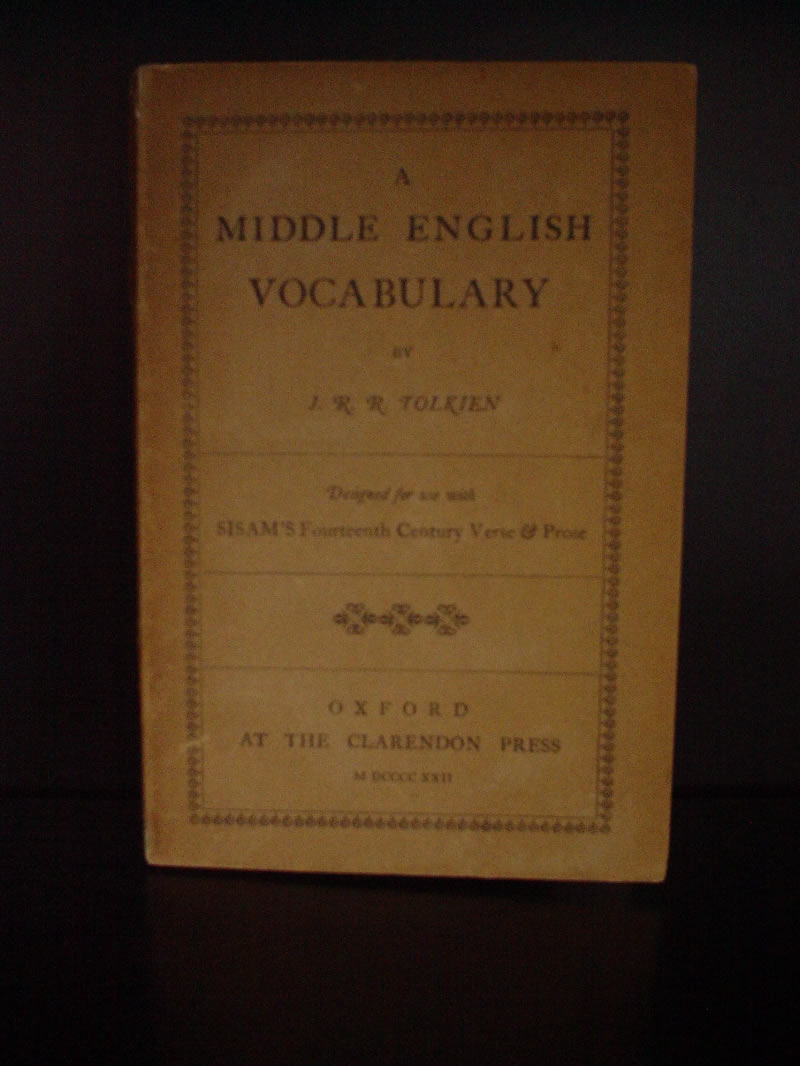
Tolkien’s first book-length scholarly publication, A Middle English Vocabulary, was written to accompany Kenneth Sisam’s Fourteenth Century Verse and Prose. Its careful treatment of Middle English words offers an early view of Tolkien’s work as a philologist and remains of interest to readers, students and collectors.
About the book
This is Tolkien’s first book-length scholarly publication: a vocabulary designed as a supplement to Kenneth Sisam’s Fourteenth Century Verse and Prose.
Editions and publishing history
Originally published by the Clarendon Press on 11 May 1922, in an edition of 2,000 copies. Some copies were bound separately, while others were issued together with Kenneth Sisam’s Fourteenth Century Verse and Prose.
Separate copies of A Middle English Vocabulary have been seen dated 1922, 1925, 1929, 1933, 1939 and 1947. Their appearance and text can vary. An earlier version of this guide estimated six different states. TolkienBooks.net documents seven known variants of the first impression, distinguished by details such as cover ornaments, advertisements and the title-page imprint. The priority of the later variants remains uncertain.

Review
Fourteenth Century Verse and Prose, Sisam’s collection, was a groundbreaker in its day, anything but interchangeable with others. As originally published in 1921 (Oxford, at the Clarendon Press), the 300-page volume had an excellent introduction, interesting texts with informative headnotes, detailed technical endnotes, and an appendix on “The English Language in the Fourteenth Century.” However, it lacked a glossary.
This appeared separately the following year as A Middle English Vocabulary: about 170 unnumbered, double-column pages, compiled by one of Sisam’s colleagues, none other than the young J.R.R. Tolkien. Tolkien’s contribution is a model of rigor, precision and compression. It will probably be enjoyed by those intrigued by his created languages, and used with respect, if not affection, by others.
Reading and using the vocabulary
This division into two volumes may have been a little annoying and expensive—two purchases instead of one—but it did have the advantage that the glossary could be kept open, with no constant flipping to the back of the book. It was customary at the time to keep printed sheets until there was demand for binding; consequently, several variants are in existence.
Margaret L. Lee praised Tolkien’s method, particularly his detailed treatment of the words that form the backbone of the language. Rather than devote disproportionate space to conjectural etymologies of rare or obscure words, he carefully distinguished the meanings and forms of common prepositions, pronouns and verbs. For the student of a language, understanding these apparently simple words thoroughly is more valuable than accumulating a broad but superficial vocabulary of seldom-used words.
Collecting and related reading
The book in its original, separately bound form is now quite scarce. Used, out-of-print and rare editions can be found through specialist booksellers and AbeBooks; later reading editions may combine Tolkien’s vocabulary with Sisam’s anthology.
For a separate introduction to Tolkien’s shorter creative works, The Tolkien Reader contains The Adventures of Tom Bombadil, Tree and Leaf (including “On Fairy-stories” and “Leaf by Niggle”), Farmer Giles of Ham, and “The Homecoming of Beorhtnoth Beorhthelm’s Son,” together with Peter S. Beagle’s introductory essay “Tolkien’s Magic Ring.” It does not contain A Middle English Vocabulary.
Book details
Author: J.R.R. Tolkien
First published: 1922
Original publisher: Clarendon Press, Oxford
Language: English
Purpose: A vocabulary for Kenneth Sisam’s Fourteenth Century Verse and Prose
Find a copy
Find editions on AbeBooks
Find editions on Amazon.co.uk
Find editions on Amazon.com
These are affiliate links. Tolkien Library may earn a commission from qualifying purchases, at no extra cost to you. The cover shown is an earlier edition; check the seller’s edition and ISBN before ordering.