The name Beren has a place on Tolkien Library beyond the bibliography: it is the name beside my own collector profile. In reviewing Beren and Lúthien, I want to give as much attention to Christopher Tolkien’s work as to the love story on the cover. He has brought together writings which allow us to follow a tale through some remarkable changes.
Published in 2017, with illustrations by Alan Lee, the book begins with an early telling and moves through later prose and verse, with Christopher explaining the connections. A reader expecting a newly completed novel will need to adjust. The interest lies in hearing different tellings of the same story, including passages whose detail disappeared when the story was compressed.1
Begin with the story you know
For readers approaching the First Age for the first time, I would begin with “Of Beren and Lúthien” in The Silmarillion. It gives the familiar story its place among the wars, oaths and losses of Beleriand. Beren, a mortal man, loves Lúthien, the daughter of the Elven king Thingol. Her father demands a Silmaril, one of the hallowed jewels in Morgoth’s crown, as the condition of their marriage. He expects the quest to kill Beren.
Carry that account into the 2017 volume. The differences then become easier to follow. When a name changes, or an incident takes another form, there is a story in mind against which to read it. Christopher supplies guidance, but it helps to know that the book’s sequence follows Tolkien’s writing rather than a single uninterrupted journey through Middle-earth.
One of the first differences is substantial. In the early Tale of Tinúviel, Beren is a Gnome. Tolkien’s Gnomes are Elves, the people who would become the Noldor; the word does not mean the small garden creature it suggests to a modern reader. Beren approaches the king as an outsider from a distrusted Elven people. The gulf between mortal Man and immortal Elf has not yet become the reason for the king’s contempt.2
This is more than an earlier label on the same character. Change Beren’s kindred and we have to reconsider the obstacle facing the lovers. The demand for a jewel can remain, as can the journey into the enemy’s power, while the meaning of those events grows. Christopher’s arrangement gives us the opportunity to notice that difference before the later mythology becomes familiar again.
Lúthien makes her own escape
I would resist reading the early tale only to identify things Tolkien later discarded. Tinúviel, the early tale’s name for Lúthien, already refuses to wait while others decide Beren’s fate. Her father confines her in a house high in the great beech Hirilorn. She answers imprisonment with practical work and magic: she obtains what she needs, grows her hair, and makes the means of escape.3
The details take time. Water and wine must be brought in particular vessels, at particular hours. A spinning wheel and a small loom enter the story. The spell of growth names things of exceptional length. We are allowed to follow the making, and the escape becomes an achievement of patience and invention.
That attention changes how I read the scene. Lúthien’s power does not remove the need for thought, materials or courage. When she reaches the dangerous country beyond her father’s protection, she can still be frightened, weary and unsure what to do. The early story allows those difficulties to remain. Her determination is more convincing because it has a cost.
Huan, the great hound she meets, listens to her and helps devise a way to reach Beren. He guards her while she rests. The eventual alliance of maiden and hound is already taking shape in these older pages. Lúthien’s central part in the rescue was not an idea added only when Tolkien made the story grander.
The cats are worth meeting
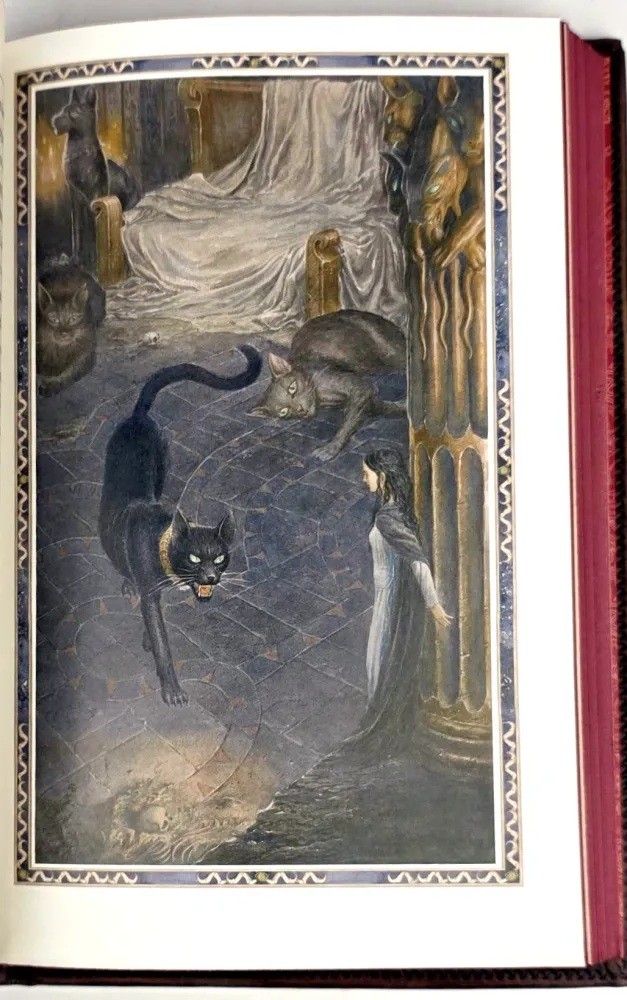
Readers who know Sauron’s tower and its werewolves may be unprepared for Tevildo, Prince of Cats. In the early tale, Beren becomes a servant among monstrous cats who supply meat for Melko’s table. He is given a humiliating test as a mouser, then set to work washing, carrying and turning spits. The episode has comic absurdity, but Beren’s hunger and exhaustion are real.4
Tevildo’s household is cruel as well as ridiculous. A servant who becomes unsteady on his feet is treated as something to throw away. The sunning terraces, the kitchens, the enormous purring creatures and their offended dignity belong to a fully imagined establishment. It deserves to be read before being reduced to a footnote in the history of Sauron.
Christopher himself warns against the simple statement that Sauron began as a cat. In his commentary in The Book of Lost Tales, Part Two, he explains that the cats’ stronghold and the later tower occupy a corresponding place in the narrative, while their character is very different. There is transformation as well as replacement: the enemy becomes a lord of wolves, and the struggle between Huan and a hostile beast survives.
I find this distinction useful well beyond Tevildo. A writer can preserve a rescue, a confrontation or a journey while changing the people and ideas that give it significance. Looking only for the finished character’s first appearance can cause us to miss the older story’s own pleasures.
When the story becomes a poem
The later Lay of Leithian gives us a different pace and a different weight of history. Beren travels with Felagund and his companions. Their capture by Thû, the Necromancer who develops into the familiar Sauron, brings the quest into contact with Elven kingship, loyalty and the consequences of earlier wrongs. The name changes are only part of what has happened.
Try the questioning in Canto VII. Thû tests the supposed Orcs’ knowledge, their names and their allegiance. Beren’s assumed name, Nereb, turns his own name backwards. The disguise is precarious, and the verse gives the questions an insistent movement. We hear the captives trying to maintain a story which their interrogator is pulling apart.5
Then Felagund answers the enemy’s magic with song. For a moment his words bring back the sounds and beauty of the Elven lands. The answering darkness calls up the killing of the Elves at the havens and the taking of their ships. A history outside this immediate adventure enters the contest. Beren’s quest now carries the weight of events which the early cats’ tale did not contain.
The sound matters. The poem can move from sustained descriptions to short, forceful statements; its rhymes drive the confrontation forward. I would read this passage aloud before deciding that verse is an obstacle. A prose summary can tell us who wins the contest. The poem gives us the experience of resistance being overcome, while something essential remains unbetrayed.
Mortality changes the whole quest
The early tale has not forgotten death. At its ending, the lovers’ return is already bound to mortality: both are allowed back into the world, but their renewed life will end. That is an important qualification to any account which treats the oldest story as a simple romance without the later tale’s grief.
In the familiar story, however, Beren is mortal before he meets Lúthien. The difference is present from the beginning of their love. When Lúthien comes before Mandos, the keeper of the Halls of the Dead, she cannot obtain an ordinary restoration of what they had. Her choice brings her into a mortal life with Beren and a second death. The story’s ending reaches back and changes how we understand every earlier moment of happiness.6
It is therefore possible to recognise a stable outline and still see deep revision. The meeting, the impossible demand, the rescue and the loss are recognisable across tellings. Their relation to the rest of Tolkien’s world becomes more demanding. Keeping both facts in view gives the book much of its interest.
Christopher Tolkien’s choices
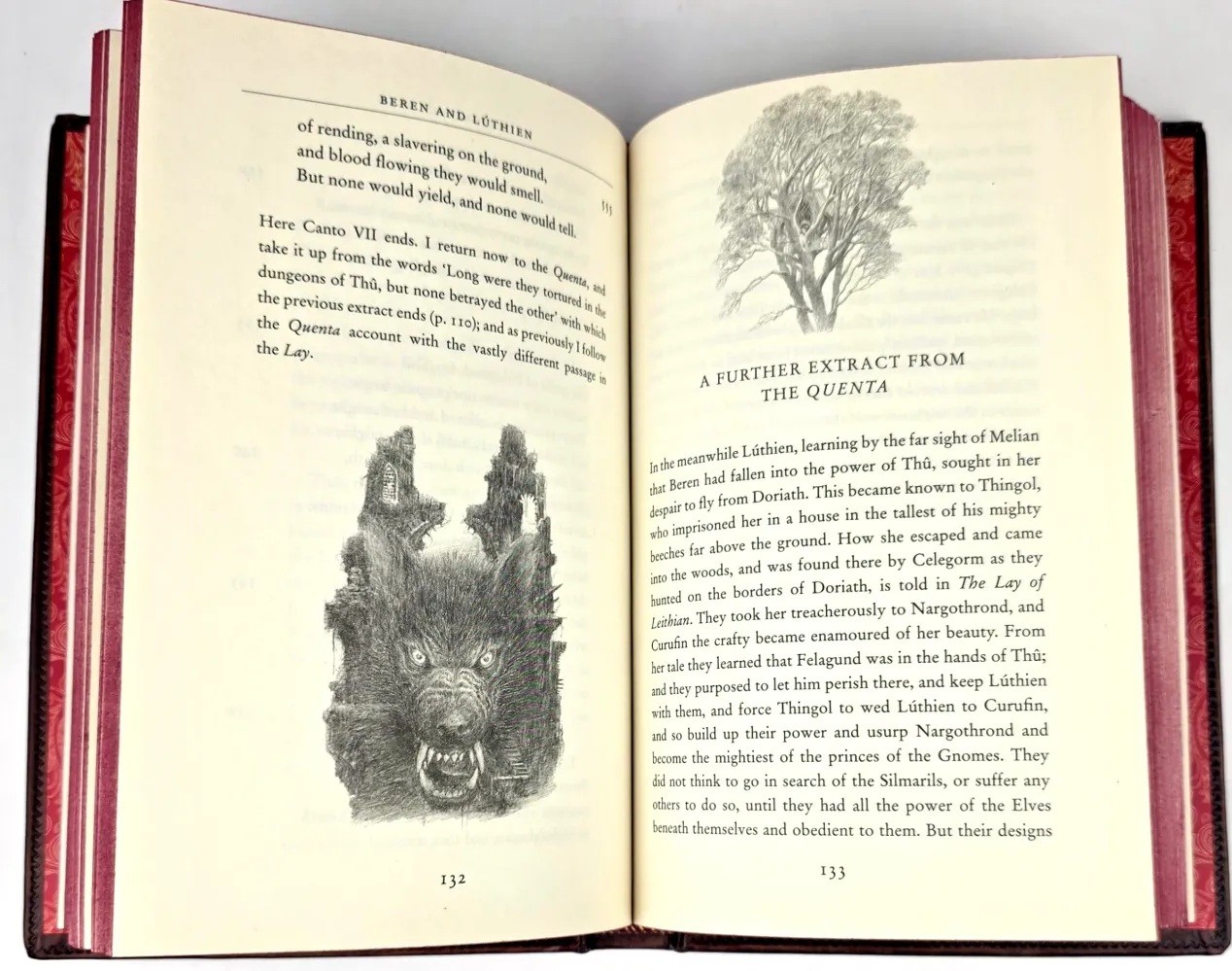
The photographed opening below makes the editorial method visible. At the end of a passage from Canto VII, Christopher returns to the Quenta, a prose account of the mythology, and directs the reader back to the point where its previous extract stopped. On the facing page, the prose resumes with Lúthien learning of Beren’s captivity. We can see the book changing forms, and Christopher tells us why he is making the move.7
This method has a cost. The narrative is interrupted, familiar events recur, and names need attention. Someone seeking a seamless evening’s reading may find the movement frustrating. I would rather explain that before recommending the book than leave a reader to discover, halfway through, that the form is different from what the cover led them to expect.
For a reader interested in Tolkien’s making, those transitions are the point. Christopher lets an earlier telling retain its voice, then provides enough of another to show what has changed. The 2017 volume is a selection and a guided comparison. The History of Middle-earth remains the place to pursue the fuller textual record, including the unfinished Lay and its later rewriting in The Lays of Beleriand.
I would also distinguish this book from The Children of Húrin. Both draw one of the great First Age tales into a volume of its own, but they make different editorial demands on the reader. The achievement here is the ability to follow the changes without having to begin by navigating the whole twelve-volume History.
The Fall of Gondolin (2018) takes this comparison further. Christopher prints the principal versions first and follows them with his account of their evolution. Its long early tale reaches the escape from the city; the sustained later revision ends at Tuor’s first sight of Gondolin. His Preface explains why that unfinished history calls for another arrangement.
Edith, memory and the life outside the story
Tolkien’s account of Edith dancing in a woodland glade at Roos in 1917 belongs here. In the letter to Christopher about her grave, begun on 11 July 1972 and continued over the following days, he explained why he wanted the name Lúthien beneath hers. He connected the tale with the young woman’s dark hair, voice and dancing, and with the loss he was now living through.8
The letter should be read in full. It holds memories of their love alongside difficulties and suffering which a brief romantic anecdote can smooth away. Tolkien also says that he did not call Edith Lúthien. Her place in the story was more profound than a pet name.
I do not want the knowledge of Edith to close the tale down into a code in which every event must stand for something in the marriage. What it gives me is a better understanding of why Tolkien kept returning to it. A story first imagined during their early married life remained a language in which he could speak of bereavement more than fifty years later.
Christopher’s own recollection adds another relationship to the book. He remembered the eyes of the wolves in the dungeon from his father’s oral storytelling in the early 1930s. The son who later edited the texts had first encountered their terror as a child listening. His editorial work carries that memory alongside the evidence of the manuscripts.
Alan Lee gives the earlier tale room
The pictures reward attention to which version we are reading. Tevildo’s hall is a particularly good example. Lee gives the cats a room proportioned to their power: heavy furnishings, a great couch, stone underfoot. Tinúviel stands at its edge beside a pillar. The cats dominate the space, and her smaller figure makes the danger legible without needing a battle.9
I like the decision to give this discarded part of the mythology such a full visual life. It prevents the early tale from becoming merely a set of names to be corrected into later ones. For the duration of the picture, we are guests in its particular world.
The small drawings matter too. On the opening at pp. 132–133, a wolf’s head is joined to broken towers, while a tree marks the beginning of the facing prose extract. The illustrations help give shape to a book which repeatedly changes between verse, prose and commentary. They are part of its reading experience, alongside the more immediately striking colour plates.
Editions and a copy to live with
The standard UK hardback was published by HarperCollins on 1 June 2017, edited by Christopher Tolkien and illustrated by Alan Lee. The first US edition was issued by Houghton Mifflin Harcourt. Both should be distinguished from later impressions, paperbacks and separately produced deluxe or custom bindings.10
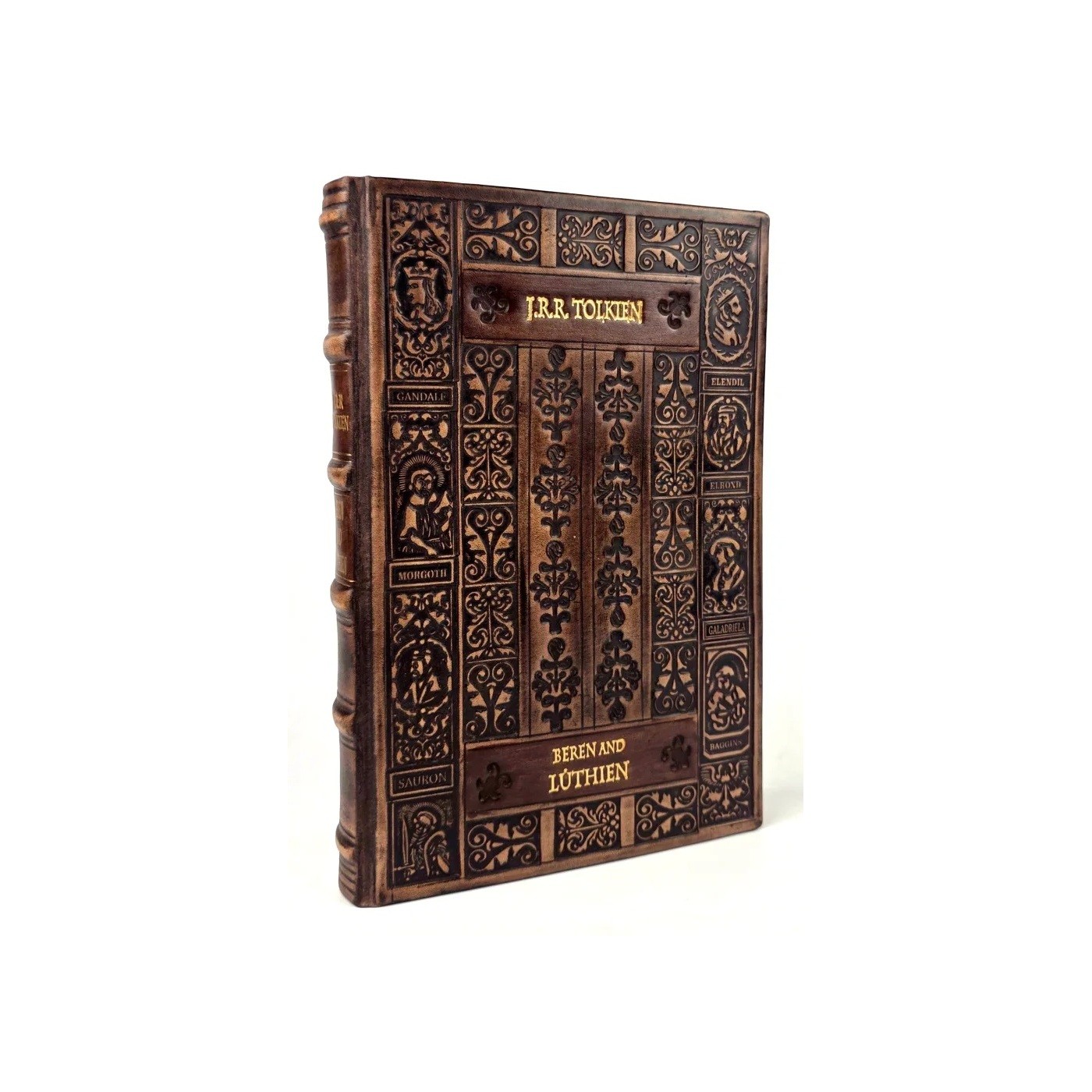
The cover photograph on this page shows the custom leather binding offered through our shop, on the 2017 US edition. Its decorated leather, raised bands and coloured edges belong to that later binding. The numbering of the binding series does not make it a publisher-issued signed limited edition. For any particular copy, ask for the publication page and the details of the binding rather than relying on the appearance of the boards.
Readers who already own The Book of Lost Tales, Part Two and The Lays of Beleriand will recognise much of the material. The reason to choose this edition is its concentration on one tale, Christopher’s guidance between its forms and Lee’s illustrations. For a first reading of the familiar legend, I would still recommend the Silmarillion chapter. For understanding how that legend acquired its depth, Beren and Lúthien is a rewarding next book.
Notes and sources
1. J.R.R. Tolkien, Beren and Lúthien, ed. Christopher Tolkien, ill. Alan Lee (2017), Preface and the sequence of prose and verse extracts. Christopher’s aims and his childhood recollection are quoted in Catherine McIlwaine’s account for the Tolkien Estate. ↩
2. The Book of Lost Tales, Part Two, ed. Christopher Tolkien (1984), I, “The Tale of Tinúviel”, Beren’s arrival in Artanor; see especially the commentary, pp. 52–54, on his Elven or mortal nature and the changing narrative background. “Earliest” here refers to the early complete telling presented in the book, not a claim that every surviving idea began in that form. ↩
3. The Book of Lost Tales, Part Two, “The Tale of Tinúviel”, pp. 18–23: imprisonment in Hirilorn, the spells and weaving, and the meeting with Huan. Compare the shorter account in The Silmarillion (1977), ch. 19. ↩
4. The Book of Lost Tales, Part Two, “The Tale of Tinúviel”, Beren’s captivity and Tinúviel’s visit to Tevildo; Christopher Tolkien’s commentary, pp. 53–54, explicitly qualifies the relationship between Tevildo and Sauron. ↩
5. The Lays of Beleriand, ed. Christopher Tolkien (1985), III, The Lay of Leithian, Canto VII, especially lines 2100–2225; the questioning is on pp. 228–230 and the contest of songs on pp. 230–231. See also the introduction to the Lay, pp. 150–151, for composition and revision. ↩
6. Compare the ending of “The Tale of Tinúviel”, Lost Tales II, pp. 40–41, with The Silmarillion, ch. 19, especially Lúthien’s song before Mandos and the choices offered to her. ↩
7. Beren and Lúthien (2017), pp. 132–133, the end of the Canto VII extract and “A Further Extract from the Quenta”, shown in the shop photograph. For the fuller poem and its revision, see The Lays of Beleriand, Parts III–IV. ↩
8. The Letters of J.R.R. Tolkien, ed. Humphrey Carpenter with Christopher Tolkien, revised and expanded by Wayne G. Hammond and Christina Scull (2023), no. 340, to Christopher Tolkien, 11 July 1972, with continuations. The Tolkien Estate publishes the relevant passage. ↩
9. Alan Lee’s colour illustration of Tinúviel in Tevildo’s hall, and the black-and-white drawings on pp. 132–133 of Beren and Lúthien (2017), as photographed in Tolkien Library’s SOB0017 gallery. The comments on their composition are my reading of the pictures. ↩
10. HarperCollins’ record for the UK hardback, ISBN 9780008214197; Indiana University’s record for the first US edition, ISBN 9781328791825. The shop’s custom binding is described separately from these publisher formats. ↩