On Tolkien Library’s Silmarillion page, I call the fall of Gondolin my all-time favourite. Christopher Tolkien’s 2018 edition gives that attachment more to work with. The city can be approached through its earliest full destruction, through compressed accounts of its place in the mythology, and through a much later journey which never quite reaches its streets.
That last distinction needs to be clear before buying the book. The Fall of Gondolin is not a newly completed novel. It brings successive writings together, with Christopher’s guidance and Alan Lee’s illustrations. The long early tale carries us through the sack and the escape; the last version stops when Tuor has passed the final gate and sees the city across the plain. Their incompleteness belongs to the book’s meaning.1
A city we must learn to lose
Tuor, a Man, is sent by Ulmo, the Lord of Waters, to the hidden Elven kingdom of Turgon. Morgoth’s power is spreading across Beleriand, the western lands of the First Age. Gondolin survives behind its encircling mountains. Its security is also its danger: the king and his people have grown attached to a refuge which they cannot imagine abandoning.
Christopher arranges the principal texts first, then discusses their evolution. That differs from Beren and Lúthien, where his commentary more frequently accompanies the movement between extracts. Here we can spend a longer stretch inside one telling before turning to the comparison. The short Prologue and the List of Names provide help without requiring us to read an editorial explanation at every step.
I would read the original tale as a story before trying to reconcile it with the later mythology. Its unfamiliar names are a reminder that we are in an earlier conception. Melko is the name used for the enemy who becomes familiar as Morgoth; the Noldoli or Gnomes are Elves. They are not mistakes to correct as we go. This is the world as Tolkien was then imagining it.
Idril’s answer is a way out
The original tale gives Idril something more substantial than a foreboding. She distrusts Meglin, the later Maeglin, and fears what his knowledge might put into the enemy’s hands. Tuor sees the difficulty of acting against the king’s nephew without a charge. Idril answers with work that can be done: find reliable delvers and begin a secret passage from their house beneath the hill.2
Tolkien makes the labour difficult. The rock is hard, secrecy slows the work, and the tunnel will take a long time. Idril persists. As danger draws nearer, she changes the priorities and urges Tuor to favour speed over concealment. She also thinks about who will gather around them if the king falls. Her foresight acquires practical consequences in stone, in trust and in the movement of people.
That is one reason I value the early tale’s room to develop. We can follow an argument, a decision and years of preparation before the escape is needed. The passage is not an unexpected convenience produced when the plot requires it. Idril has imagined the failure of the city while those around her still treat its survival as a certainty.
She is also suspicious of the established Way of Escape. The distinction is painfully exact. A route everyone already knows may be the route an enemy knows too. When the city burns, salvation depends on having thought beyond its accepted defences. This does not diminish the courage of the warriors. It gives their courage somewhere to bring the people they protect.
Summer arrives from the wrong direction
The attack begins with a disturbance of a familiar ceremony. The people are waiting to greet the summer dawn with song. Lights hang in the trees and silver lamps fill the city. Then a glow appears beyond the northern heights. It deepens until the snow is stained red. The light has come from the wrong direction, and its meaning changes from wonder to terror.3
The long account of the city’s houses and their emblems can initially feel like a delay. I would not hurry past it. The archers, the smiths, the people of the Fountain and the Golden Flower give the defenders distinct trades, loyalties and appearances. When the fighting moves through the squares and streets, we have begun to recognise the communities being destroyed.
The enemy’s creatures belong to this early imagining too. Some are linked iron, carrying Orcs within; others have bodies of metal and hearts of fire. Sorcery and manufacture are joined in forms which should not simply be replaced in the reader’s mind by the dragons and Balrogs of later stories. Their destructive force is described through what happens to buildings and stone, and through the people trapped before them.
There is much battle here, but the detail does more than enlarge the spectacle. A street can be lost, a retreat cut off, a defence overwhelmed. The accumulated geography makes the fall understandable. We are losing a place, rather than merely being told that a mighty kingdom has ended.
Glorfindel fights for people who cannot fight
The flight through the mountains should be read with as much care as the battle. The company stretches into a long line: wounded people, women carrying children, those able to walk and those who must be supported or carried. The narrow path and the cold impose their own order. The strongest cannot simply choose the fastest pace.
In that setting Glorfindel’s encounter with the Balrog has a particular purpose. The creature has reached the women and the sick. Glorfindel’s attack draws it into the combat on the rock above the path. Knowing who stands below him changes the scene. His death belongs to the protection of a vulnerable company, as well as to the history of heroic encounters.4
The flowers at his cairn carry the emblem of the Golden Flower beyond the ruined city. Yet the survivors’ grief does not end at the burial, nor does their ordeal end when the enemy falls. Tolkien follows hunger, thirst, wandering and further losses. There is time for the cost of escape to be felt.
The later journey asks us to slow down
The last version, written in 1951, changes the balance of the book. Tuor’s childhood, enslavement and escape receive a history of their own. The road to the city expands. A ruined hall, a shield on a wall, a conversation with a mariner and a night of hiding become scenes which can sustain a close reading. Christopher discusses how old features survive within a much more developed world.5
The encounter with Ulmo is worth reading aloud. Tuor stands at the edge of the sea as the weather changes. The apparent wave becomes a living presence, but Ulmo does not simply step onto land and speak like an ordinary visitor. His voice, his mantle and the movement of the water keep the meeting beyond Tuor’s scale. The message nevertheless falls to one mortal traveller to carry.
The abandoned hall of Vinyamar makes that traveller’s part visible. Its stairs are being covered by thrift and campion. Wind, rain and frost have marked its stone. Inside, light reveals the arms left for the messenger. The old building has a function in a future its absent inhabitants could not witness. It is one of the places where Tolkien’s history can be understood through a material object.
Christopher’s later discussion supplies the connection with the earlier warning to Turgon and the provision of those arms. His commentary is useful because it allows us to distinguish a detail inherited from the old tale from an association developed much later. The familiar swan emblem survives, but the web of relationships around it grows.
Voronwë has reasons to turn away
Voronwë is much more than a guide who knows a hidden road. He has survived years at sea and the destruction of his ship. When Tuor finds him, he is still stunned by that loss. He would like to remain far from the danger of the North, perhaps among the flowers and willows of Nan-tathrin. His agreement to return to his people costs him the peace he had imagined.6
His recollection of the Land of Willows is extraordinarily attentive to living things: flowers, leaves, birds and insects. It also reaches back into the history of the writing. In the early tale, Tuor lingers enchanted in that country; in the last version, its remembered delight belongs to Voronwë’s account of his own wandering. Christopher points out the alterations. A beautiful passage has acquired a different speaker and a different place in the journey.
The contrast with Ivrin then becomes severe. At a place Voronwë remembers as a clear pool among trees, the travellers find broken stone, burned or uprooted trees and frozen mire. They discover the marks of the dragon. The state of the water tells them something terrible has happened before any messenger explains it.
Then a man in black passes through the scene, calling for someone who is lost. He is Túrin, Tuor’s cousin, fleeing the ruin of Nargothrond. The travellers do not understand the encounter as we can. Their stories touch for an instant without becoming one adventure. Readers of The Children of Húrin will recognise how much suffering lies behind that brief appearance.
A cloak instead of a victory
As winter tightens, Tuor’s mortal limits matter. He is cold, hungry and close to the end of his strength. An Orc fire offers warmth and food, and he wants to fight for it. Voronwë refuses: other posts would hear them, and no enemy may be led to the hidden kingdom. The quest requires the surrender of a possible small victory.7
Tuor finally draws Voronwë beneath Ulmo’s cloak and crosses the road. The help they receive does not remove their exhaustion or the fear of pursuit. They have to hide together beneath a rock. The scene gives us dependence, disagreement and practical judgement alongside the great mission. For me, this is where the last version becomes especially convincing: the importance of the errand does not make the body inexhaustible.
The sequence of gates which follows offers beauty and protection in increasing measure. It also makes entry a grave commitment. At the last gate, Tuor is warned that a stranger who passes within will not leave alive. We already know from the earlier tale what the reader of this revision alone would not: the city’s greatest danger is its belief in remaining apart.
Why the unfinished ending matters
Then the sustained narrative stops. Notes indicate the reception which Tolkien intended to describe, but the revised story does not cross the plain and bring Tuor into Turgon’s presence. Christopher does not manufacture the missing continuation. The earlier tale and the shorter accounts allow us to know the events; they cannot supply the unwritten later prose.
His explanation deserves its qualifications. In “The Evolution of the Story”, Christopher connects the abandonment with his father’s difficulties in finding a way to publish The Silmarillion alongside The Lord of the Rings. He supports the dating with manuscript evidence, including a page from a September 1951 engagement calendar. His account of discouragement is an editorial interpretation grounded in letters, not a surviving declaration by Tolkien that this was why he stopped this particular narrative.8
I find the break painful, but it makes the edition more honest. We are allowed to admire the last version without pretending that admiration can complete it. The book’s older prose remains valuable in its own right. A reader can prefer the later journey’s intimacy and still be grateful for the early tale’s streets, ceremonies and desperate escape.
Alan Lee and the scale of the landscape
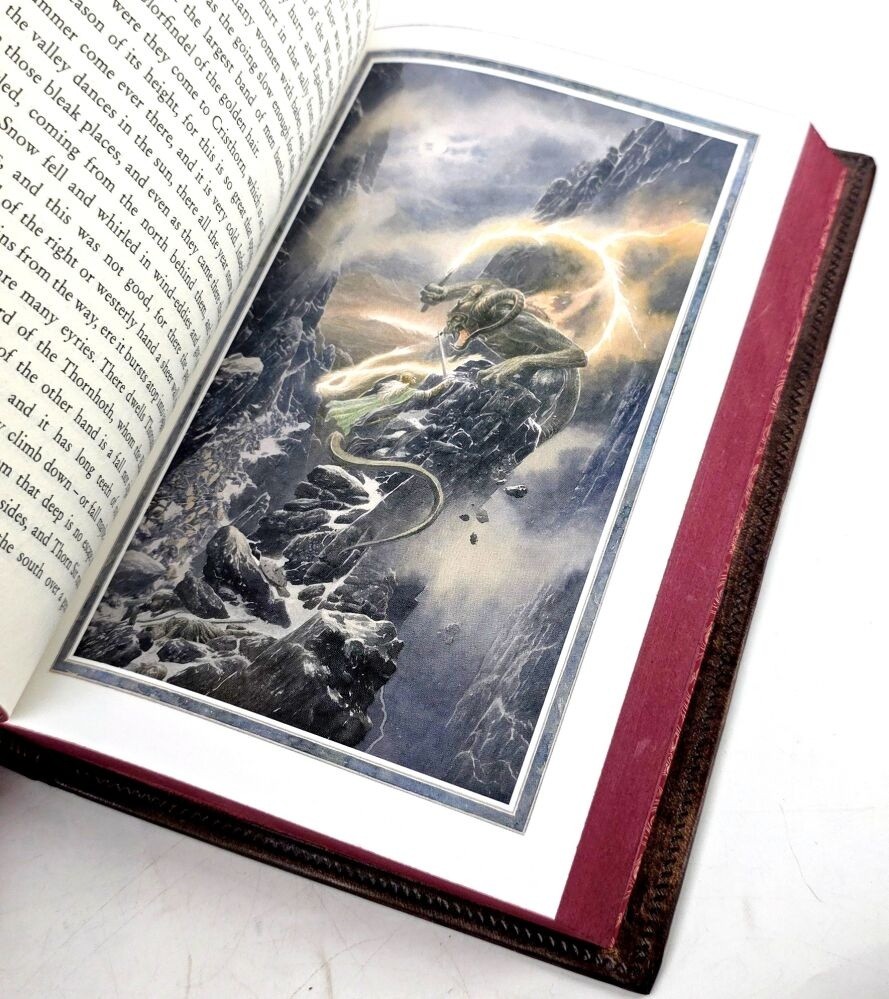
Lee’s illustrations help the different tellings retain their presence. In the photographed Rainbow Cleft, the water runs through a deep, steep-sided ravine towards a brightness high above. The small figure near the rock gives the landscape its scale. It is a place which must be negotiated, rather than a view placed behind the traveller.9
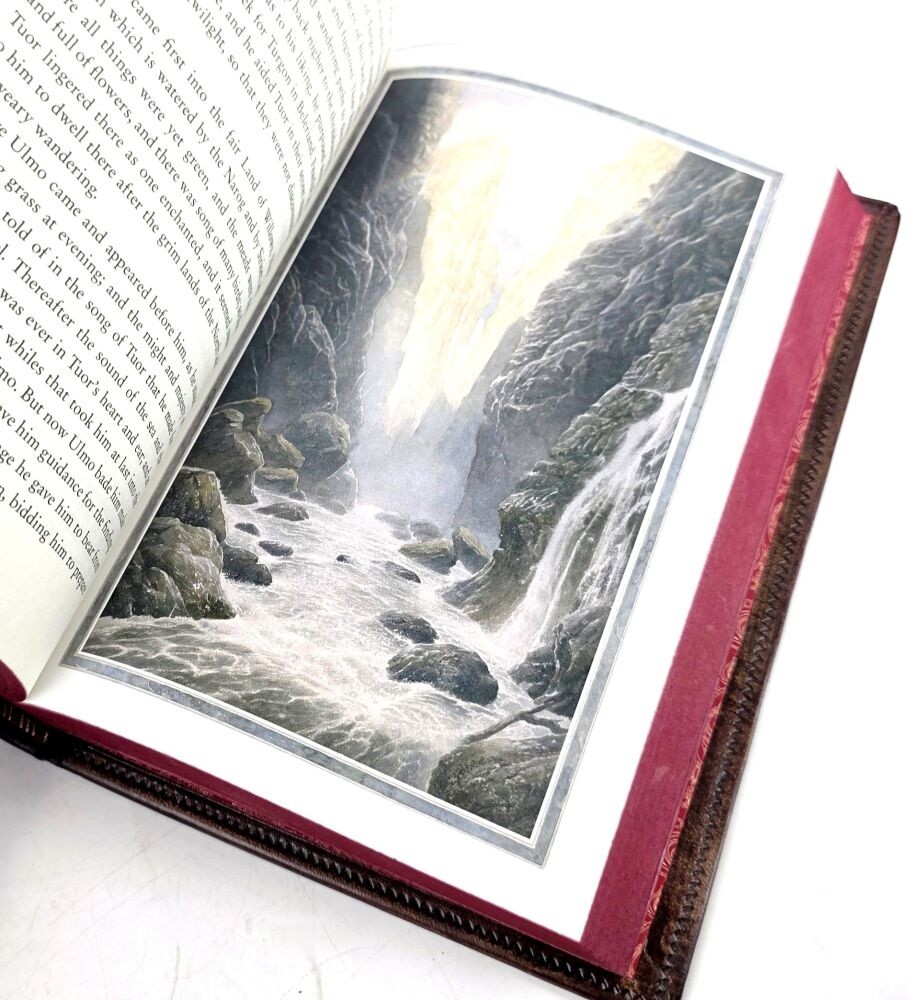
The Glorfindel picture makes a different use of restricted space. The combat occupies a projecting ledge, while a line of smaller figures continues along the mountainside. The danger to the fugitives remains visible within the heroic subject. These comments are my reading of the compositions, but the actual photographs allow a reader to look closely and disagree.
The edition rewards that kind of attention. The illustrations are not all views of the final mythology reconstructed into a single consistent world. Like the texts, they allow us to enter moments from the story’s history.
Which edition should we collect?
The UK illustrated hardback appeared in 2018 from HarperCollins; the first US edition was published by Houghton Mifflin Harcourt. The standard UK hardback, the publisher’s slipcased deluxe edition, later impressions and custom bindings should be identified separately. An ISBN usually identifies a publishing format, not an individual impression.10
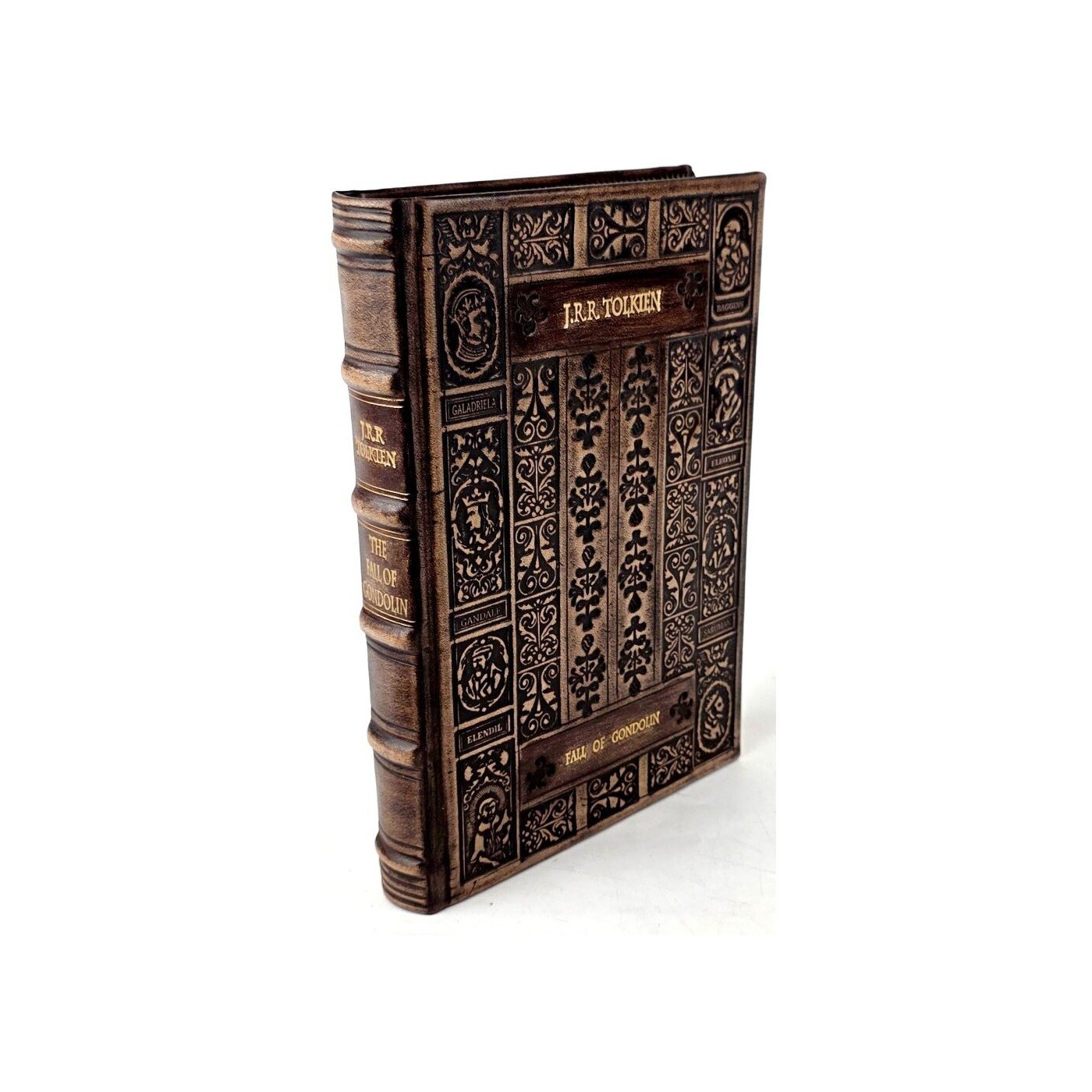
Our photographs show the custom leather binding offered as SOB0019. The photographed title page bears the William Morrow imprint, so I would not describe it as the original Houghton Mifflin Harcourt first impression. The shop’s 2018 date refers to the work’s publication history; the exact supplied copy, its publication page, number and condition must be confirmed. A numbered custom binding is a different proposition from a publisher-issued signed limitation.
For a reader who wants only the story’s place in the First Age, The Silmarillion remains the shorter route. For someone who wants to understand how Tolkien returned to Gondolin, and what remained unfinished when he did, this volume is the better companion. It gives us the complete early catastrophe and enough of the later journey to understand why Christopher mourned the narrative that was never written.
Notes and sources
1. J.R.R. Tolkien, The Fall of Gondolin, ed. Christopher Tolkien, ill. Alan Lee (2018), Preface, especially the final discussion of the arrangement; “The Last Version”, closing narrative and following notes. The comparison of editorial forms is stated by Christopher himself. ↩
2. The Fall of Gondolin, “The Original Tale”, Idril’s conversation with Tuor after her dream of Meglin and the later preparations before the Gates of Summer. Compare “The Story Told in the Quenta Noldorinwa”, where the secret passage remains but its course and Meglin’s knowledge differ. These versions should not be combined into one account. ↩
3. “The Original Tale”, the approach of Tarnin Austa, the northern glow, the array of the houses and the making of Melko’s iron and fire monsters. “The Evolution of the Story” and the Preface discuss the unusually full early account of the city’s fall. ↩
4. “The Original Tale”, the flight through Cristhorn, Glorfindel’s duel and burial, and the subsequent wanderings to the Land of Willows. The List of Plates identifies the duel by its passage on p. 107. ↩
5. “The Last Version”, pp. 145–202; especially Tuor at Vinyamar and the appearance of Ulmo, pp. 161–168. “The Evolution of the Story” compares the swan emblem, Tuor’s ancestry, the earlier coastal dwelling and the later role of Vinyamar. ↩
6. “The Last Version”, Voronwë’s account after his rescue from the sea, the Land of Willows and the ruined pool of Ivrin; compare the Preface on the passing of Túrin and “The Evolution of the Story” on the changed sequence of the early journeys. For Túrin’s own narrative see The Children of Húrin, ch. XII, “The Return of Túrin to Dor-lómin”. ↩
7. “The Last Version”, the Fell Winter, the Orc encampment and the crossing of the road beneath Ulmo’s cloak; then the approach through the Seven Gates to Ecthelion. The sustained narrative ends with the vision of Gondolin, before the planned reception by Turgon. ↩
8. Christopher Tolkien, “The Evolution of the Story”, opening discussion of Tolkien’s letters to Stanley Unwin, 24 February 1950, and Rayner Unwin, 22 June 1952; manuscript evidence from the September 1951 engagement calendar, including notes for the unwritten continuation referred to on p. 202. Christopher identifies discouragement over publication as his explanation, rather than quoting Tolkien on this specific abandonment. ↩
9. Alan Lee, The Rainbow Cleft and Glorfindel and the Balrog, colour plates in The Fall of Gondolin; the List of Plates cites the associated passages on pp. 135 and 107. Photographs from Tolkien Library’s SOB0019 gallery. The visual interpretations here are the reviewer’s. ↩
10. HarperCollins’ publisher-supplied edition record, standard UK ISBN 9780008302757 and deluxe ISBN 9780008302764; Indiana University catalogue, first US edition, Boston: Houghton Mifflin Harcourt, 2018, ISBN 9781328613042. The actual title-page photograph in SOB0019 reads William Morrow, a later imprint; the available copy’s impression requires confirmation. ↩