J.R.R. Tolkien & his works » Tolkien’s fiction and scholarly work » Books written by J.R.R. Tolkien » The Collected Poems of J.R.R. Tolkien
The Collected Poems of J.R.R. Tolkien
By J.R.R. Tolkien, edited by Christina Scull and Wayne G. Hammond (2024)
A poem written for Edith, a troll with a stolen bone, a ship leaving for the West. This three-volume collection follows Tolkien’s verse through years of rewriting, showing how a private poem or a comic song could find a different life in Middle-earth.
Review
I am interested in the life of a text. The finished poem matters, of course, but so does the page on which Tolkien crossed out a word, changed a speaker or returned to a line after twenty years. The Collected Poems of J.R.R. Tolkien makes that history available on a scale we have not had before. Its particular strength lies in allowing us to follow a poem far enough to understand what the changes do.
Christina Scull and Wayne G. Hammond have organised the collection into 195 numbered entries, with five appendices. An entry can contain several related poems or versions, so 195 is not a count of individual poems. Their introduction describes at least 240 discrete poems, depending on how one separates titles and versions. The distinction matters more than a large number on a publisher’s announcement: these volumes offer both poetry and an account of its making.1
How to read the collection
The entries generally begin with the earliest surviving form of a poem and follow its development. Complete texts alternate with discussion, shorter extracts and notes. A letter distinguishes one version from another. Once this system becomes familiar, it is possible to put two texts beside one another and see a change without having to reconstruct it from a list of variants.
I would begin with a poem I already knew. Read its familiar form first, then return to the opening of its entry. Otherwise the sheer amount of material can make the book feel more difficult than it needs to be. The early drafts become much more interesting when we have heard the finished poem and can ask what Tolkien was trying to achieve.
The sequence is broadly chronological, according to a work’s beginnings, rather than its publication date. But a poem begun early can lead us forward by several decades, and poems selected from The Hobbit and The Lord of the Rings are also grouped in sequences reflecting their place in the stories. This is a history with overlapping paths. The chronology, contents and index are useful companions, particularly when a poem has changed its title.
The editors are careful about what they can establish. A question mark beside a date remains a question mark. A clean manuscript may be a copy of a lost draft. The earliest surviving text need not be the first text Tolkien wrote. Their introduction explains how handwriting, paper and typewriters can help with dating, while also recording the limits of that evidence. Anyone interested in collecting manuscripts should read those pages as carefully as the poems.2
A morning written for Edith
The opening entry, “Morning”, gives a small, manageable example of the whole enterprise. The earliest dated surviving text belongs to a letter Tolkien wrote for Edith Bratt on 28 March 1910, when he was eighteen. He did not post that message until 1913, after their enforced separation had ended. The circumstances are intimate and particular: this was a poem for a person who would recognise the memory behind it.3
It would be easy to read the earliest version only as a touching document of their relationship. The later texts ask more of us. Tolkien returned to the poem, changed its length and rhyme, and worked on the description of the morning itself. By 1915 the wakeful birds, the leaves and the dispersing mist carry more of the poem. The invitation to the beloved remains, but the surrounding world has become more closely observed.
A blackbird acquires the older name ousel. The poplar becomes more precisely an aspen, and Tolkien adds Old English words for the tree and bird to one of his copies. These details are worth attending to because they show language and observation meeting in a poem about an ordinary morning. His philological interests are already present in the words he chooses for something living outside the window.
I prefer the later poem’s attention to the aspen leaves and the changing light. The first version explains its emotion more directly; the later one gives that emotion more room in the scene. Other readers may prefer the directness of the young man’s message. Having the versions together allows that judgement. We can recognise an improvement in one respect without deciding that everything earlier should have been discarded.
For Tolkien Library, this is one reason to keep the personal poems within view. The poet who wrote about trees, weather, separation and affection cannot be understood entirely through the verse assigned to Elves and Hobbits. The collection gives these smaller occasions their own place, before we ask where they lead in the mythology.
How a comic troll entered Middle-earth
Entry 83 follows a much less solemn journey. Its titles run from the Latin “Pēro & Pōdex” through “The Root of the Boot” and “Sam’s Song” to “The Stone Troll”. The oldest form reproduced here has a troll gnawing a bone and a young man called Tom objecting to this treatment of his uncle. There are jokes about Heaven, Hell, a halo and the uncle’s doubtful respectability. The humour belongs to a world which can take a churchyard and a Sunday for granted.4
In this early form, the troll can sound surprisingly like a scholar, offering a distinction between the body and the soul. Tom speaks much more roughly. That difference is part of the joke, and the editors help us hear it by attending to vocabulary and dialect. The poem’s history includes its printing in Songs for the Philologists in 1936, but the editors distinguish that publication from its earlier composition.
When Tolkien considered the poem for the story that became The Lord of the Rings, he had more to do than assign it to a Hobbit. The Christian references disappear from the developing texts. The troll becomes more threatening, and the exchange between the two characters changes. Even the names shift: at stages the young man is John rather than Tom. A familiar song was being made suitable for another world.
The eventual setting gives it an additional purpose. In “Flight to the Ford”, after the travellers have found the stone trolls from Bilbo’s adventure, Sam sings it to his companions. We learn something about Sam through the performance and through their response. An old piece of comic verse has become an occasion for hearing a character’s voice.
This is also a useful reminder to read a collection’s title carefully. The Tom of “The Stone Troll” is not identified as Tom Bombadil. Its appearance in The Adventures of Tom Bombadil does not make every Tom in the book the same person. Following the texts makes that distinction clear. It also makes the poem more interesting: its history reaches beyond the character whose name appears on the 1962 collection.
The comedy has survived all this work. A reader can still enjoy the rhythm, the indignation and the consequences of kicking a troll without consulting a single note. The notes explain how carefully that apparent ease was made. For me, this is among the most persuasive uses of the collection: it takes a poem we might pass over as a little joke and lets us see the decisions that keep the joke alive.
Before it was Bilbo’s last song
“Bilbo’s Last Song” seems inseparable from its place at the Grey Havens. Many readers know it through Pauline Baynes’s pictures or its use in the BBC radio adaptation. Entry 127 begins somewhere earlier, with a poem entitled “Vestr um Haf”, Old Norse for “West over Sea”. The editors tentatively place this text around 1931, on physical and thematic evidence. They do not present the date as certain.5
That qualification should stay with the story. Even so, the surviving early text is unmistakably different from a farewell written from the outset for Bilbo. It already has a waiting ship, a departure and a destination beyond the sunset. The manuscript history then brings us to revisions in which Tolkien gave the voyage to Bilbo. The new speaker changes the weight of the farewell.
The movement from a shared voyage to an individual voice can be followed in the wording. The later text also gives more prominence to age, failing sight and departure from mortal life. Those meanings have a particular force when we bring Bilbo’s long history to them. Yet the ship and the westward longing belong to an earlier part of Tolkien’s imagination.
It is tempting to turn the poem into Tolkien’s own final goodbye. That can be a moving way to receive it, but it should not become a claim about when he first composed it. The editors distinguish the uncertain dating of revisions from firmer evidence: the final form existed by October 1968; Tolkien gave Joy Hill a copy and its copyright in September 1970; the poster followed in 1974, and the illustrated book in 1990. Composition, gift and publication are separate events.
The Old Norse title will interest readers following Tolkien and the North. Here it supplies a documented title and a translation. It does not, by itself, establish a particular saga as the poem’s source. What we can follow is the persistence of a westward journey through Tolkien’s own writing. The evidence is already rich enough without adding an influence we cannot demonstrate.
I would still read the Baynes-illustrated book separately. Pictures, page turns and the poem’s final form create an experience of their own. The Collected Poems adds the earlier life of the words. Both books have a purpose, and seeing that earlier life makes the familiar farewell more complex.
Collected does not mean complete
This is a large collection, but it does not put every line of Tolkien’s poetry between three pairs of boards. Most of the poems from The Hobbit and The Lord of the Rings are omitted. The longer narrative poems and major translations are represented by extracts. The introduction also records material which the editors could not consult, as well as works they judged too problematic to include.6
Keep The History of Middle-earth nearby if the long lays are your particular interest. The Lays of Beleriand remains essential for reading those poems at length. Equally, Poems and Stories is a different kind of book: an illustrated gathering of shorter works, including prose. The new set is not a replacement for every earlier Tolkien volume with poetry in it.
There are practical demands on the reader. Moving between versions interrupts the flow one expects from an anthology, and a long entry can require a bookmark or two. Someone wanting only a quiet evening with finished poems may prefer a smaller collection. I would not recommend starting at page one with an obligation to read every variant before going on. Choose an entry, read the poem aloud, then follow the changes that interest you.
Nor does publication make every experiment equally successful. The value of an early or awkward poem may lie partly in what Tolkien later made from it. A collection broad enough to include those stages gives a fuller account of the writer, but it also asks us to exercise our own judgement. The editors supply the history; they leave room for disagreement about the poetry.
For the collector and the returning reader
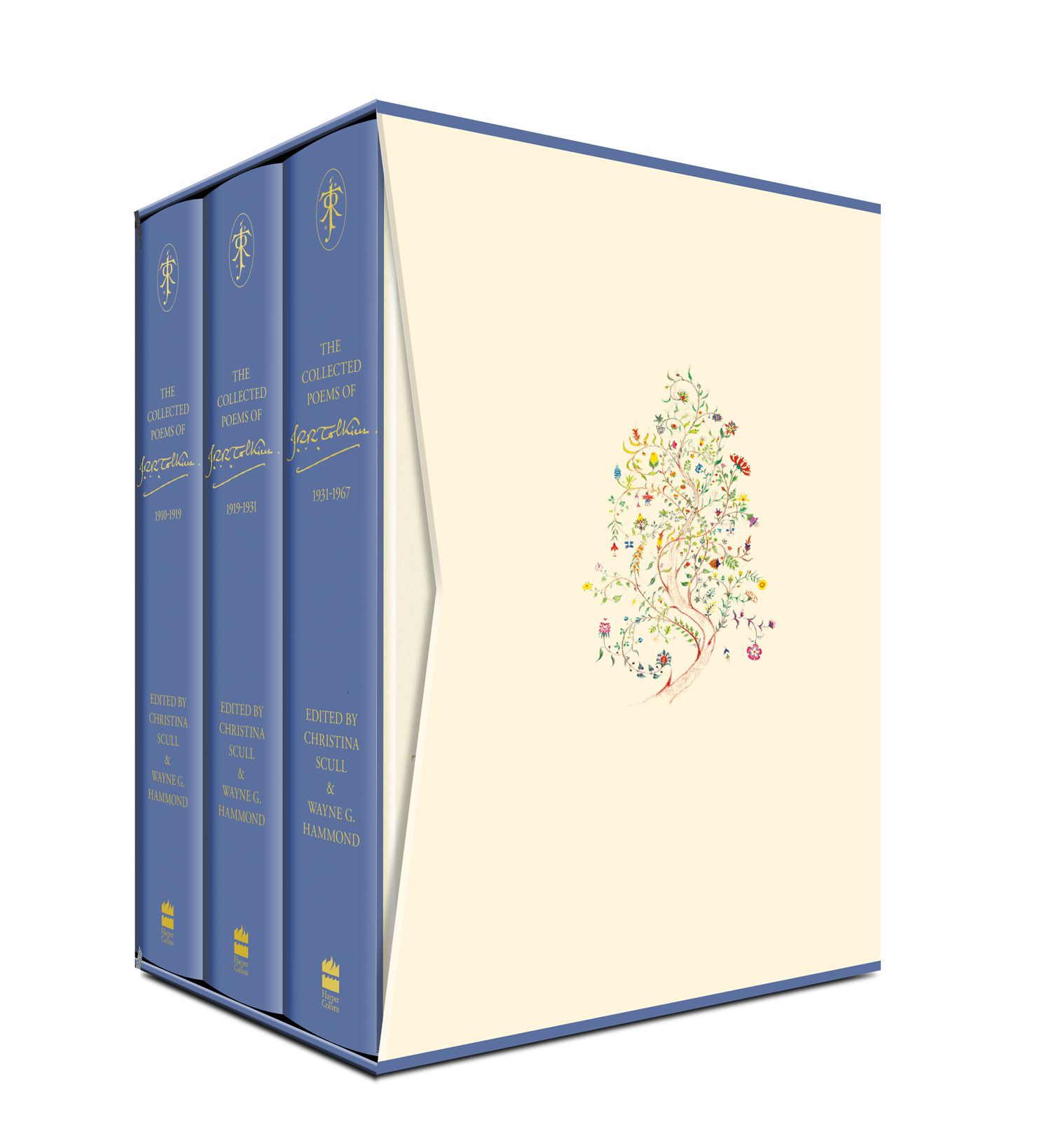
The UK edition appeared as a three-volume HarperCollins hardback set on 12 September 2024. The American set was published by William Morrow. The publishers’ presentation uses Tolkien’s own tree designs; the editors explained that the UK and US designs differed in their imprint. The image on this page is the publisher’s image of the UK set, rather than a photograph of a copy offered in our shop.7
Edition and impression deserve separate attention. Hammond and Scull maintain an online list of additions and corrections to the first printing and report that many corrections entered the second printing in 2025. A later impression may therefore be preferable for everyday reading. A first impression has its own collecting interest, but a first-printing claim needs to be supported by the publication page of the actual set. An ISBN alone will not settle it.8
My reason for recommending the collection is the opportunity to return to familiar poems with better questions. Who was speaking before Tolkien gave these words to Sam or Bilbo? What changed when the poem entered Middle-earth? What remained from its first occasion? The three examples above reward that attention. A private morning, a comic encounter and a departure by sea each acquire a history we can follow, with the uncertainty left visible where the surviving papers cannot answer everything.
Notes and sources
1. J.R.R. Tolkien, The Collected Poems of J.R.R. Tolkien, ed. Christina Scull and Wayne G. Hammond (HarperCollins, 2024), Introduction, discussion of scope and the 195 entries; Contents and Appendices I–V. The editors’ announcement of 12 March 2024 also explains the project’s origins. ↩
2. Collected Poems, Introduction, editorial method: arrangement, dating, copies, versions and transcription; see also the opening explanation to the Chronology. Entry numbers and version letters below locate passages without confusing electronic pagination with printed pages. ↩
3. Collected Poems, no. 1, “Morning · Morning Song (1910–15)”, texts A–D and accompanying commentary, especially the letter of 28 March 1910 and the May 1915 revisions. ↩
4. Collected Poems, no. 83, “Pēro & Pōdex · The Root of the Boot · Sam’s Song · The Stone Troll (c. 1924–62)”, texts A–F and commentary. Compare The Fellowship of the Ring, Book I, ch. 12, “Flight to the Ford”, and poem 7 of The Adventures of Tom Bombadil (1962). ↩
5. Collected Poems, no. 127, “Vestr um Haf · Bilbo’s Last Song (at the Grey Havens) (?1931–c. 1960)”, texts A–C and commentary, pp. 885–889. The editors suggest a possible connection between the revisions and preparations for the 1962 Bombadil collection, explicitly without direct evidence. ↩
6. Collected Poems, Introduction, scope, selection and inaccessible papers. See also the editors’ General Comments on the Collected Poems, under their addenda, for their explanation of the intended audience and the limits of a three-volume set. ↩
7. HarperCollins’ UK publication record, ISBN 9780008628826; Indiana University’s catalogue record for the William Morrow set, ISBN 9780063422711. Scull and Hammond, “Collected Poems Bindings & Boxes”, 26 May 2024, identifies the tree designs and compares the publishers’ mock-ups. ↩
8. Scull and Hammond, Addenda and Corrigenda to the Collected Poems, introductory notice concerning the 2024 first printing and 2025 second printing. Consult the current list when checking a particular reading. ↩
Book details
Author: J.R.R. Tolkien
Editors: Christina Scull and Wayne G. Hammond
UK first publication: HarperCollins, 12 September 2024
Format: Three hardback volumes in a slipcase
UK set ISBN: 978-0-00-862882-6
US set: William Morrow, 2024; ISBN 978-0-06-342271-1
Volume 1: 1910–1919
Volume 2: 1919–1931
Volume 3: 1931–1967
Find a copy
Start with Tolkien Library. Check our shop for The Collected Poems. Individual copies come and go; a search result for Poems and Stories is a different book.
The image shows the UK HarperCollins set. Check the set ISBN and ask the seller for the publication page if a particular impression matters to you.
Affiliate links. As an Amazon Associate I earn from qualifying purchases. Tolkien Library may also earn a commission from purchases made through the AbeBooks link.
UK HarperCollins set on Amazon.co.uk
ISBN 978-0-00-862882-6
US William Morrow set on Amazon.com
ISBN 978-0-06-342271-1
UK HarperCollins set on AbeBooks
ISBN search; sellers may offer different impressions.
Tolkien’s chronological bibliography
Books written by J.R.R. Tolkien