Gudrún is weaving the story that has ruined her life. In the figures of her tapestry are the waterfall where the gold was taken, the house of the Völsungs, the sword being forged and Sigurd riding towards her family’s hall. The second of Tolkien’s two lays begins by gathering the first into a woman’s work. The dragon is dead. The hero is dead. Someone has to live with what remains.
When I reviewed The Legend of Sigurd and Gudrún in 2009, I admitted that I had struggled at first to find its rhythm. The poems became more compelling as I read them, and I read them aloud. That is still useful advice to give with this book. The short lines can look forbidding on a page. Heard together, they begin to move, and the people inside them become much easier to follow.1
What kind of Tolkien book is this?
Published in 2009 and edited by Christopher Tolkien, the volume contains The New Lay of the Völsungs and The New Lay of Gudrún, with Tolkien’s lecture material, Christopher’s commentaries and three appendices. These are English narrative poems made from the Northern legends. Calling them translations misses the decisions Tolkien was making between sources that disagree, leave gaps or tell the same event in different ways.
The date needs care. Christopher suggests the earlier 1930s, but describes that dating as an intuition, rather than a discovery in a dated manuscript. In a letter to W. H. Auden of 29 March 1967, Tolkien remembered the work as an attempt to bring the Völsung lays of the Elder Edda together while learning to write alliterative poetry. His interest was both scholarly and practical: how could this material be made into a poem in English?2
A reader coming from The Hobbit will recognise a dragon, a dangerous treasure and birds whose speech matters. But Sigurd’s story belongs to the Völsung tradition. It should be allowed its own people and its own consequences, rather than being read only as a cupboard of things Tolkien later used in Middle-earth.
Finding the beat
The name of the metre, fornyrðislag, looks harder than the first step in reading it. Tolkien uses stanzas of eight short lines. Think of each pair as two balanced halves, usually with two principal stresses in each half. The important sounds belong to the stressed words. They carry us across the break; end-rhyme is not the organising principle.
Take “the deep Dragon / shall be doom of Thór”. The repeated d joins the halves; doom carries the linking sound in the second. Or read the opening, “Of old was an age / when was emptiness”. The stressed vowels can link with one another, even when the letters differ. You do not need to shout the beats. Give the words their weight and let the short phrases balance.
Christopher explains another helpful detail. Much of the first lay was written out by Tolkien in long lines, but Tolkien added an instruction that it should be set in the short-line form. The printed shape is a way into hearing the verse. It is also one of the small editorial decisions that would be invisible without Christopher’s account of the manuscript.3
The dragon is part of a family
The trouble begins before Sigurd is born. Loki kills an otter who is really Otr, a son of Hreidmar. The gods must cover and fill the skin with gold as compensation. Loki obtains it by robbing the dwarf Andvari, whose curse goes with it. What is supposed to settle one killing supplies the cause of further killings.
The repeated claim that gold can heal becomes increasingly bitter. Hreidmar wants it for himself; Fáfnir kills his father and keeps it from his brother Regin. By the time Sigurd reaches the dragon, the hoard already has a history of violence within a household. Fáfnir is not an obstacle placed beside a reward. He is one of the people whom possession of that reward has transformed.
Regin, meanwhile, has fostered Sigurd and taught him much more than smithcraft. He offers the young man glory and wealth, but conceals what the venture means for his own family. After the killing, he and Sigurd argue over who deserves credit: the courage of the fighter, the smith who made the sword, or the counsellor who planned the deed. The talk sounds almost practical until we remember that Regin means to kill the man he has helped.
Sigurd tastes the dragon’s blood while testing the heart at the fire and understands the birds. Their warning exposes Regin. Yet the larger warning has already been spoken by Fáfnir himself: the gold will destroy its possessors. Sigurd can recognise an immediate plot without believing what the defeated dragon tells him about his future. That difference makes the victory dangerous to read as an ending.4
Promises that cannot be kept together
Brynhild first appears in a scene of release. Sigurd rides to the mountain, cuts her out of the armour that binds her and wakes her. Her greeting calls on daylight, night, the gods and the fruitful earth. For a moment the language opens out. Wisdom, healing and joy seem possible between two people who recognise one another.
They promise fidelity. Then Brynhild sends him away to win a kingdom. At the court of Gjúki, Grímhild gives Sigurd the drink that makes him forget Brynhild; he marries Gudrún and binds himself to her brothers Gunnar and Högni. Later he helps Gunnar win Brynhild by taking Gunnar’s appearance and riding the fire in his place. Sigurd’s obligation to his sworn brother becomes the means of betraying his earlier promise.
Tolkien makes the consequences painfully visible. After the marriages, memory returns. When Gudrún and Brynhild quarrel at the river, rings become evidence, and the deception is uncovered. Brynhild then falsely accuses Sigurd of having broken faith with Gunnar in her bed, although a sword had lain between them. Her accusation is a means of obtaining his death. Love, shame and the demand to keep an oath have become instruments for destroying the person loved.
Christopher’s “Note on Brynhild” shows how closely this tragedy is tied to Tolkien’s reading of the old poems. He discusses conflicting accounts of the Valkyrie, the betrothal and the murder. Tolkien does not simply smooth the tale into easy modern motives. He gives its competing obligations a clearer sequence, so that we can understand how each person helps to close the way out.5
Gudrún has to remember
Sigurd’s death does not finish the book. Gudrún withdraws into the woods and weaves. Her family come to find her because another marriage would be useful: Atli’s growing power threatens them. Grímhild sees her daughter’s beauty as a means of binding him to the family. Gudrún’s loss has scarcely become bearable before it is made part of a political arrangement.
One alteration is especially revealing. In the source tradition, Grímhild gives Gudrún a drink of forgetfulness. Tolkien omits it here. Christopher explains his objection to repeating the mechanism and his doubts about how it works in the older text. In this lay, the mother’s will is enough. Gudrún goes to Atli remembering the injuries she has suffered and knowing that she does not want the marriage.6
Atli wants the treasure still held by Gunnar and Högni. His invitation to a feast is a trap. Gudrún sends warnings, including a ring wound with wolf’s hair and a message in runes, but the written warning is altered. The scene turns on reading: Grímhild detects earlier marks beneath the changed signs, while Gunnar is drawn towards the journey by drink, pride and the messenger’s taunts.
This is a fine example of what language does in Tolkien’s stories. A message does not deliver its truth automatically. Someone can change it; someone else can read the warning and still refuse its force. Högni recognises the bitter reversal: they have followed Grímhild’s advice when it went wrong, and now that she speaks truth they do not trust her. The disaster follows a failure of judgement as well as a falsified text.7
A voice outside the heroic bargain
The fighting in Atli’s halls is fierce, but a brief speech by Hjalli, a servant caught in the violence, deserves equal attention. He has no kingdom to defend and no hoard to conceal. He wants morning light, a day’s work and the evening fire. Those ordinary things are all the life he is about to lose in a quarrel between rulers.
The princes measure courage against fear; Hjalli’s terror is held against him. I find his small account of a working life a necessary interruption to their claims of honour. Christopher carefully compares the different versions of this episode, including a source in which Högni’s intervention saves him. Tolkien’s version gives Hjalli no such escape. Admiration for endurance does not require us to overlook who pays for it.8
Sigurd at the end of the world
Alongside these human disasters Tolkien gives Sigurd a purpose beyond his death. The opening prophecy looks towards the last battle of the gods. A serpent-slayer who has lived and died as a mortal may stand there deathless and help make a renewed world possible. Sigurd’s arrival in Valhöll is therefore more than the welcome due to a famous warrior.
Here we can identify Tolkien’s invention with unusual precision. His own explanatory note calls this special function of Sigurd an invention, or an interpretation not explicit in the sources. Christopher then draws attention to Túrin’s return in versions of Tolkien’s own last-battle tradition. That connection is Christopher’s published observation. It deserves acknowledgement, rather than being offered as a fresh discovery.
Read beside The Children of Húrin, the comparison is substantial: a mortal dragon-slayer, a death within a tragic story, and a further destiny imagined beyond it. The histories and versions remain different. But they show Tolkien asking how a life apparently defeated within the world might still have value beyond the visible defeat.9
A Norwegian doorway inside the book
The drawings by Bill Sanderson bring a very particular Norwegian object into the volume. They derive from the carved portal of the medieval stave church at Hylestad. The carvings tell the Sigurd story through bodies, tools, a horse and a dragon: a smith at work, a killing, a finger brought to the mouth, birds whose voices can now be understood.
These images help a reader hold a long story in mind without illustrating every event. The same narrative can be followed in a poem or recognised in a sequence cut into wood. For a library concerned with Tolkien and the North, this is a direct and documented connection between the book’s visual design and Norwegian storytelling.
There is even a useful difference to notice. The Hylestad image of Gunnar shows him playing the harp with his feet, his hands bound. In Tolkien’s lay he takes it in his hands. Christopher explains the divergent sources. The drawing and the poem need not be forced to agree: together they show that the legend survived in several forms.10
What Christopher’s notes let us see
The final part of Gudrún’s story is terrible. Her brothers are killed; her revenge destroys her children and Atli. The poem leaves room for her to name the wrong she has done as well as the wrongs done to her. Explanations of grief and coercion do not make the children’s deaths just. The lament gives the damage its full extent.
There is an editorial complication here that a synopsis can easily conceal. Christopher prints the concluding passage in which Gudrún wanders to the sea, laments and is finally taken by the waves. His note records that Tolkien marked the concluding passage for omission, with uncertainty over the extent of the cut. We can read and value the printed ending while recognising that its place in the poem was under revision.
This is why I would keep the commentary close. Christopher lets the poems stand as poems, then provides the means to examine a decision, a variant or a doubtful point. Readers of The Fall of Arthur or The History of Middle-earth will recognise the value of being shown what the surviving papers actually allow an editor to say.11
Choosing a copy
The first UK hardback was published by HarperCollins in May 2009, ISBN 9780007317233. The US Houghton Mifflin Harcourt hardback has ISBN 9780547273426. For ordinary reading, the important thing is a complete text with the commentaries. A handsome binding cannot make the first encounter with the metre for you.
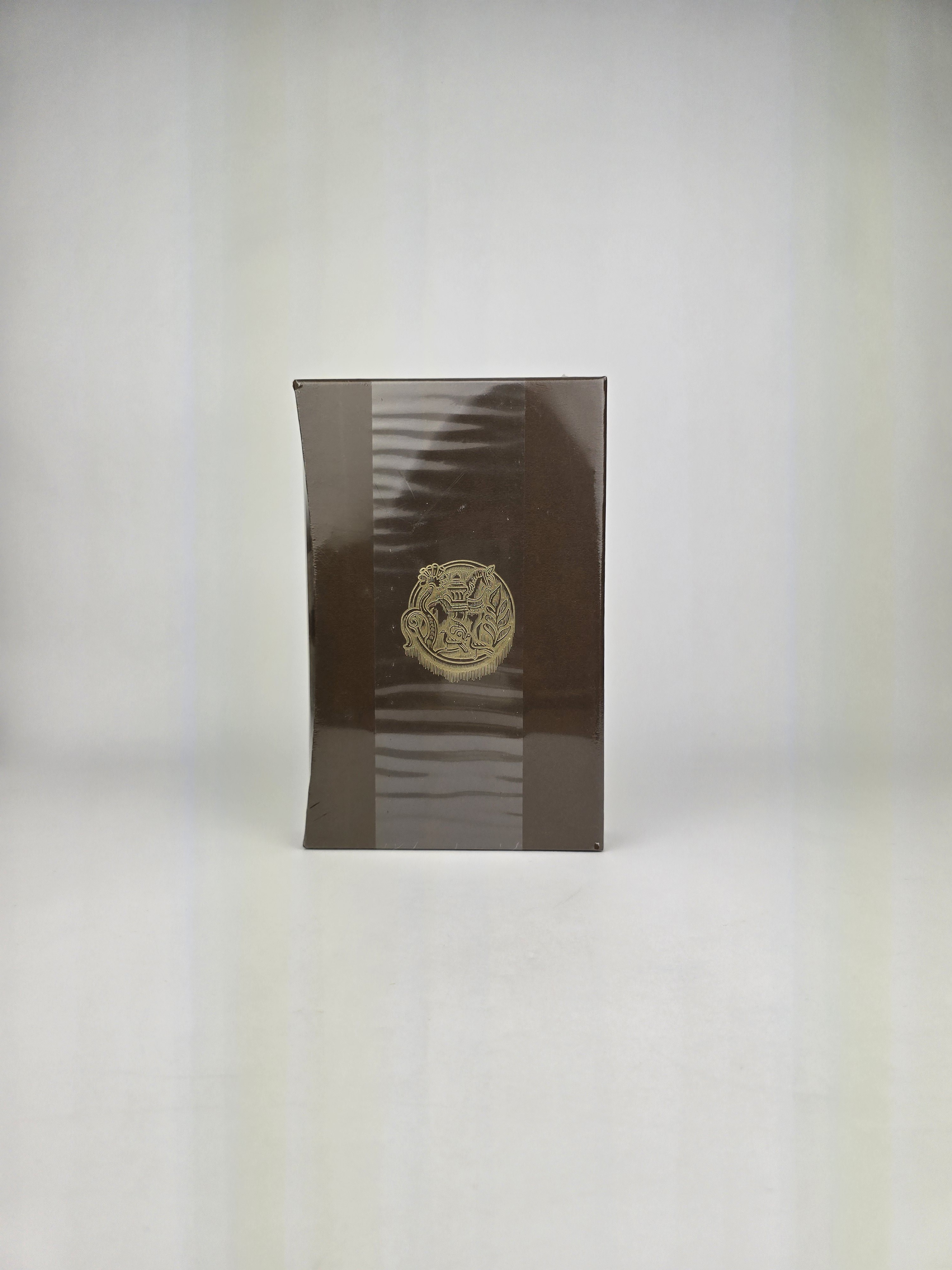
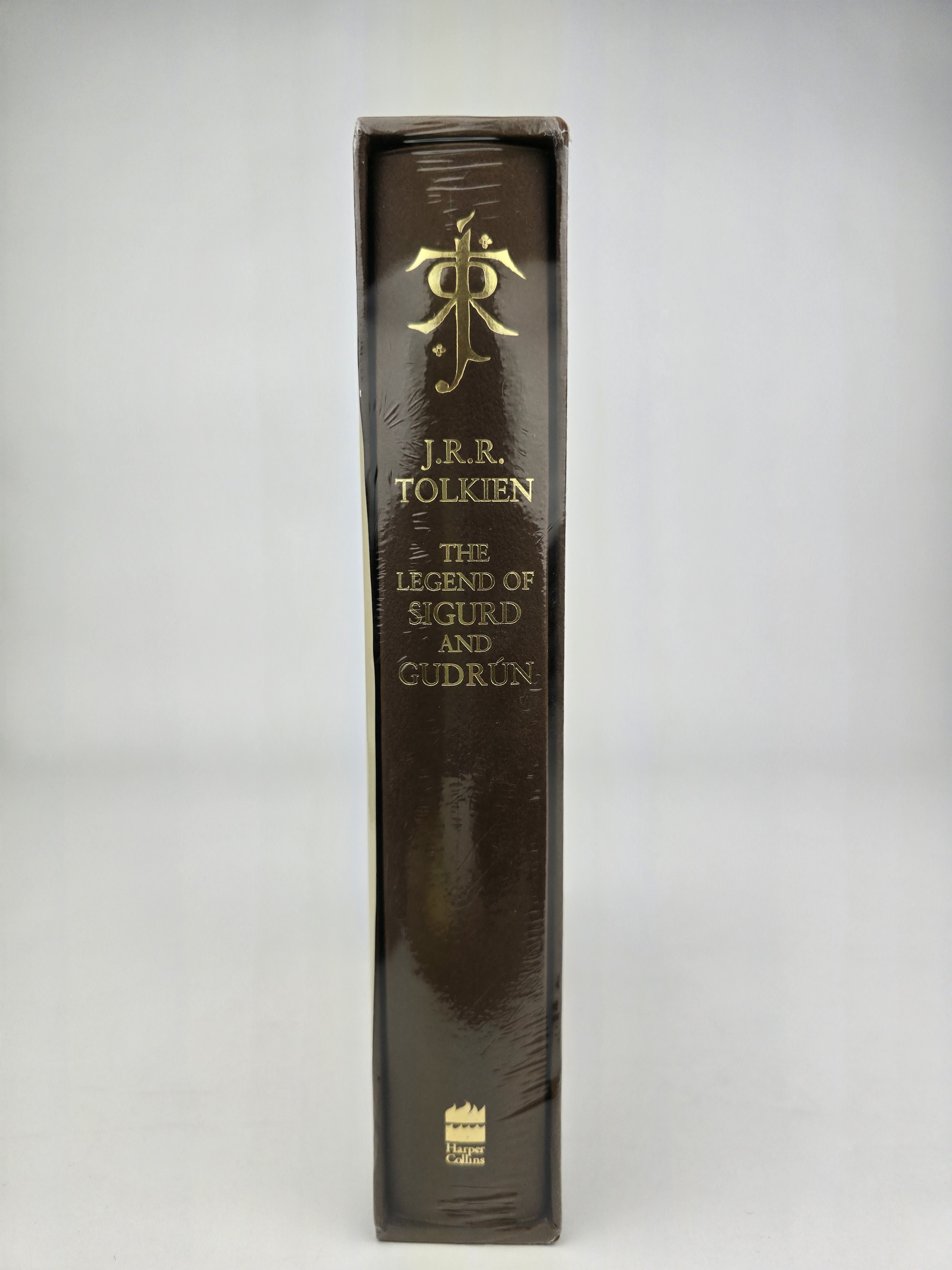
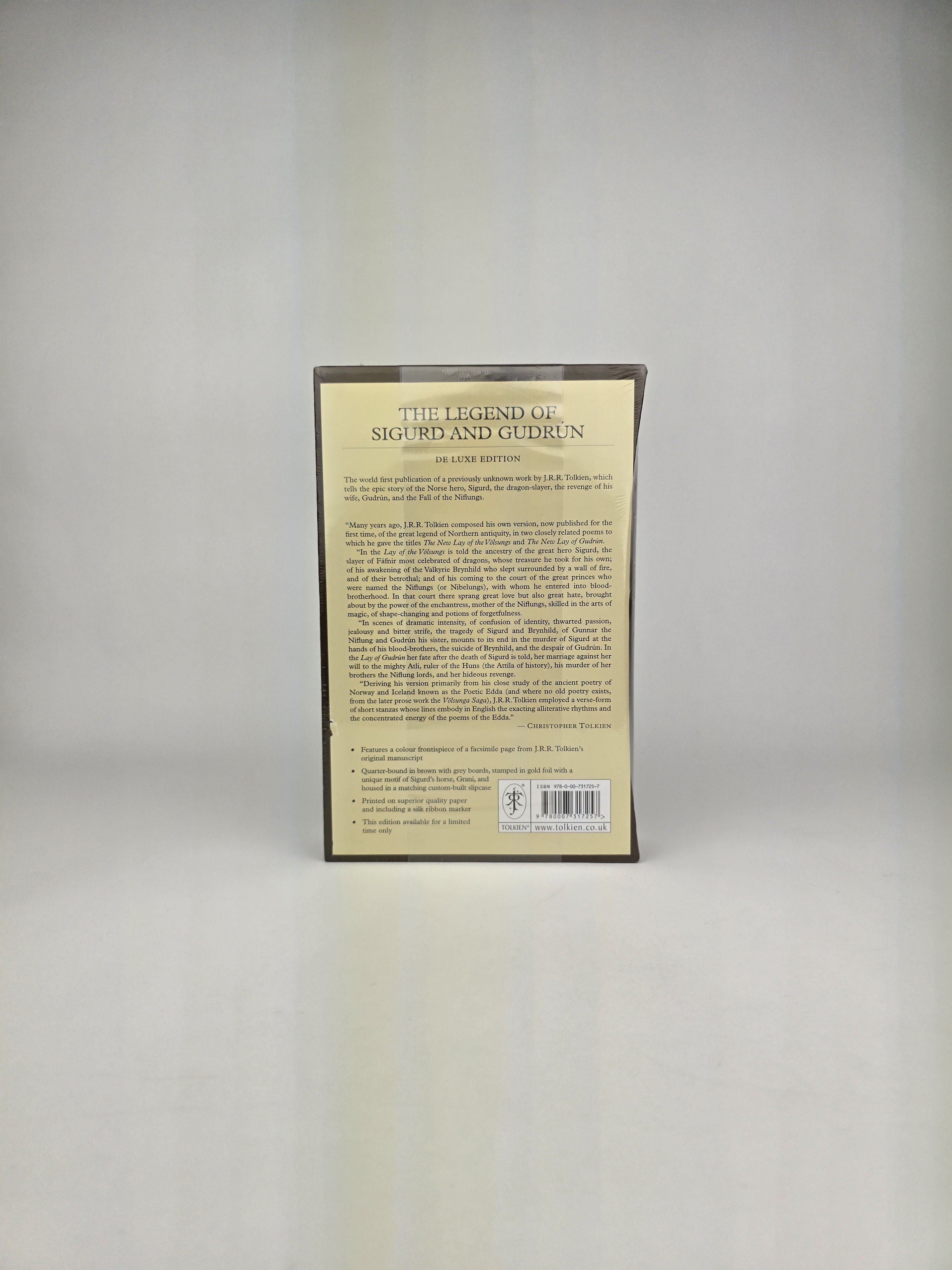
The photographs here show our deluxe copy PC0109, in its original shrink-wrap. The publisher’s band identifies ISBN 9780007317257 and describes a facsimile manuscript frontispiece, brown quarter-binding with grey boards, and a ribbon marker. Those interior features are the publisher’s description; the sealed book has not been opened to inspect them. Its impression line cannot be verified through the wrapping.
A collector should also distinguish this slipcased deluxe format from the separate signed, numbered issue. Our photographs are of the copy described in the linked shop listing. Follow that listing for its current availability and condition; an ISBN alone does not establish the impression, a signature or the completeness of a particular copy.12
I would begin by reading a few stanzas aloud, without stopping at every unfamiliar name. Let Sigurd reach the dragon; then give Gudrún the same attention. The book’s deepest loss is not contained in a dragon’s treasure chamber. It is in the voices of the people left after the victory.
Notes and sources
- Pieter Collier, “Review: The Legend of Sigurd and Gudrun”, 2 May 2009, especially the concluding paragraphs on rhythm and reading aloud. The personal recollection here follows that contemporary review. The new close reading is based on the poems and editorial material in J.R.R. Tolkien, The Legend of Sigurd and Gudrún, edited by Christopher Tolkien (HarperCollins, 2009). ↩
- Christopher Tolkien, Foreword, discussion of composition and the two Auden letters; J.R.R. Tolkien, Letters, no. 295, to W. H. Auden, 29 March 1967, postscript. Christopher expressly qualifies the early-1930s dating and the suggested connection with the abandonment of the Lay of Leithian. See also his introduction on the Tolkien Estate website. ↩
- Introductory notes, §3, “The Text of the Poems”, and §5, “The Verse-form of the Poems”, especially the discussion of short-line presentation, stanza structure and sound-based alliteration; Lay of the Völsungs, Upphaf, stanzas 1 and 13. ↩
- Introductory notes, §6, author’s note (i); Lay of the Völsungs, I.1–15 and V.1–48, especially the prose headnote to V, the exchanges in V.30–38 and the birds in V.41–45; Christopher’s commentary on I and V. The reading of gold as failed compensation follows these repeated claims and their consequences. ↩
- Lay of the Völsungs, VI.1–23, VII.35–39, VIII.9–34 and IX.3–69; Christopher’s commentary on VI.20–23 and IX.21–64, and “Note on Brynhild”. In particular, IX.43 gives Brynhild’s accusation and IX.68 reveals the sword that lay between her and Sigurd. ↩
- Lay of Gudrún, stanzas 1–34; introductory notes, §6, author’s notes (ii)–(iv); Christopher’s commentary on stanzas 10–16 and 17–28. The tapestry’s contents and the omission of Gudrún’s drink of forgetfulness are specifically discussed there. ↩
- Lay of Gudrún, stanzas 35–60, especially 44–48 and 57. The distinction between changing a message, interpreting it and acting upon it is the reviewer’s reading of this scene. ↩
- Lay of Gudrún, stanzas 118–131, especially Hjalli’s speech at 122; Christopher’s commentary on 118–131 compares Atlakviða, Atlamál and the Völsunga Saga. The response to Hjalli’s account of ordinary life is a critical reading, not an attributed statement of Tolkien’s intention. ↩
- Lay of the Völsungs, Upphaf 13–20 and IX.77–82; introductory notes, §6, author’s note (iv); Christopher’s commentary on Upphaf, opening discussion of Sigurd’s special function and the comparison with Túrin. Christopher cites differing last-battle conceptions from Tolkien’s mythology; these should not be collapsed into a single final account. ↩
- Christopher Tolkien, Foreword, concluding account of Bill Sanderson’s drawings and their source in the Hylestad church portal; Lay of Gudrún, 134–139, and commentary on 132–140. The printed divider for the second lay shows Gunnar and the harp. The Foreword itself distinguishes the carving’s feet from the lay’s hands. ↩
- Lay of Gudrún, 140–166; Christopher’s commentary on 148–150 and 157–165. The note to 157–165 records Tolkien’s instruction to omit the conclusion from 157 except for 166, while the drawn omission marks extend only to 164. This revision evidence qualifies any claim that the printed seaside ending represents an unaltered final intention. ↩
- Bibliography: Indiana University’s UK hardback record (HarperCollins, 2009, ISBN 9780007317233); US record (Houghton Mifflin Harcourt, 2009, ISBN 9780547273426); and the publisher’s edition selector. The photographed publisher’s band on PC0109 gives deluxe ISBN 9780007317257 and its binding and interior specifications. The separately signed, numbered issue is illustrated by our sold archive copy HR0003; it is not the copy photographed for this review. ↩