The knife has belonged to his father. Kullervo keeps it when almost everything else connecting him to his family has been taken away. When his master’s wife bakes a stone into his bread, the blade breaks against it. Kullervo answers that loss with revenge.
That is where I would begin with The Story of Kullervo. Before the comparisons with Túrin, before the place this little book occupies in Tolkien’s bibliography, there is an object someone cannot bear to lose. Tolkien gives the knife a name, Sikki. He also gives its owner time to grieve for it. The violence that follows grows out of that grief, although grief cannot make it just.1
For Tolkien Library, this is an essential book. Finland belongs near the beginning of the story of Middle-earth. Here we can read one of the actual texts through which that beginning happened. It is awkward, disturbing and unfinished. It also lets us watch a young writer making choices that would occupy him for the rest of his life.
What sort of book is this?
Verlyn Flieger’s edition contains Tolkien’s unfinished retelling of the Kullervo story, a list of names, draft plot synopses, explanatory notes, two versions of his discussion of the Kalevala, and her own essay on their relationship to his later work. The narrative takes up only a small part of the volume. A reader buying it for another complete Tolkien novel will have been given the wrong expectation.
The accompanying material deserves to be read. Flieger explains difficult words, follows alterations of names, compares passages with Tolkien’s source and identifies where the manuscript is uncertain. She supplies a way through a difficult early text while leaving the difficulties visible. Several cancelled passages appear within curly brackets; square brackets can mark supplied or conjectural wording. Those small signs are part of the reading, especially when a detail seems to offer an exciting connection with a later story.2
There are two publication histories to keep apart. Tolkien was working on the adaptation as a young man; its surviving form belongs to his early writing, with questions remaining about the precise dates. Flieger first published the story and the Kalevala essays in Tolkien Studies VII in 2010. The standalone HarperCollins book followed in August 2015, with revisions to the editorial presentation. Calling 2015 its first publication without qualification loses that earlier scholarly edition.3
An undergraduate reading Finland
In an October 1914 letter to Edith, Tolkien describes his attempt to turn one of the Finnish stories into prose with passages of poetry between. William Morris’s romances were a model for the form. The letter places the work among ordinary undergraduate obligations: an overdue essay, visitors, rain and military drill. An important beginning in literature can sit in a letter beside the problem of cleaning a wet rifle.
That letter is firmer ground than an exact composition date inferred from a much later recollection. Flieger discusses the competing evidence. We can say that Tolkien was working on the adaptation in 1914; we should allow more room around the dating of the manuscript as a whole. The book is more interesting when the evidence is allowed to remain evidence, with its gaps, rather than made into a smooth account of inevitable progress.4
His source was the Kullervo sequence in the Kalevala, the collection assembled by Elias Lönnrot from traditional songs, particularly associated with Finland and Karelia. Tolkien encountered it through W. F. Kirby’s English translation. The Finnish language drew him towards the original, but enthusiasm should not be confused with complete command of it. The language and the stories opened different possibilities for him, and those possibilities continued beyond this abandoned adaptation.
A child taught to hate
Untamo kills his brother Kalervo and enslaves his household. Kullervo and his twin sister Wanōna are born into that captivity. Their mother is crushed by what has happened; the older children accommodate themselves to life under Untamo. The twins grow up with very little protection. Tolkien makes the neglect part of their story, so that Kullervo’s bitterness has a history we have been made to witness.
Untamo’s attempts to kill the child have the extravagant cruelty of a folktale. Water, fire and a gallows fail to destroy him. When he is set to work, his strength brings further destruction. He cuts down the trees he should preserve, builds an enormous fence without a gate and reduces useful labour to waste. There is an almost comic disproportion in these episodes, but nobody in the household knows how to turn his power towards a tolerable life.
It would be easy to read this as an explanation that removes all responsibility from Kullervo. The later violence prevents that comfortable reading. Tolkien lets us understand the conditions in which his anger grows, then makes us follow what he does with it. A child who has been treated as disposable becomes capable of treating others in the same way.5
Musti remembers the family
Musti, the black hound, gives the story some of its tenderness. He belonged to Kalervo and follows the captives after the destruction of their home. He preserves knowledge of the father for the son. His powers make him formidable, but his loyalty matters before his magic does: somebody still remembers who these children are.
There is a practical reason to read Flieger’s notes here. The dog appears under both Musti and Mauri, and a passage about the gift of three hairs was cancelled in the manuscript but retained by the editor because a hair matters later. A reader can see Tolkien testing the means by which the animal will protect the child. Those changes help explain why the dog’s magic does not have the consistency we might expect in a finished tale.
The temptation to turn Musti immediately into Huan is understandable, particularly beside Beren and Lúthien. A marvellous hound protecting someone in danger certainly belongs among Tolkien’s recurring interests. But the early dog has a distinct place in this family catastrophe. In the projected ending even his protection fails. I would rather read that failure carefully than reduce him to a first sketch of a more familiar creature.
The bread, the stone and the knife
Kullervo is sold to the smith, whom Tolkien renames Āsemo. The smith’s wife sends him out with the cattle and gives him the bread containing the stone. Her long invocations ask the powers of the world to keep her animals safe. The cattle receive a care which the person tending them is denied. Read together, the prayer and the bread make an uncomfortable account of the household’s priorities.
When Sikki breaks, the injury reaches further than a spoiled meal. The knife is an inheritance from a father Kullervo has lost. Tolkien has already made the reader understand why an ordinary useful object can hold so much. Kullervo’s lament allows the damage to register before the story moves into revenge. This is one of the places where the early writing acquires emotional weight through something small and tangible.
His answer is monstrous. Wolves and bears take the place of the herd, and he sends them against the woman. She offers better food, clothes and treatment if he will save her. He refuses. The story makes us hear both the cruelty that provoked him and the refusal that belongs to him. To call him merely a victim would leave out the person he has become.
The ending Tolkien did not finish
The later encounter with the young woman is particularly difficult. She refuses Kullervo and asks for help in finding her way home. He pursues her and carries her away. The narrative subsequently speaks of affection, but the coercion is there on the page and cannot be removed by calling the episode a romance. When their accounts of their families reveal that she is his sister, recognition brings catastrophe.
The sustained prose then breaks off. What follows in the edition is an outline of the further action. Kullervo destroys Untamo’s household, learns more fully what he has done and turns to his own death. The answering sword, so important to comparisons with Túrin, belongs here to the projected conclusion. Readers should know when they have passed from a narrated scene into notes for scenes Tolkien never wrote out in this manuscript.6
Flieger’s arrangement allows us to see that difference. She does not write a missing final chapter in Tolkien’s manner. The book therefore asks something of its reader: we have to imagine the intended sequence without pretending that the surviving words give us a finished work. For anyone interested in how Tolkien wrote, that is part of its value.
From Kullervo to Túrin
Tolkien himself identified Kullervo as the beginning of his attempt to make legends for his invented languages. In his 1964 letter to Christopher Bretherton he also stressed how much had changed when the material became The Children of Húrin. That second part deserves as much attention as the famous statement of origin.7
The family destroyed by violence, the unknown sister, the fatal recognition and the sword accepting its owner’s death give us specific points of comparison. Readers of The Children of Húrin will recognise them. But Túrin lives in a much larger network of relationships and decisions: his upbringing in Doriath, Beleg’s friendship, his attempts to lead other people and the ruin brought by Glaurung. The later tragedy has been built into the history of Beleriand.
That transformation is why I find it useful to read the two books together. One should resist the habit of treating every early detail as a code waiting to be solved by a later name. Kullervo is a source for Túrin, not a lost member of his family tree. The relationship is literary. The Silmarillion, especially chapter 21, shows where the later story belongs; Flieger’s book lets us examine an earlier act of adaptation on its own terms.
Names still moving on the page
The reproduced manuscript list of names is worth stopping over. Forms are crossed out, alternatives placed beside one another, meanings tried. Places bearing recognisable names from Tolkien’s source acquire names of his own. The smith Ilmarinen becomes Āsemo; the dog’s name changes; Kullervo receives several by-names. We are looking at decisions in progress.
Flieger credits Carl F. Hostetter for comparisons with early Qenya and discusses work by John Garth and Andrew Higgins. These connections have a history of scholarship behind them. Garth’s comparison of Sikki with Tolkien’s later knife words is especially relevant to the object at the centre of the tale. It deserves its attribution, and it does not establish that every invented name here already has a fixed meaning in a fully formed Elvish language.8
For me, this is where the book becomes especially valuable beside The History of Middle-earth. Inventing a language and inventing a story were becoming connected activities. A new name could help a borrowed figure move into a world Tolkien was beginning to make for himself. The manuscript preserves that movement before subsequent revision could conceal it.
Why keep both Kalevala essays?
The two essays bring us back to Tolkien as a reader. His first version was given to Oxford audiences in November 1914 and February 1915. The revised typescript belongs to a later, uncertain date after the war. Flieger explains the evidence and does not claim a documented performance for that second version.9
In the earlier essay Tolkien values the profusion of strange incidents, spells, exaggerations and apparently undignified behaviour. He fears what a more conventionally elevated treatment might remove. That helps explain why the cattle charms and the impossible feats have so much space in the story. They belong to the texture that attracted him. A synopsis retaining only the incest and the sword would leave much of that attraction unexplained.
I would not repeat every claim in these early talks as modern scholarship on Finland or its languages. They preserve the arguments and limitations of their young author. What I want from them here is his account of reading: his pleasure in a body of stories that did not behave as he expected, and his wish to remain among them long enough to understand their ways. That is a good reason to include both versions in a book about his first adaptation.
Reading and collecting the book
For a first reading, the ordinary hardback gives the important things: Tolkien’s surviving text and the editorial help needed to follow it. The 2015 UK hardback is ISBN 9780008131364. The first US edition, published by Houghton Mifflin Harcourt in 2016, has ISBN 9780544706262. A date on a bookseller’s listing is not proof of the impression of the particular copy supplied.10
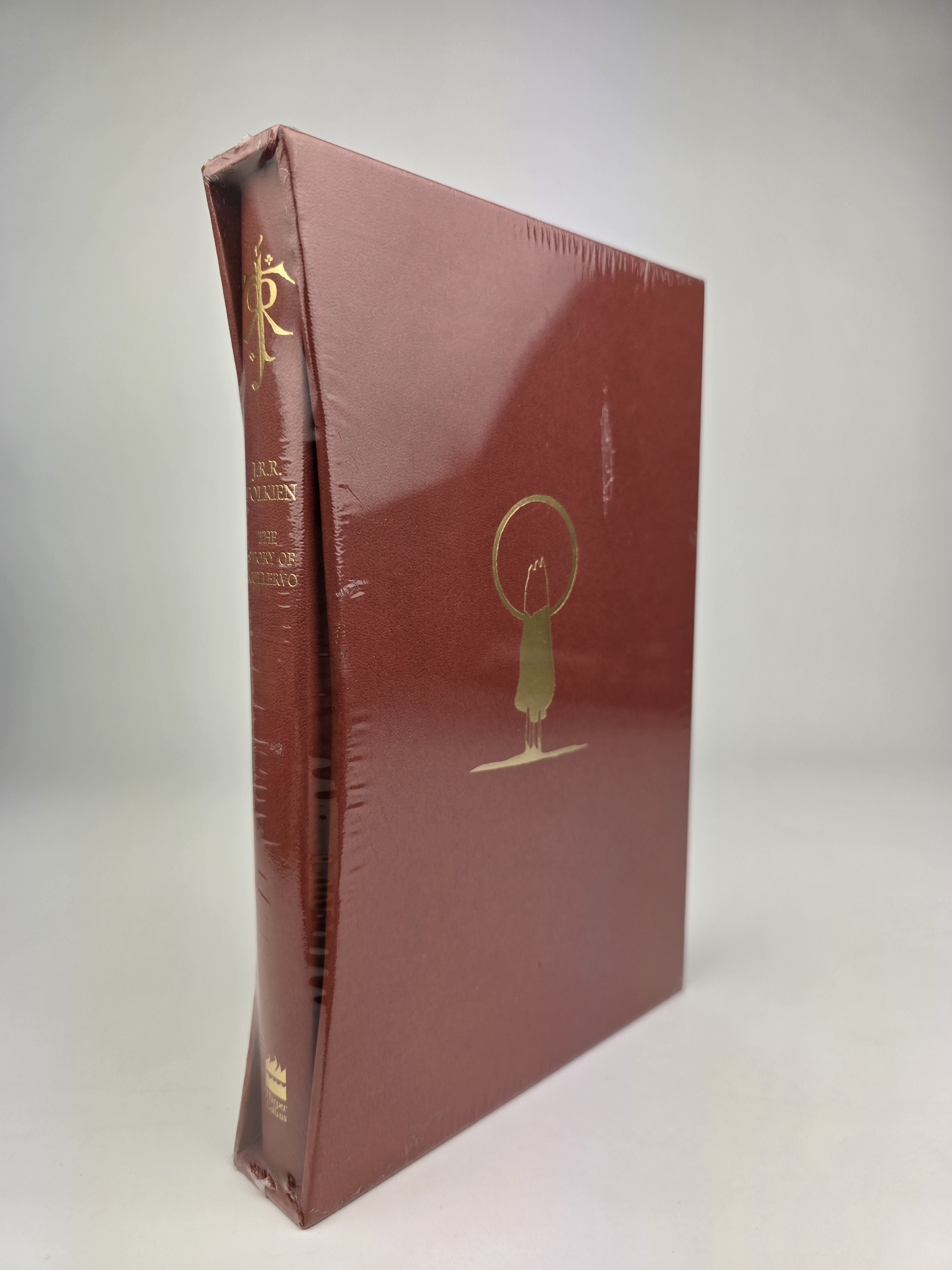
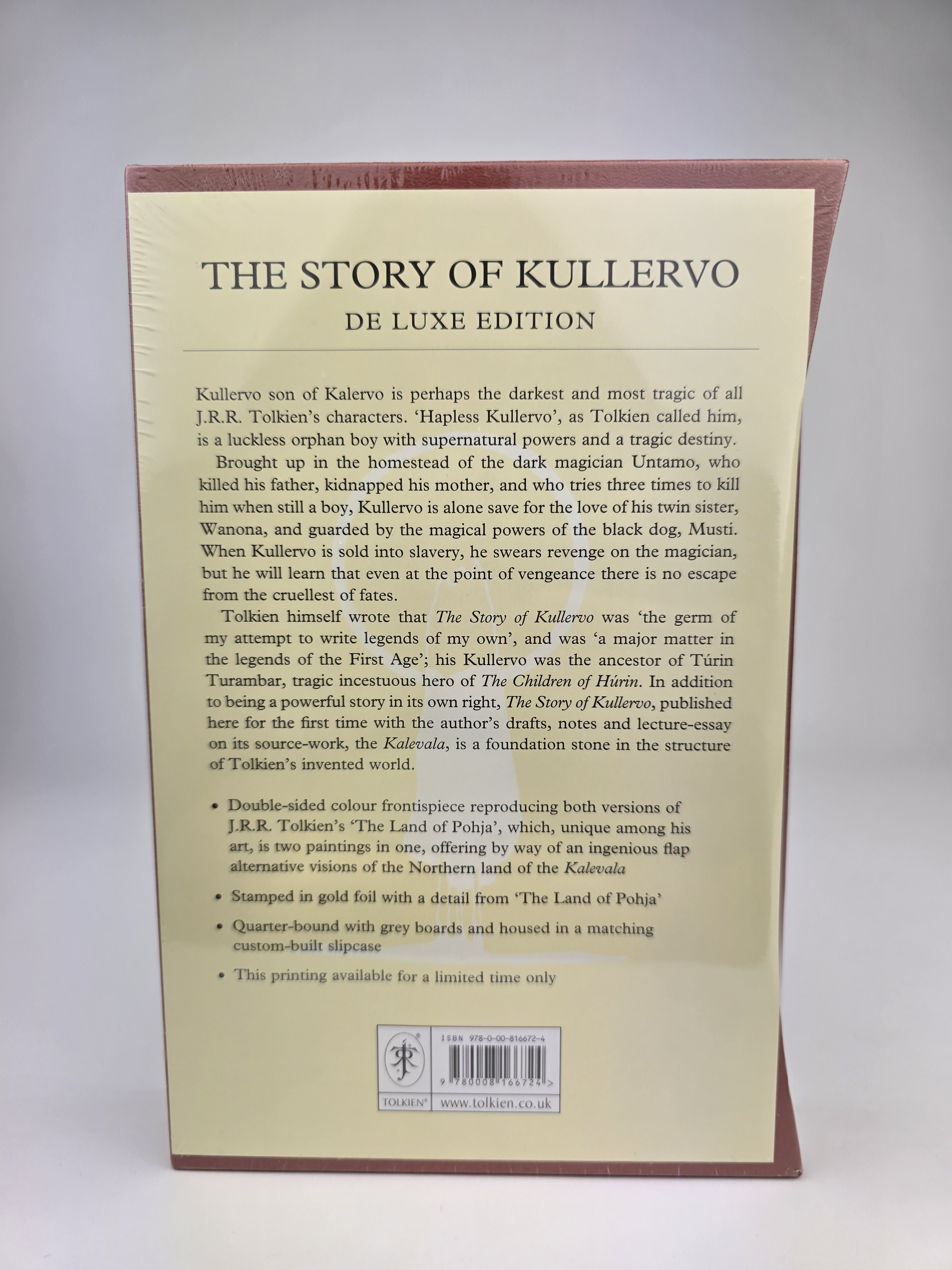
The slipcased deluxe edition adds a different collecting interest. Our shop photographs show the red slipcase, gilt tree design and publisher’s descriptive band of the sealed 2016 copy PC0099, ISBN 9780008166724. The band describes a double-sided colour frontispiece showing both versions of Tolkien’s The Land of Pohja. That is the publisher’s description; this copy remains unopened. Its concealed copyright and number lines cannot be checked through the wrapping.
The deluxe binding does not complete the story, and an attractive edition should not obscure what is inside it. I would recommend this book particularly to a reader of Túrin who wants to understand how a traditional tale could become the starting point for something very different. Its roughness sometimes slows the reading. Its names can be confusing. The commentary earns its place.
We often approach Tolkien’s early work knowing where it will eventually lead. Here it is worth allowing ourselves to stay with the child, the dog and the inherited knife for a while. The young writer has not yet found the world in which Túrin will live. He has already found a loss worth giving a name.
Notes and sources
- J.R.R. Tolkien, The Story of Kullervo, ed. Verlyn Flieger (HarperCollins, 2015), story: the smith’s household, the bread containing a stone, Sikki’s breaking and Kullervo’s lament. Flieger’s “Notes and Commentary”, entry “the great knife Sikki”, identifies the naming of the knife as Tolkien’s addition. ↩
- Flieger, “Introduction”, account of transcription and cancelled passages; “Notes and Commentary”, entry “and to Kullervo he gave three hairs”. Curly brackets preserve selected cancellations; they do not indicate a finished alternative version. ↩
- Flieger, “Foreword”; Tolkien and Flieger, “‘The Story of Kullervo’ and Essays on Kalevala”, Tolkien Studies 7 (2010), pp. 211–278, journal record and DOI. For the standalone UK hardback’s date and ISBN, see the publisher’s record. ↩
- Tolkien, Letters, no. 1, to Edith Bratt, undated [October 1914]; Flieger, “Introduction”, discussion of manuscript dating. W. F. Kirby, trans., Kalevala: The Land of the Heroes (1907), vol. II, runos XXXI–XXXVI, is the source sequence: public-domain edition. ↩
- Tolkien, The Story of Kullervo, opening family history, the three attempts on Kullervo’s life and labour episodes; Flieger, “Notes and Commentary”, entries on the elder children, the twins and “for ill cradle rocking”. The account of responsibility here is my reading of the narrative. ↩
- Tolkien, story: the encounter in the forest, the paired accounts of family history and the sister’s death; the immediately following outline of the unwritten conclusion. Flieger, “Introduction”, distinguishes the sustained narrative from its continuation in synopsis. ↩
- Tolkien, Letters, no. 257, to Christopher Bretherton, 16 July 1964. Compare The Children of Húrin, ed. Christopher Tolkien (2007), especially chapters XVII–XVIII; The Silmarillion, chapter 21, “Of Túrin Turambar”. Flieger’s concluding essay reviews the established scholarship on the relationship. ↩
- Flieger, “Introduction”, discussion crediting Carl F. Hostetter, and “Notes and Commentary”, entries “Sutse”, “black hound Musti” and “the great knife Sikki”; facsimile “Draft list of character names”, Bodleian MS Tolkien B 64/6, fol. 6 recto. Her Sikki note cites John Garth, “The road from adaptation to invention”, Tolkien Studies 11 (2014), p. 40, and The Lost Road, p. 385. The linguistic comparison is Garth’s, reported and discussed by Flieger. ↩
- Flieger, “Introduction to the Essays”; Tolkien, “On ‘The Kalevala’ or Land of Heroes”, manuscript draft, especially its opening discussion of strangeness, epic treatment and the material such treatment might prune away; revised typescript “The Kalevala”. The title leaf records Corpus Christi College, November 1914, and Exeter College Essay Club, February 1915. ↩
- HarperCollins hardback record, 27 August 2015, ISBN 9780008131364; Free Library of Philadelphia catalogue, first US edition, Houghton Mifflin Harcourt, 2016, ISBN 9780544706262. Deluxe ISBN 9780008166724 is visible on the publisher’s band in Tolkien Library’s PC0099 photograph; no concealed impression statement has been verified. ↩