Tolkien’s Own Copy of De recta et emendata linguae anglicae (1913)
A fascinating survival from Tolkien’s academic world
Among the most historically important Tolkien association items are books that once belonged to Tolkien himself — especially those connected directly to his academic and philological interests.
This remarkable volume appeared on eBay in 2004 and contained not only Tolkien’s signature, but two separate ownership inscriptions in Tolkien’s hand, both linking the book to his close friend and fellow scholar E.V. Gordon.
The book itself, Thomas Smith’s De recta et emendata linguae anglicae scriptione Dialogus, perfectly reflects Tolkien’s deep fascination with language, phonetics, medieval scholarship, and the historical development of English — subjects that would shape both his academic career and the languages of Middle-earth.
Even more fascinating is the strong personal connection to Eric Valentine Gordon, Tolkien’s colleague, collaborator, and close friend from the Leeds years. Objects directly connecting Tolkien’s scholarly circle rarely appear on the market and provide a remarkable glimpse into the intellectual world surrounding Tolkien during the 1920s and 1930s.
Historical auction details
Platform: eBay Auction start date: 30 August 2004 Auction end date: 6 September 2004 Current bid captured: US $202.50 Bids at capture: 9 bids Seller: rowns Location: Campbell, California, USA Object number: 6923469553 Status: Archived historical listing
This original eBay listing was archived during the formative years of online Tolkien collecting and survives as a fascinating example of important Tolkien association material appearing on general online marketplaces.
The auction had not yet reached its reserve price when this page was captured, meaning the final realised price unfortunately remains unknown.
Original archived eBay description (2004)
Thomas Smith De recta et emendata linguae anglicae scriptione Dialogus Halle a. d. S, Vienna Austria, 1913 First thus
Original brown wrappers, exterior soiled, rear panel separated, mostly unopened with page edges unseparated and uncut. viii + 61 + (6) + 44 + xxii pp.
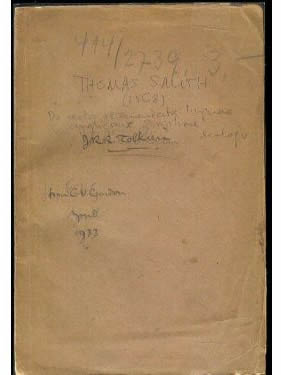
In ballpoint pen, on front wrapper: “THOMAS SMITH / (1568) / De recta et emendata linguae / anglicause scriptione dialogus.”
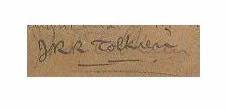
Tolkien added his calligraphic fountain pen signature, “JRR Tolkien” below this, followed by, “from E.V. Gordon. / April / 1933” adding his three-dot symbol beneath the date.
The fountain pen signature and note were written over an earlier, faded signature and note in pencil, also in Tolkien’s hand: “JRR Tolkien / From EVG / 1933.”
E(ric) V(alentine) Gordon was one of Tolkien’s good friends. They met when Gordon was appointed as a junior lecturer to “the language side of the English Department at Leeds” in 1922. Tolkien and Gordon collaborated on editions of Sir Gawain and the Green Knight, A Glossary of Middle English, and helped found the Viking Club amongst undergraduates.
Original wraps are protected with an archival sleeve.
Reserve set well below retail price.
Tolkien and E.V. Gordon
The association between Tolkien and E.V. Gordon remains one of the most important scholarly friendships of Tolkien’s early academic life. Gordon was not merely a colleague, but a close collaborator during Tolkien’s Leeds years.
Together they worked on what became the famous Clarendon Press edition of Sir Gawain and the Green Knight, first published in 1925 and still considered a landmark scholarly edition today.
Books carrying inscriptions connecting both men therefore possess exceptional importance within Tolkien collecting, as they directly document the academic environment that shaped Tolkien during the years leading toward the writing of The Hobbit.
The importance of Tolkien association copies
Books from Tolkien’s personal library occupy a special place within Tolkien collecting. Unlike ordinary signed books, they represent working objects from Tolkien’s own intellectual and scholarly life.
Volumes connected to Tolkien’s academic studies, philology, medieval literature, and language development are especially prized because they illuminate the foundations upon which Middle-earth itself was later built.
Today, association copies with strong provenance, inscriptions, or direct links to Tolkien’s inner scholarly circle are exceptionally difficult to acquire and increasingly find their way into major institutional or advanced private collections.