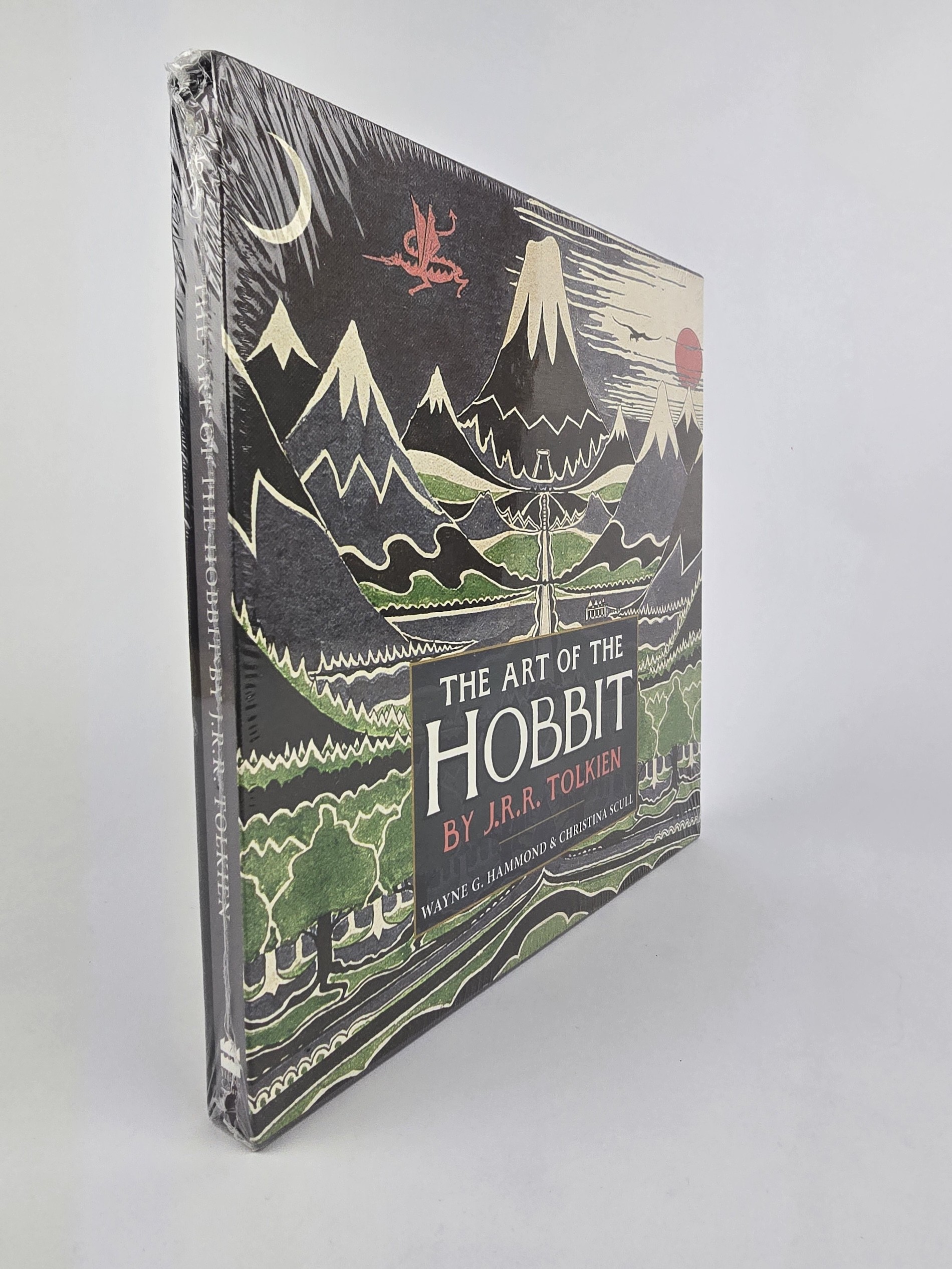
I would begin with the dust-jacket. We tend to recognise it at once and then stop looking: the mountains, the trees, the dragon, the runes around the edge. Put the design beside its working stages and the familiar cover becomes a record of decisions. The colours, lettering and border had to fit both Tolkien’s idea of the book and what the publisher could afford to print.
The surviving jacket material reproduced on pages 100–101 gives us a particularly clear example. Tolkien’s submitted design called for more colours than Allen & Unwin could use. The scheme was reduced to black, green and blue, with the paper providing white. The red sun and dragon were left out of the first published jacket; red was restored in later editions. A difference between jackets can therefore preserve a small piece of the book’s production history. It is a reason to compare copies carefully, rather than assume that every variation began as an artistic revision.4
There is a story inside the design as well. Hammond and Scull explain that the sun and moon together refer to the special conditions under which the hidden door in the Lonely Mountain can be found. The jacket is already asking us to read. Its runic border carries a publication statement, while the landscape and the small signs above it anticipate the journey. For anyone interested in Tolkien’s lettering, the cover belongs beside the maps and the text, rather than outside them.4
The maps offer another way into the book. A finished map can look inevitable: the mountains are there, the road goes there, and the names occupy their proper places. The preliminary versions remind us that someone had to establish those relationships. Follow the early and finished forms of Thrór’s Map, then return to Bilbo and the dwarves discussing it in the opening chapter. The map is an object within their story as well as a means of helping us follow it.
That relationship between picture and writing was one of the questions put to the editors in Damien Bador’s 2011 interview on Tolkien Library. They explained that Tolkien sometimes used maps to resolve points of story. They also drew attention to something less obvious: details established in his pictures of Hobbiton and Rivendell later entered the writing of The Lord of the Rings, although they had not been described in the text of The Hobbit. The pictures could carry knowledge that the earlier narrative had left unstated.5
This is why the book deserves a place alongside J.R.R. Tolkien: Artist & Illustrator. The earlier volume surveys a much wider artistic life, from early drawings to patterns and heraldic devices. This one allows a closer sequence of comparisons within a single work. In the same interview, Hammond and Scull made clear that they had known the additional Hobbit pictures when preparing the 1995 book. Space, and the permitted number of colour reproductions, had limited what they could include. Their later collection gave that material room.5
For a first approach, I would read it with The Hobbit open beside it. Choose one subject, follow its versions, and then reread the scene. The commentary supplies dates, circumstances and connections; the drawings allow you to test what you have read against the marks on the page. Readers interested in the writing behind those scenes can continue with John D. Rateliff’s The History of The Hobbit. The two books follow different parts of the same developing work.
There is pleasure here in simply looking, of course. But the working material asks for more time than a quick passage through the best-known pictures. A corrected line, an altered colour or an unfinished map can bring us closer to Tolkien at his desk. That is the attraction of a book like this: we can follow some of the work that made the finished book appear so natural.
Sources and further reading
- Wayne G. Hammond and Christina Scull, “Go, Little Book”, 7 June 2011: format, page count and first UK publication plans. ↩
- Hammond and Scull, bibliography, entry for The Art of The Hobbit: UK 2011 and US 2012. ↩
- HarperCollins, 2023 edition record, ISBN 9780008601423: publication date, extent and contents. ↩
- Hammond and Scull, The Art of The Hobbit (HarperCollins, 2011), pp. 100–101, dust-jacket designs and commentary. Checked in the publisher’s three-page extract, also containing the title page and p. 5. ↩ 1 ↩ 2
- Damien Bador, interview with Wayne Hammond and Christina Scull, Tolkien Library, 2 August 2011, answers on the selection of artwork and the relationship between pictures and writing. ↩ 1 ↩ 2