The amazing art of bookbinding - The Lord of the Rings - Part 1
Bookbinding has the rare ability to transform a beloved story into a true work of art—where craftsmanship, imagination, and literature come together. Few works have inspired binders as profoundly as The Lord of the Rings, a text rich in imagery, symbolism, and atmosphere. In this article, we explore some of the most remarkable bindings ever created for Tolkien’s masterpiece, ranging from bold artistic interpretations to refined traditional craftsmanship—each offering a unique vision of Middle-earth beyond the printed page.
This weekend, I found myself thinking back to the Tolkien exhibition my friend Johan Vanhecke organised in Antwerp in 1992. I vividly remember a copy on display featuring a binding by Philip Smith. At the time, I thought it looked impressive, but I did not yet understand the true value, importance, and artistic depth of such work. Since then, I have encountered many custom Tolkien bindings and have developed a deep appreciation for them.
In general, I still prefer a clean, original copy of The Lord of the Rings over a rebound example. Yet occasionally, the quality of a binding is so extraordinary that it transcends the book itself, becoming something entirely different—something to be admired not just as a book, but as an object of art. In some cases, particularly with worn or damaged copies, a fine binding can even restore a book to the dignity it deserves, especially when executed without compromise.
Beyond standard rebinding lies a higher level altogether: the true art of bookbinding. Mastering the craft is already a considerable challenge, but there are artists who elevate it far beyond technique. These binders do not simply create fine bindings—they create book art.
Over the coming days, I will explore this fascinating world in a short series. We begin with The Lord of the Rings, followed by The Hobbit, and conclude with The Silmarillion and related works. In this first article, it is only fitting to start with one of the most influential and visionary binders of all: Philip Smith.
Born in 1928, Philip Smith is widely regarded as one of the most innovative bookbinders of the twentieth century. His work combines unorthodox materials, experimental techniques, and a deeply personal artistic vision. Often working across multiple volumes, he created bindings that move beyond the book as an object into the realm of sculpture and conceptual art. His influence on modern bookbinding is profound—he served as President of Designer Bookbinders (UK), authored important works on the subject, and lectured extensively worldwide.
He is perhaps best known for his extraordinary bindings of The Lord of the Rings—and it is these remarkable creations that we will now explore.
The bookbindings by Philip Smith, the most beautiful copies of The Lord of the Rings in the world
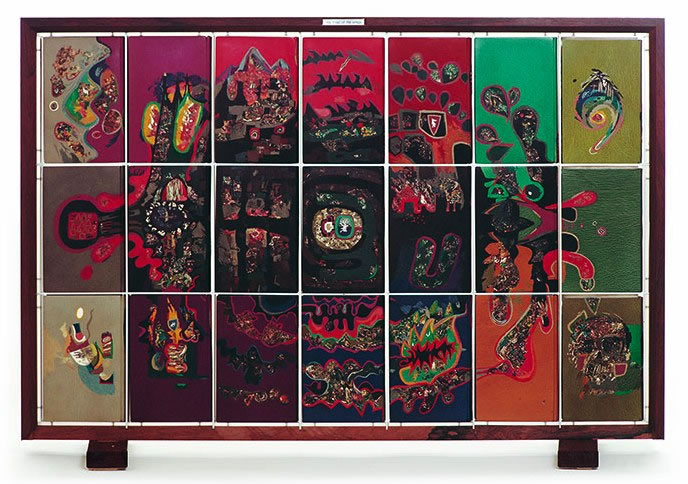
When Philip Smith was asked to provide some bookbindings for a one-man exhibition at Ascona in Switzerland in 1970, he decided to create a unique centre-piece. Being a long time fan of The Lord of the Rings, Philip Smith felt that this complex psychological book could be the basis for a large art work - a Lord of the Rings book wall.
There was no prior example of a series of bindings where the design flowed across several covers and Philip Smith perceived that this concept could allow him freedom of expression and technique. He ordered six sets of unbound sheets of the 1968 edition from the publishers, George Allen & Unwin, and subsequently purchased the 1966 edition from a bookseller.
The bindings were subsequently exhibited at the Craftsman's Art Exhibition in May 1973. J.R.R. Tolkien visited the exhibition and saw the bindings and was very delighted. He commented to Philip Smith that at the age of eighty-one he could at last say what he liked and that indeed he liked Philips Smith's bindings very much. Tolkien even purchased a binding of The Lord of the Rings by Philip Smith at this exhibition and presented it as a gift to the Duke of Edinburgh. Philip Smith from his side stated he owes J.R.R. Tolkien an immense debt for the inspiration he gained from the reading of his works.
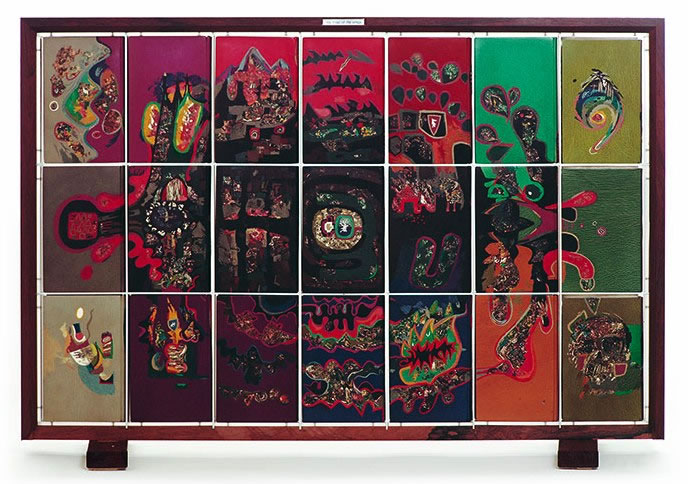
The first Lord of the Rings book-wall created by Philip Smith can be viewed on three different levels:
1) When the twenty-one volumes are in the display case you see one overall image of the lidless eye of Mordor. In the middle is the Tengwar incantation from the One Ring. The exaggerated and fluid shape of the eye reflects the multiplying evil of Mordor. At the opposite side of the wall you can see the ground plan of the city Minas Tirith.
2) Each book when opened forms its own integral image relating to the Lord of the Rings. The series of book images can be read from top left through to bottom right. Amongst others one can see the following scenes: Gandalf's arrival at Bilbo's front door, the fireworks at Bilbo's birthday party, the Council of Elrond, the Balrog and Gandalf falling into the chasm, the Forbidden Pool, Shelob's lair, the Circle of Isengard and the Tower of Saruman, the Battle of Helm's Deep, and the final eruption of Mount Doom.
3) When the books are placed next to each other on a conventional book shelf the lettering on the spine of each volume is at different vertical position. According to Philip Smith if staves are drawn at 45 mm intervals the basis of a musical sequence can be obtained.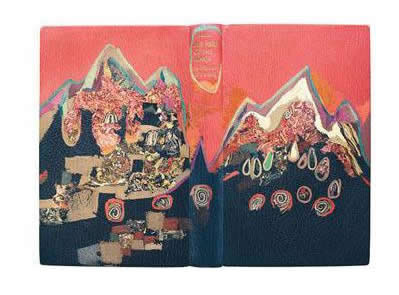
The volumes set flat within the double-sided rosewood and perspex display case measures 800 by 1170 mm.
In July 2003 this amazing art work was sold by auction at Christies for 151,200 GBP.
Next to this large book-wall, Philip Smith later created a smaller one that consisted of 6 deluxe editions. In total he made at least 54 bindings for The Lord of the Rings and made many bindings for other books like The Hobbit, The annotated Hobbit and The Silmarillion. During the creation of these bindings Philip Smith not only changed the art of bookbinding completely, but also invented 'Maril,' marble-inlaid leathers that got their name from the 'Silmarils' from Tolkien's Silmarillion. By mixing scraps and fragments of leather parings and compressing them, a block or thick tile is created. Parings from the surfaces can be taken at different angles and used to produce configurations and textures to build up images along with conventional parings for onlays or inlays. The result is a material of extraordinary richness—one that gives Smith’s bindings their unmistakable depth and vitality.
Philip Smith and The Lord of the Rings
Among all binders who have worked on Tolkien, Philip Smith stands apart. His bindings are not merely decorative—they are conceptual works, often conceived as a single artistic vision unfolding across the entire book. Rather than illustrating scenes directly, Smith sought to express the deeper structure, movement, and mythology of Tolkien’s world through abstract and experimental techniques.
His work on The Lord of the Rings spans decades and shows a remarkable evolution in both style and ambition. From early experimental bindings to later, more refined and symbolic compositions, each piece reflects his constant search for new ways to interpret the text through material and form.
The 1969 “Maril” Binding — A First of Its Kind
One of the most important examples of Smith’s work is his binding of the 1968 one-volume edition (second impression), completed in January 1969. This binding is particularly significant as it represents the first use of his now-famous “maril” technique—a method in which fragments of leather are compressed and reworked into layered, marbled forms to create entirely new visual textures.
Bound in full limp pale blue-green morocco with yapp edges, the design flows uninterrupted across both boards and the spine, forming a continuous, organic landscape. The surface appears almost geological, with shifting layers and currents of colour suggesting movement, time, and transformation—echoing the deep history of Middle-earth itself.
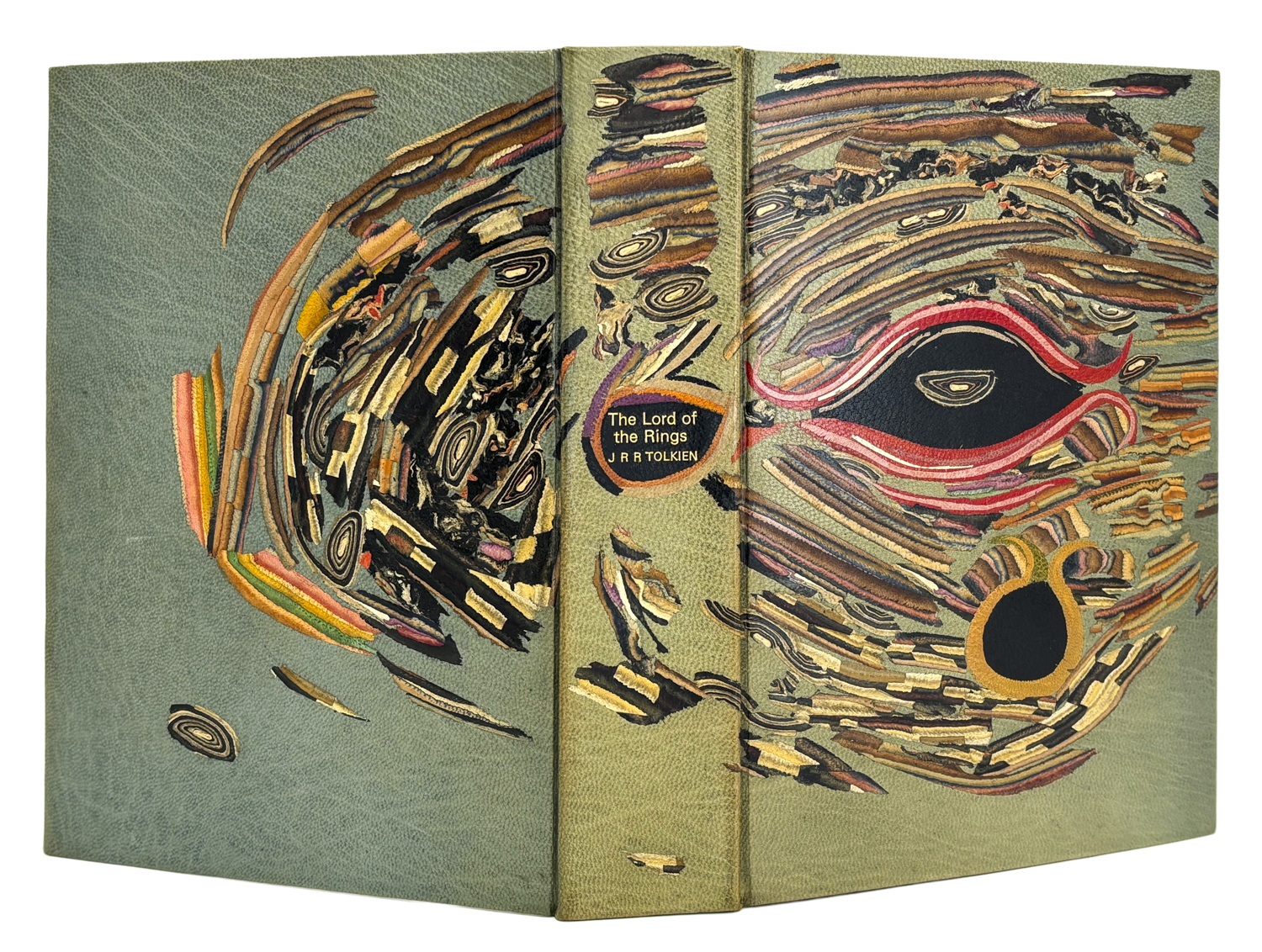
Smith approached this binding as a complete artistic object. The thickness of the book posed a structural challenge, leading him to experiment with a convex fore-edge, allowing the volume to open more naturally. He also sewed the textblock in hemp after removing the original adhesive, and added elaborate gauffered edges to both protect and visually unify the work.
Accompanied by Smith’s own typed binding statement, this piece is not only visually striking but also historically important—marking the beginning of one of the most innovative techniques in modern bookbinding.
The Ringwraith King binding
One of the finest book boxes created by British artist Philip Smith holds a deluxe edition of The Lord of the Rings, probably an India paper edition published by Allen & Unwin in 1969.
It presents the artist’s vision of Tolkien’s The Lord of the Rings. The skull represents the Ringwraith King and the contorted upper spires his crown. The bookbinding is designed to work with a raking light to give deep relief to the modeling. The nine dead ringwraiths' headstones line the lower edge of the box.
The opposite side shows Galadriel with her mirror, this time the upper spires show the landscape of Lothlorien.
The book-box is made from binders board, balsa wood and with brass-reinforced epoxy-putty modeling. It is covered with goatskin and to get the right effect various parts of goatskin are used: strips, emulsified or individual flesh side and grain side parings, and maril.
The box has two compartments for the book and a map folder. The leather clasp is designed to match the images on both sides.

The 1973 Silver leather with the 'Eye of Sauron' binding
Another of my favorite Lord of the Rings contemporary bindings is the one volume 1969 India paper edition rebound by Philip Smith in 1973, depicting the swirling sky and landscape of Mordor.
The sky is composed of puckered silver leather with the 'Eye of Sauron' on the lower cover. The landscape below is composed of maril and shows the erupting Mount Doom beneath the 'Eye,' the Two Towers and abstract representations of characters and creatures from the books.
On the spine is 'Tolkien' and 'The Lord of the Rings' lettered in silver and gilt. The book further has gilt edges, decorative front endpapers comprising the title in mirrored writing reminiscent of tolkien's own hand, printed grey on white with shadowed outline. The two folding maps are housed in a separate folder, covered in paper of the same design, but with the letters not mirrored and printed black on white.
This amazing The Lord of the Rings copy was sold by action at Christies in December 2002 for GBP 4,541.

The Crafts Council Binding (1974) — Landscape as Narrative
By 1974, Smith’s approach had developed further into a more recognisable yet still deeply personal visual language. The example held in the Crafts Council Collection (London) represents one of his most refined interpretations of The Lord of the Rings.
Here, the binding draws directly from Tolkien’s own maps, transforming them into a layered landscape across the boards. Executed in green oasis and gold kid leathers, overlaid with multi-coloured elements including maril, the design suggests a shifting terrain—at once abstract and geographical.
Smith himself described this binding as one of his most “nearly literal” works, though still open to interpretation. A subtle profile—almost a face—can be discerned within the composition, formed by the contours of mountains and valleys. This interplay between abstraction and representation is central to his work.
The binding was accompanied by a separate folder containing maps, further reinforcing the idea that the book is not just a text, but a landscape to be explored.
Philip Smiths' 51st binding
To conclude this first exploration, it is worth highlighting another remarkable example: a fine rebinding of the 1969 Allen & Unwin deluxe edition of The Lord of the Rings, now held in a private collection in Trenton, USA.
This is recorded as the 51st binding of the work by Philip Smith.
The volume is bound in scarf-joined black, blue, and beige goatskins, featuring multicoloured onlays and extensive use of maril. A hand-painted inset in waxed acrylics, combined with expressive endpapers over maroon Ingres flyleaves, transforms the book into a striking piece of visual art.

Many of Smith’s bindings were commissioned works, often reflecting a personal connection to the text. Some illustrate specific scenes, others subtly reference the profession or personality of the owner, while some aim to capture the emotional experience of reading Tolkien’s work.
These bindings go far beyond craftsmanship—they are deeply personal interpretations. True works of art.
Later Interpretations — Movement, Texture, and the One Ring
Other bindings by Smith continue this exploration, often focusing on the central symbolism of the Ring itself. In some examples, the design becomes more dynamic, with swirling forms and layered textures suggesting the corrupting and transformative power of the Ring moving through Middle-earth.
These bindings frequently make use of maril in increasingly complex ways, combining it with feathered onlays, gold tooling, and experimental surface treatments. The result is a sense of motion—almost as if the binding itself is alive.
Rather than depicting specific characters or scenes, Smith captures something more elusive: the underlying forces at work within Tolkien’s mythology.
A Unique Place in Tolkien Book Art
What makes Philip Smith’s work so compelling is that it resists easy classification. These are not simply fine bindings in the traditional sense, nor are they purely illustrative. They exist somewhere between book, sculpture, and visual narrative.
For collectors and enthusiasts, they represent the highest level of engagement with Tolkien’s work—where the text becomes a starting point for artistic exploration rather than an end in itself.
While many fine binders have worked on The Lord of the Rings, few have approached it with the same level of innovation, ambition, and originality as Philip Smith.
There are many more examples that deserve attention, and this article will no doubt continue to evolve over time. For now, I hope this first part has offered a glimpse into the extraordinary world of Philip Smith’s bindings.
In the next part, we will turn our attention to other remarkable binders and explore how different craftsmen have interpreted Tolkien’s work in their own unique ways.
Related Articles
The Hylestad doorway tells Sigurd’s story in wood. There is a sword at the forge, a dragon, a horse carrying gold, and a man playing a harp among snakes. Each scene asks the eye to pick out a few details.
When The Legend of Sigurd and Gudrún appeared in 2009, one of those details reached the cover. I went back to the doorway and to my interview with Bill Sanderson to see what the book’s designers and illustrator had chosen to carry over.

Reading The Silmarillion after our move to Norway brought me back to Peter Wessel Zapffe. In The Last Messiah, a hunter comes to understand what it means for the animals he hunts to suffer. Tolkien gives his Elves centuries in which to learn what it costs to remember.
I follow that comparison through Fëanor’s refusal to break the Silmarils, Finrod’s conversation with Andreth, and the choice Galadriel makes before she leaves Lórien.
We arrived in Trollbergvika, across the fjord from Risør, on 1 September 2025. The move came after years in which I kept collecting and helping others with their libraries while finding less time to write. The books had to be packed, brought north and put in order again.
Looking back, I can see how much of the move was about finding a place for the work to continue. It began with opening the boxes.