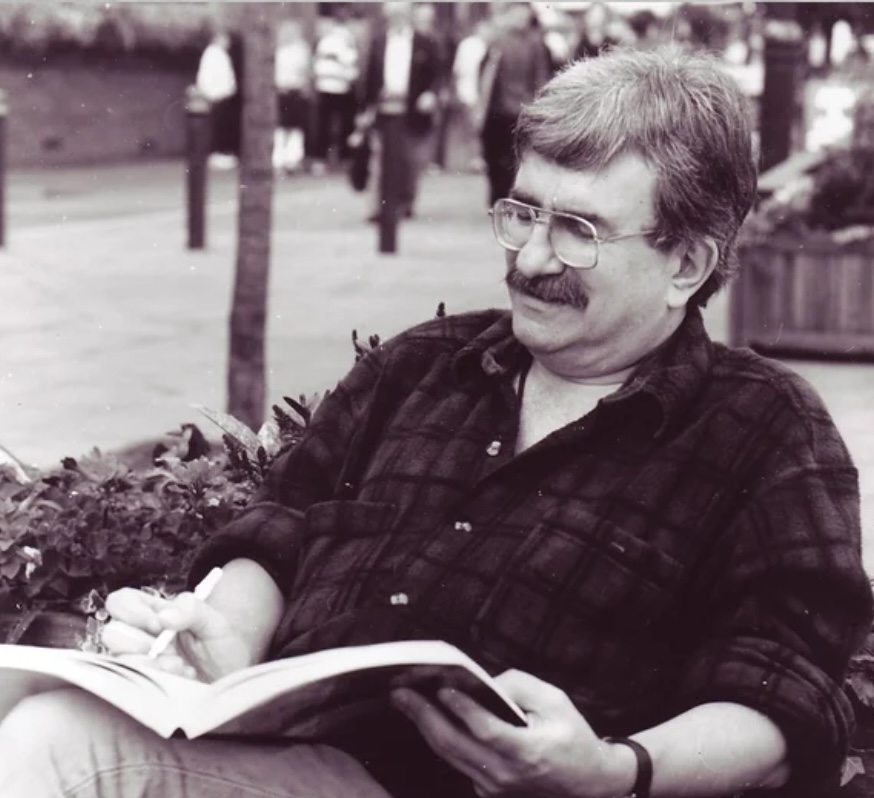
Paul Corfield Godfrey: The Silmarillion Opera Interview
Tolkien’s legendarium has inspired artists across countless disciplines, but few have ventured as boldly into music as composer Paul Corfield Godfrey. In this fascinating interview, we explore his ambitious Silmarillion Opera-cycle—a monumental project that seeks to translate the depth, drama, and mythology of the First Age into sound. From creative challenges to musical vision, Godfrey offers a rare insight into what it means to bring Middle-earth to life through opera.
Rockin' Middle earth; from Cirith Ungul through Minas Morgul, both Hobbit and Valar, from Gandalf till Sauron.
As music collector and a Tolkien lover, one cannot get around the massive musical interpretations of all kinds of artists from 'Bo Hanson's' creative effort of progressive-organ-rock to the classical formation of 'the Tolkien Ensemble' (and Mr. Chr. Lee) and the progressive metal formation 'Battlelore' and techno sound of 'Sauron'. Amongst this turbulent scene there sprang a light bright as the 'Silmarils', Paul Corfield Godfrey.
Here follows an article about Paul Corfield Godfrey's music by Jeroen Bakker, who recently also submitted his collector profile. Jeroen Bakker explains us how he discovered the music by this artist and came in contact with him. After this introduction follows an interview that Jeroen conducted with the musician and will be of interest to any Tolkien lover.
JEROEN BAKKER & PAUL CORFIELD GODFREY
It all started for me when I was reading an article about Tolkien inspired music in the publication 'Lembas' of the Dutch Tolkien Society 'Unquendor'. There was a name and a remark that made me curious. But I could not find any store selling his music. Not even non-tolkien related works, and most remarkable off all even René van Rossemberg (owner of Tolkienshop.com) had not heard of him. On the internet I came across a website, www.tolkien-music.com, and found out that the production company was in the United Kingdom.
I wrote the company and received a reply right away. Then I bought at once almost all there was on Tolkien and started to listen to as soon it had arrived. At first I thought the music to be rather odd. And I noticed that this was not, as I had hoped it to be, an orchestra recording. (The work I was listening to first was Ainulindalë Symphony No. 3). Instead it was the composer playing his synthesizer keyboard (I actually knew this before I ordered, but still my hope remained strong). While this not really fill in my expectations slowly I started to like what I was hearing. The more often I played this cd the more it touched me by its beauty and its complexity; but also the remarkable performance as well.
Next I played the 'Akallabêth' a 'rondo for solo piano' and again it grasped me. At that point I knew I was not ready for the Opera parts, because I was not prepared for the way it would have come to my ears, but the next day it was the first thing I put on when I woke up. With the opening of 'Fëanor' there came a click in my head, I had not experienced this in a long time. I had it only thrice before in my life. The first time I heard 'Arvo Pärt' (2001), the First time I heard 'Richard Wagner' (1995) and my first contact with the metal scene in late 1999, in this case thanks to my dear friend Bregje, 'Nightwish' (A metal-opera combination) was the subject that came to my ears then.
Mr. Godfrey and I started to have a correspondence and from one thing leading to an other, this article is it's result; this includes a interview with Mr. Godfrey. But that's enough about me.
First let me tell you something about the music before we go to the interview, which is quit extensive. The music breaks down into many parts of which the most complete is the opera cycle based on 'The Silmarillion'. This consists of four opera's: 1; Fëanor, 2; Beren and Lúthien, 3; The Children of Húrin and 4; The Fall of Gondolin.
These can be performed as solo opera's or as a whole, off course as one big opera is to be desired but realizing this; 'it requires an enormous organization'. Perhaps even more so then a performance of the entire Ring-saga by Richard Wagner.
Personally I think of the 'Beren and Lúthien' opera as one of my favorites, but the part of the 'Awakening of the Elves' in 'Fëanor' as the most beautiful of the cycle. Because I love this part of the book and with the music it reads even better. But there are many more beautiful 'scenes' in the music, but it will take forever to describe them all. The reason I like Beren and Lúthien is because the story allows the composer to leap into romantic themes and quite some action cues as well. I think it is a composer dream to work on a story so full of possibilities.
It would be nice to make a special report on one of the opera's not from the 'Silmarillion' cycle, most of the media forms left him out, movies, theatre, radio and music, but not Mr. Godfrey, and I think that calls for a special word devoted to it. Imagine:
"A man enters the stage, he looks worried, the voices in the theatre grow quiet, the man cuffs and in a deep but pleasant voice he say's; 'Ladies and Gentleman the theatre is pleased to announce Mr. Paul Corfield Godfrey's opera "Tom Bombadil!", please enjoy the performance, good evening."
Tom Bombadil is often left out character in many productions of just as many media's. Mr. Godfrey devoted one complete work to him, more on this in the interview.
However Mr. Godfrey does not limit his works to Tolkien, amongst others his music includes works by; Liam Blake, Oscar Wild and Leon Wiltshire. His works also include arrangements of folk tunes, mostly from Wales, where the composer now lives.
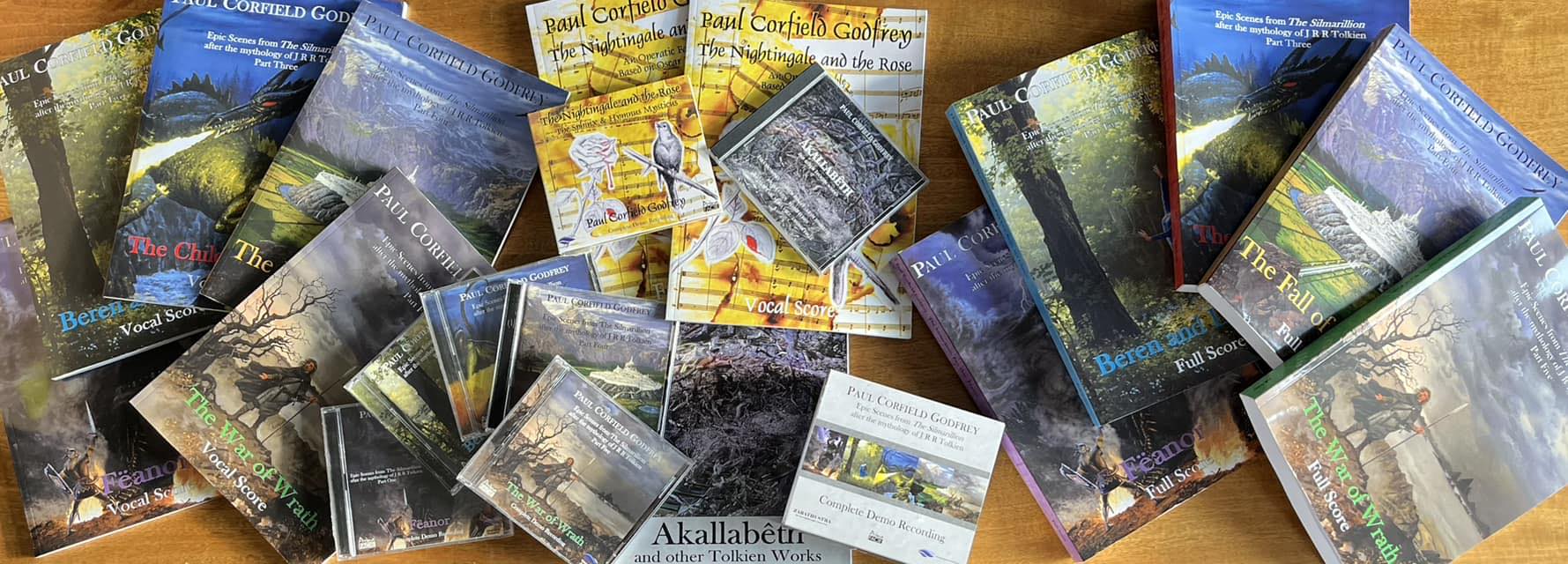
There some works that are released on CD, that share their place with non-tolkien music as well, that form 'only' fragments from the story, none the less they are also a great part of the works written by Mr. Godfrey based on works of Tolkien. All of them linked to Middle-earth only. So don't expect any music based on Mr. Bliss or Father Christmas Letters, though I regard for example 'Farmer Giles of Ham' a very good candidate to be a very nice opera.
There is to much to tell about these works that it is hardly possible to grasp it in one article and one interview, one may find one's self to have more questions then answers, my only advice would be get in contact and listen to the music yourself, or play it yourself.
ABOUT PAUL CORFIELD GODFREY
Mr. Godfrey was born in London, lived for a time in Ireland and later relocated to Wales where he still works and lives.
Some of his work has been performed throughout the world, but there are no commercial recordings ever made up till this point. (So if any one is interested please contact Mr. Godfrey!)
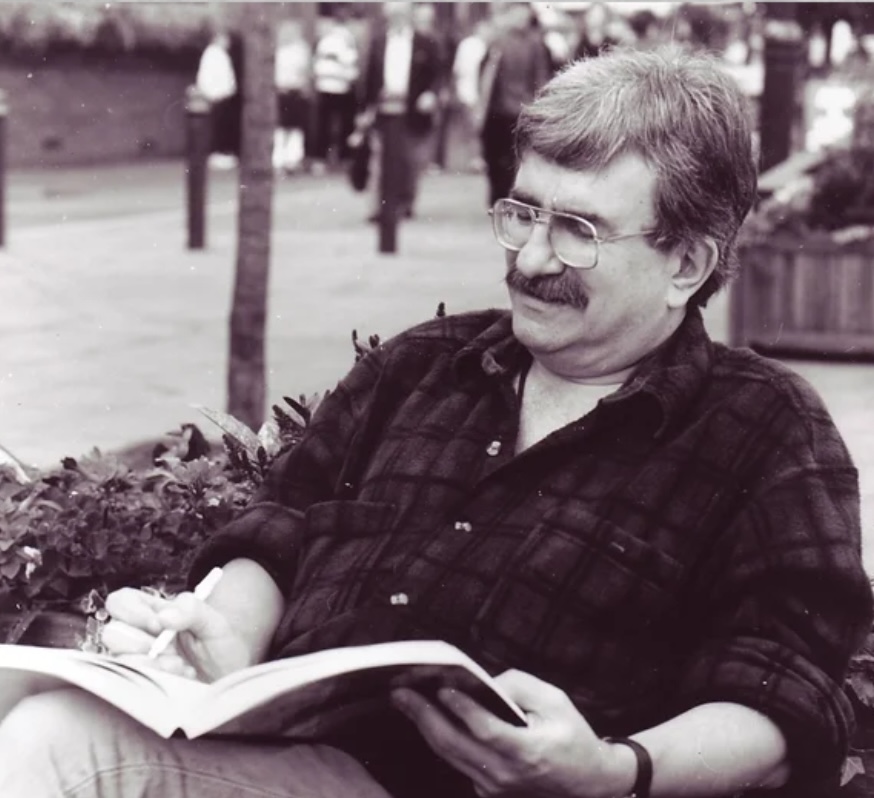
There is so much to say about the works, but why should I tell you when the composer could do so instead, once asked the right questions. That was one of my greatest objectives, what are the right questions? As one may conclude from my questions, I did not do this before in such an extensive manner and I am not an interviewer by any means. The questions came at first slowly but from the perspective as a musical hobbittist. The questions evolved once I started to entrust them to the paper, and before I knew it I had to cut questions because they lost the means of a consistent interview or drew to deep into matters and would pass by the interest and/or knowledge of the average reader (no offence intended) of any tolkien-related publication. I hope you (the reader) will enjoy reading this as much as I did writing it.
INTERVIEW WITH PAUL CORFIELD GODFREY by Jeroen Bakker
Part 1 - PERSONAL RINGS
JB. How did you first came to be in contact with classical music?
PCG. I sang in my local church choir, played with my school orchestra and then sang with my school choir which was quite adventurous in their choice of repertoire. We sang everything from Monteverdi and Palestrina to Britten and Finzi, and I was also introduced to the great romantic composers like Wagner, Strauss and Berlioz.
JB. In the orchestra what was your instrument, and what was your rank?
PCG. I played the oboe and timpani at various times, but I was never a great performer!
JB. Was this your favorite instrument?
PCG. I'm not sure I have a favorite instrument - I make use of what I need for the effect I want. However I do have some instruments I avoid, and I have a real aversion to the 1970s habit of lacing all orchestral scores with swathes of tuned percussion.
JB. And when did you started to compose music (classical or not) your self?
PCG. I was almost entirely self-taught as a composer until I was in my twenties and had already written a number of works. I then undertook some study with Alan Bush and David Wynne, but my style was very much formed by then - after a period of radical experimentation I settled down to a late romantic style; although I had been writing since the age of about nine, my first published work dates from 1967 when I was seventeen (and the published version was subsequently revised).

JB. You have studied with Alan Bush, alanbushtrust.org.uk, on the mentioned webpage he has quite an extensive musical repertoire. How was he to work with, or study with?
PCG. I only studied with Alan Bush for a short time, but he was a most inspiring teacher. He gave me encouragement when it was needed, although he did not share my enthusiasm for tolkien's work and thought that my work on The Hobbit would have benefited from a lot of cutting! The last time I met him was when he came to Cardiff for the first performance of my opera Arcturus, but shortly after that he was diagnosed with Alzheimer's disease and was seriously ill for some time before his death.
Alan Bush's music is very much under-estimated and some of it, such as his opera Wat Tyler, is truly great. Unfortunately only one item from Wat Tyler has ever found its way onto CD, but there are an increasing number of other works now available. I must however admit his insistence on political texts can sometimes lead to an over-emphatic and didactic approach, and I am rather afraid that his massive Piano Concerto is one such work.
JB. Did you ever write a composition with him?
PCG. No, although I did write some pieces as exercises for him and some of these have been published subsequently as movements in my Eight Studies.
JB. You also studied with David Wynne, I can't seem to find much about him, how was he to work with? What kind of a person was he?
PCG. He was quite elderly at the time I studied with him. I originally asked him for advice when I sang in the choir which gave the first performance of his cantata Owain ap Urien, not because I particularly liked his style (which although interesting was heavily atonal) but because I admired his imagination and particularly his innovative sense of rhythm. He never tried to influence the way in which I wrote, but he was extremely good in fostering my sense of self-criticism, to try and avoid the mundane and mechanical. This has always stood me in good stead, although it does mean that I have probably written rather less music than I would otherwise have done - I feel that if something is not exactly as I want it, I will not let it out into the public domain until I have got it right.
David Wynne's music has been very much under-rated even in Wales, and the recordings of his music that did exist in the 1970s never seem to have found their way onto CD. However Lyrita own the copyright on a number of the recordings, and one hopes this may change shortly. I do have superb off-air recordings of his Third Symphony and Owain ap Urien.
JB. Which composer do you like best?
PCG. There are no composers (and never have been) who do not have their off-days. It is for that reason that I would say there is no such thing as a perfect large-scale piece of music. I suppose my immediate influences are Holst and Vaughan Williams, but I also appreciate the sparer style of the later generation of composers like Britten who demonstrate that little can often mean more. Although I enjoy much of the music of the American minimalists like Adams and Glass, I often find their solutions to dramatic problems too simplistic to be properly convincing.
JB. Correct me if I'm wrong, but you say that the solutions to dramatic problems by let's say Philip Glass are too simplistic. Do you mean that they (he) are (is) too minimalistic to provide drama at all, or is it something else?
PCG. Of course minimalism can provide drama, but I must say that I find it of rather a generalised kind. There are sequences in Akhnaten, for example, which have a superb hieratic power and generate great heat; but this is achieved by sheer force of repetition, rather like Wagner working up to a climax through repetitions of sequences of notes. What minimalism finds much more difficult is to react to sudden changes of mood and interreactions between characters. I think that musical drama must be able to do this as well.
JB. Holst, to name only one, is best known for his 'Planets Suite' (and less known is Colin Mathews' additional piece 'Pluto') he uses a very orchestrated drama to put to his characters, is this what you want to achieve yourself in your works. To let the music 'be' the character or the dramatic situation rather then relying on the performing actor?
PCG. Of course the orchestra must assist in the business of characterisation, it is as vital a tool in that respect as harmony or melody. But the 'performing actor' also has a part to play, of course. There are passages in The Silmarillion where the whole burden of expression falls on the performer - I could cite the eighth scene of The Fall of Gondolin, which is (exceptionally) entirely for unaccompanied voices.
By the way I very much dislike Colin Matthews' Pluto, which I think totally ruins the original ending of Holst's suite with the offstage voices fading away at the end of Neptune. Anyway, Pluto isn't a planet any more, is it?
JB. No, he's no longer a planet, let's just say the Mathew's Pluto lasted it's time. Perhaps a start of a new series of music based on Semi planets, and the second movement is Edna.
[Just a joke]
JB. Besides Tolkien, what are your interests?
PCG. I am a trade union representative for the Public and Commercial Services Union, being the secretary for Wales, Scotland and Northern Ireland. Although I suppose this would be described as an 'occupation' rather than an 'interest' it does not leave much free time for anything other than music. But I read extensively
JB. How did you get in contact with the writings of Tolkien?
PCG. I was first introduced to The Hobbit in 1956 (I think) when my then sister-in-law Lois Mitchison (the daughter of authoress Naomi Mitchison who wrote some of the publicity for the first edition of The Lord of the Rings) gave me a copy. I didn't read The Lord of the Rings until same ten years later, but then I devoured it wholesale; and I have avidly followed each further instalment of the posthumous works as they have been published.
I originally started with a projected opera cycle on The Lord of the Rings, of which I suppose about a quarter was completed. Apart from The Black Gate is closed, there are six acts of The Hobbit, one act a piece of Tom Bombadil and The Grey Havens, and a collection of other scenes which I have gathered together as The Lord of the Rings: fragments and episodes. Same of these items were also published with piano accompaniment as Seven Tolkien Songs and Songs of the Mark (settings for male choir of two alliterative Rohirric poems).
Part 2 - P.C. GODFREY'S SILMARILS
JB. In most of your works you use, next to the classical instruments and melodies, more traditional instrumentation and melodies. Was this a deliberate choice or did it grow as a natural event? I would like to note at this point that it seems something of our time to use traditional instrumentation and melodies and mix it with the more classical music.
PCG. In 'The Silmarillion' the only use of 'traditional instruments', as you call them, are the four recorders [Blockflöten] in 'The Fall of Gondolin', but I did also use them in 'The Hobbit'. There were a number of reasons for this. In the first place I wanted a deliberately antique sound for Gondolin itself, a city which had been preserved beyond its time. You hear them almost as a block of sound set against the rest of the orchestra. In the second place I had found in live orchestral performances of excerpts from 'The Hobbit' that, contrary to general wisdom, a group of recorders is quite loud enough to make its presence felt in a modern orchestra; and the sound of four recorders combined with the three flutes in unison contributes a rich body of a particular wind sound which cannot be obtained by any other means. In the third place, as a consequence of my decision to use the recorders in the score, they could then be used as an extra battalion of piccolos in the storm music!
There are some other unusual instruments in 'The Silmarillion'; for example the ranges of bells in 'The Fall of Gondolin', the multiple xylophones for Ungoliant, and the wind and thunder effects in 'Beren and Lúthien' which form part of the fabric of the music; but other than that the orchestra is a basic large romantic symphony orchestra.
'The Silmarillion' is of course designed for live performance, and as such a composer always has to consider matters of balance. The use of instruments like the Irish whistle and the Hardanger fiddle such as Howard Shore uses in 'The Lord of the Rings' would be quite impossible without electronic amplification in the studio, at least in the way he uses them.
JB. Your use of 'strange' instruments is what I think a very nice thing to add to the musical world of Tolkien, especially the Xylophones you mention, one can almost see her (Ungoliant) walk. Was it indeed used to portray her walk?
PCG. It is a matter of atmosphere rather than a depiction of movement. Ungoliant's music is very different from anything else in The Silmarillion.

It is dodecaphonic, for a start (the only such music in the whole work); it is in a limping 7/8 rhythm for much of the time; it is underpinned with diminished harmonies almost throughout; and when she speaks, in the scene of the Thieves' Quarrel, she is portrayed by offstage amplified voices which I would expect to be subjected to electronic distortion.
JB. Did you use more instruments in a 'strange' way to portray other characters? If so can you give us a example?
PCG. Again, there are some characters who are characterised by changes in melody, instrumentation and harmony. The Elder King sings invariably on one note, changeless in the face of shifting harmonies and totally immutable. Morgoth tries to imitate this, but there is a continual shadow on the voice provided by orchestral voices a semitone below. Sauron in Beren and Lúthien takes that semitone and creeps from note to note in a more remote echo of it. The Elves tend to be characterised by modal harmonies, the humans by chromatic ones. Elbereth's music is characterised by string harmonics high above the vocal line. There are many other examples, but obviously the major dramatic characters such as Fëanor, Túrin and so on change their musical characterisation as their mood changes.
JB. The use of special instruments (ala H. Shore) as you say is very difficult, because of the availability of players, if you had to choose one instrument you would want to use in your works which is not in a 'average' orchestra, what would it be?
PCG. I do find the use of recorders in The Fall of Gondolin works, and although there is an alternative scoring in the choral suite of movements which allows for the omission of the recorders if players are not available I would not want this to become a general practice. I have always felt the want of a strong low woodwind instrument (the bass clarinet and bassoon are generally too weak in their middle and top registers) and in some of my works for chamber orchestra I have sometimes used a tenor saxophone which I must admit I think is a noble instrument if it is not abused.
JB. Talking about orchestras, if you had to those one Orchestra and one conductor, to perform you work, what would the combination be?
PCG. Oh no, I'm not being drawn on that one. Orchestras have got a lot better in my own lifetime, and many orchestras are now capable of playing modern scores which even as recently as the 1980s tended to sound rather undernourished especially in the string department.
JB. tolkien's 'Ring' is often associated with Wagner's 'Ring', do you think that this would apply for your musical approach to tolkien's 'Ring' as well? Of course your work is more focused on the Earlier Ages of Middle-earth, but in scope your work is at least as 'massive' as Wagner's 'Ring', but does it musically compare?
PCG. Tolkien had it about right when he said that his Ring and Wagner's Ring were both round, and there the resemblance ceases. Actually in terms of plot there are more parallels (for example the fight with the dragon) between Wagner's Ring and the Silmarillion.
Musically my setting of the Silmarillion, although like Wagner it does extend over four evenings, is not really very similar to Wagner's style. For a start each of my individual evenings is considerably shorter - Beren and Lúthien is the longest at around three hours as opposed to the five hours of Götterdämmerung. The orchestra is rather smaller and the staging demands are less extreme. Also The Silmarillion differs from Wagner's Ring in its extensive use of choral passages to move the action forward.
There are some similarities - for example, the use of specific motifs to represent various characters and emotions - but this is more a practical matter of meaningfully organising the music over such a long time span rather than an imitation of Wagnerian practice. Many of my 'motifs' are developed melodic phrases which are subsequently varied, rather than as in Wagner short symphonic themes which are subjected to symphonic development.
JB. On Wagner you say there are only a few similarities, what is the greatest non-similarity?
PCG. My leitmotifs are often more extended and melodic than Wagner's. I tend to develop the music by statement and variation rather than in the purely symphonic manner of Wagner's mature scores. But I do try to keep a family resemblance between motifs of related dramatic impact, because I think it is important that the listener senses the relationship even if they don't realise it consciously.
JB. What would you say is the big difference between you and Wagner?
PCG. I don't have Wagner's fascination with "endless melody", the delay in resolving a musical harmony over an extended period. Wagner writes music which is always in transition, which is fine over the vast paragraphs of his music dramas; I write music which proceeds by contrast and juxtaposition, which is fine over the smaller dimensions of my epic scenes.
JB. When I listen to the vocal parts in the operas based on 'The Silmarillion' I get a feeling as if some of the singing is based on (Saint) 'Hildegard von Bingen's' vocal technique. Is this true?
PCG. No, except insofar as I often use the same traditional mediaeval modes as Hildegard and every other composer of that period. I derive this through the use of similar techniques as found in the music of the British pastoral composers of the early twentieth century - Vaughan Williams, Finzi and Holst on the Anglo-Welsh borders, Bantock in Scotland. And also, of course, in Celtic traditional music. The modes are not specifically mediaeval in any event; it is just that mediaeval composers used nothing else.
JB. The 'modes' you use resemble a ancient kind of tone to the music, was this a good way to give a historical feeling to the music or could you just have picked any other mode?
PCG. I don't think modes are historical, ancient or old-fashioned. They are a perfectly natural way to write in the modern era, and of course they still underpin all folk music.
JB. Your music is sometimes very complicated (Ainulindalë), was this a deliberate choice or did it occur as a natural event?
PCG. I would say that everything in the score is there for a reason and a purpose. Nothing is added just to make additional counterpoint. Most of the score is melodically and thematically derived, and often one theme is laid on another; some of the themes are underscored with harmonic and textural support which are designed to enhance their atmosphere and meaning. The complexity at the end of the Ainulindalë symphony is exceptional (I think at some times there may be as many as seven themes - with their associated textures - proceeding simultaneously); but of course it is illustrating something in the book which is described musically as being extremely complex! I think at no other time in The Silmarillion cycle are there more than three themes at once, although in the Battle of the Five Armies in The Hobbit (unfortunately the sketches written in 1972-73 are now lost) I remember using five different strands of sound practically throughout.
JB. How does one get from reading tolkien-books to composing operas about them?
PCG. I always imagined music with the books from the very first time I read them. I wanted to compose an opera cycle on The Lord of the Rings as long ago as 1974, and I wrote The Black Gate is Closed as early as 1968-69. There are still parts of that first score which stand the test of time, and (for example) the storm sequence in Beren and Lúthien was derived from one of the earlier sketches I did for The Black Gate. The development of the scheme for The Silmarillion took a long time, partly because there were so many difficulties constructing a text which (1) did not get bogged down in inexplicable detail and (2) gave enough vocal material to develop an emotional and dramatic structure.
JB. Many musical works (such as Theatre, Film, Radio adaptations and (Pop) Music) based on tolkien's world have often left out one of the primary characters, namely Tom Bombadil; you devoted an entire work to him. Did you do this because you felt that he was too often forgotten by others?
PCG. No, I'm afraid to say it wasn't, although I regard Tom Bombadil as more essential to tolkien's 'message' than obviously do the adaptors who have cut him out. It was purely because when I was sketching the music for my projected opera cycle, Tom Bombadil was one of the passages on which I
Related Articles
Few artists capture the spirit of Tolkien’s world with as much depth and imagination as Jef Murray. In this engaging interview, he shares insights into his creative process, his inspirations, and the role of art, story, and “sub-creation” in bringing Middle-earth to life beyond the page.
Matthew Dickerson is widely known for his insightful studies on Tolkien, but his creative work draws from the same deep well of medieval literature and myth. In this interview, he discusses the origins of The Rood and the Torc, a historical novel inspired by Old English poetry, and reflects on how Tolkien’s influence helped shape both his scholarship and his storytelling.
Tolkien’s influence extends far beyond the written word, shaping decades of art, film, music, and popular culture. In Middle-earth Envisioned, Paul Simpson and Brian J. Robb explore this remarkable legacy, tracing how The Hobbit and The Lord of the Rings have inspired creators across a wide range of media. In this interview, the authors discuss the origins of the project, the challenges of capturing such a vast subject, and the many surprising discoveries they encountered while bringing this ambitious work together.