From Soria Moria to Moria
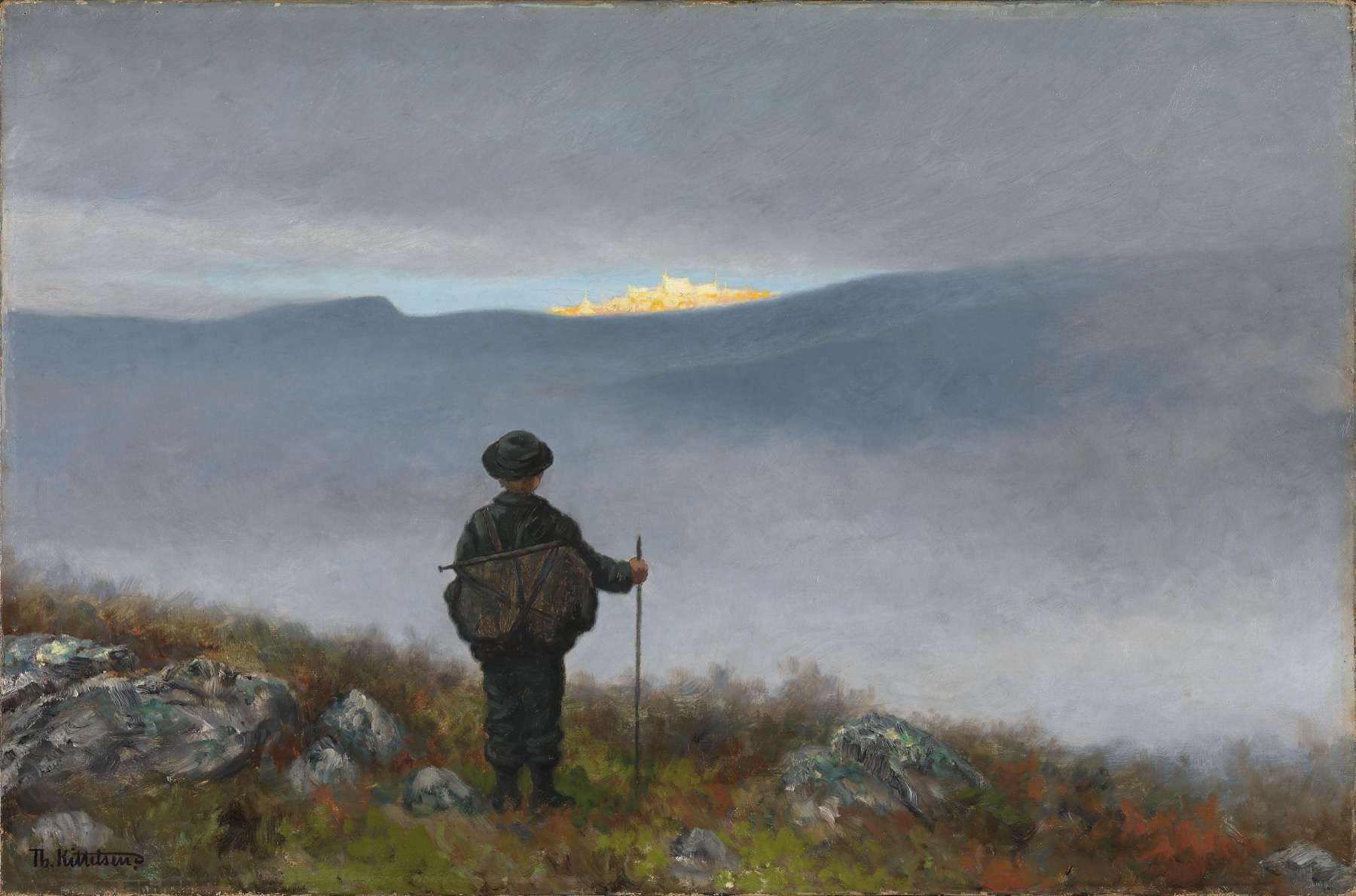
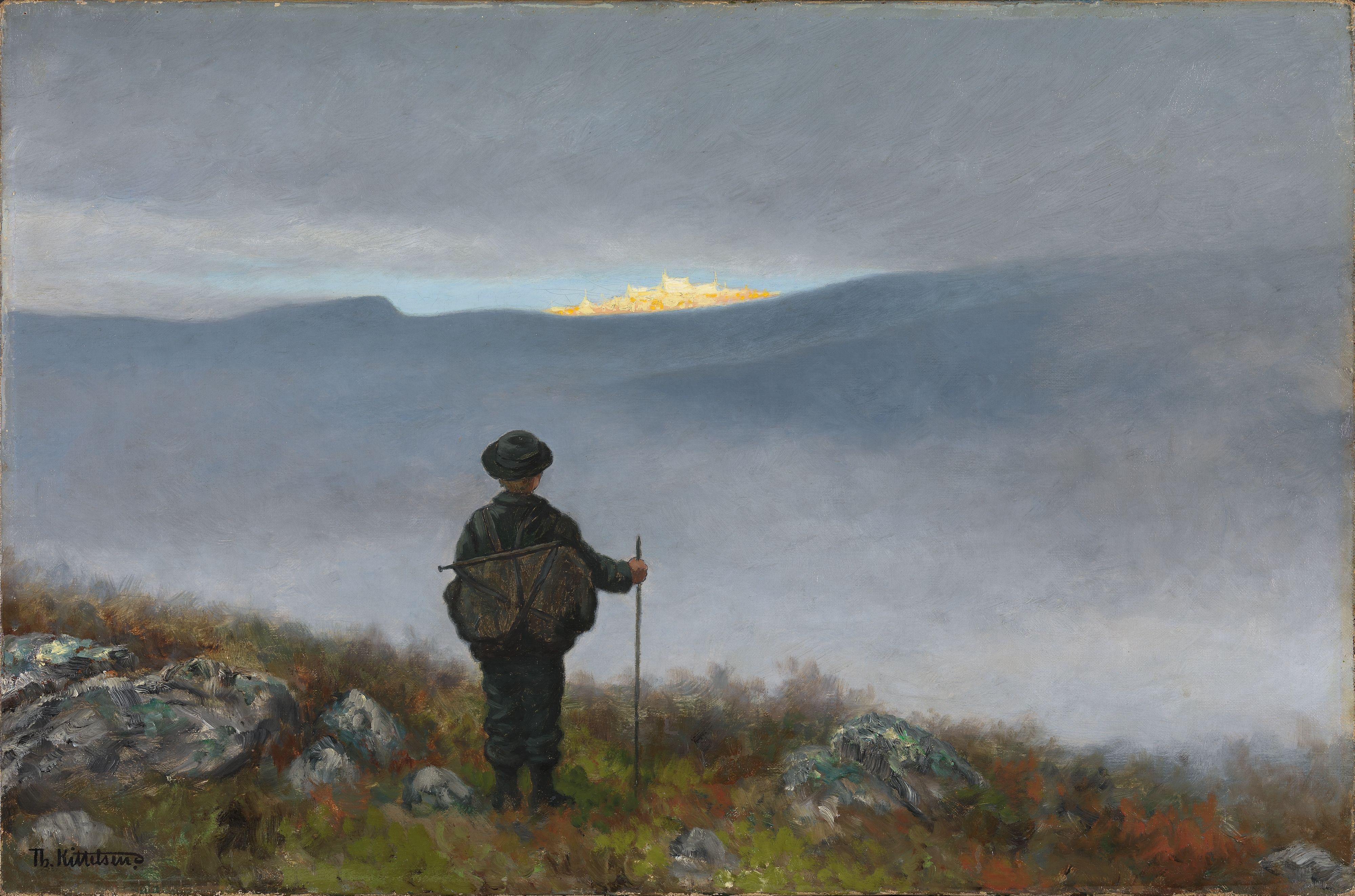
One of Kittelsen’s paintings shows a boy looking out towards a palace he can barely see. The hills near Kragerø make me think of the picture. The name of the palace was still in Tolkien’s ear when he wrote about the Mines of Moria. His letter to Mr Rang tells us how it got there.
I followed the name back to George Webbe Dasent’s book. Along the way I found a cat who could keep a troll talking until sunrise, and a set of directions that Frodo turns round on his way to the Grey Havens.
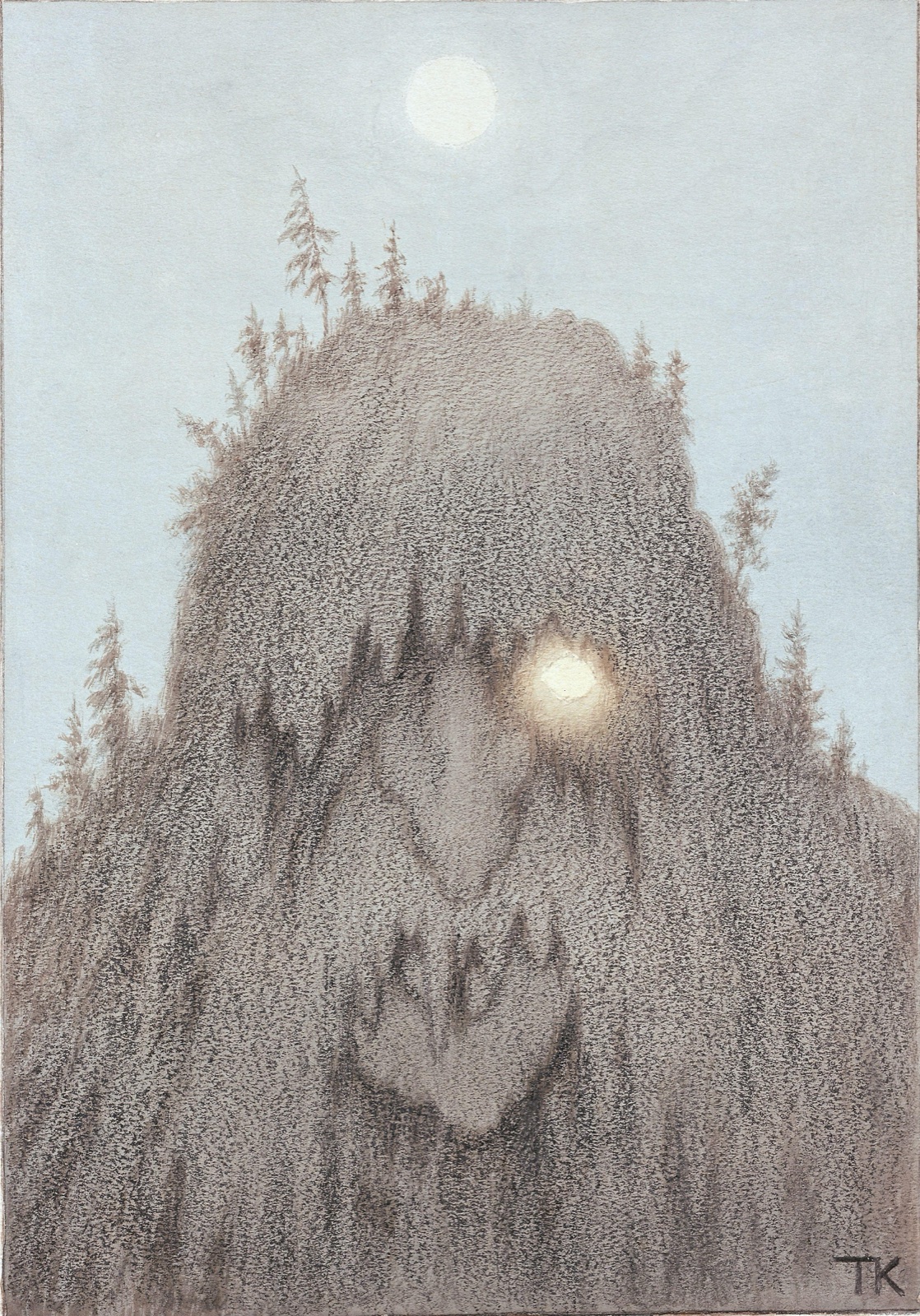
Start with the eye in Kittelsen’s Skogtroll. Once you’ve found it, look back along the ridge. The trees still belong to a hillside, even after you have seen the face. Tolkien leaves his three trolls in stone long enough for a second company of travellers to come across them.
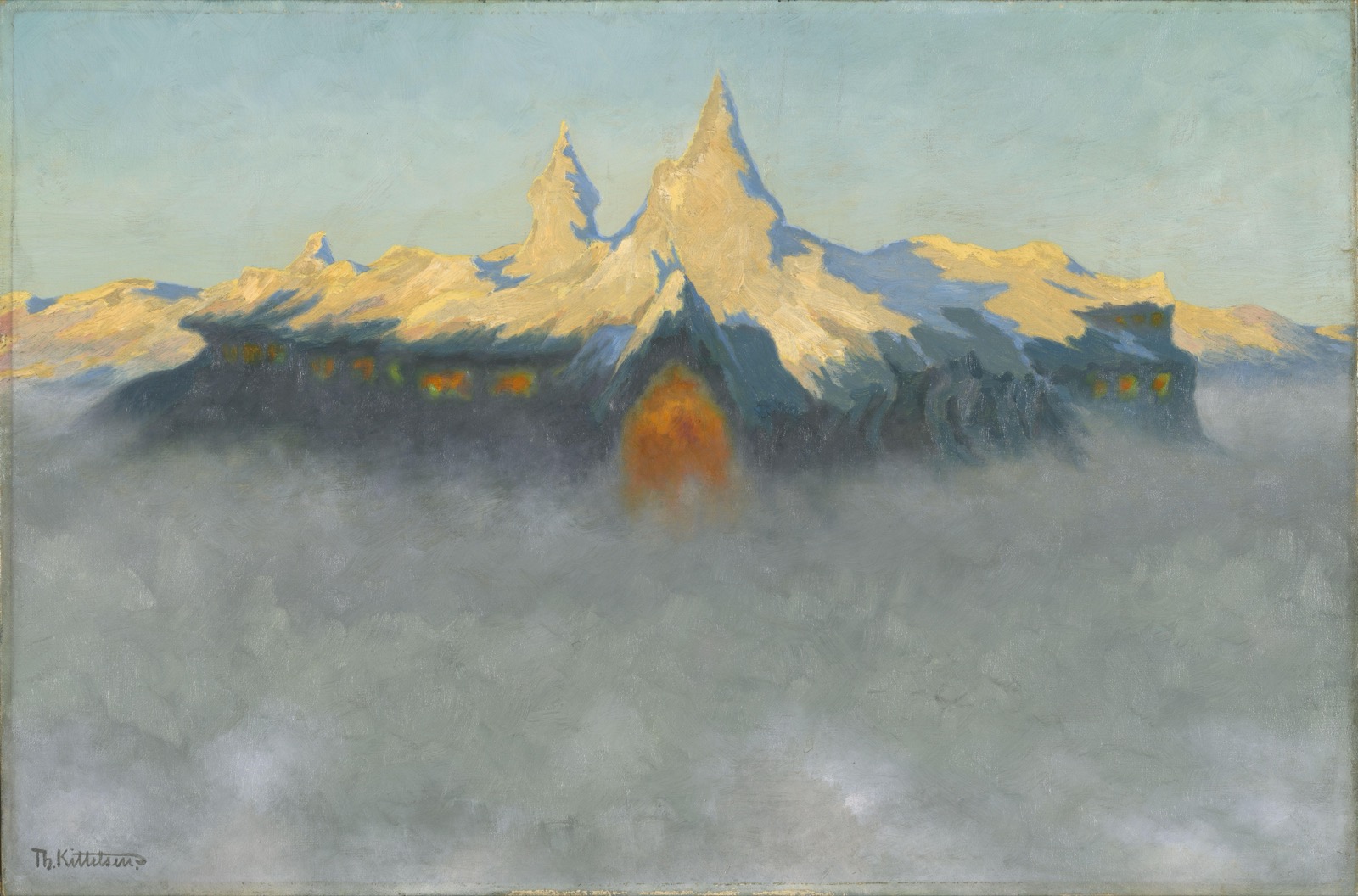
Then look at the two pictures of Soria Moria. In one the palace is a gleam that could be lost if you took your eyes off it. In the other you can see a light in the doorway. Keep that doorway in mind when the Fellowship comes to a wall of stone and Gandalf tries to read the words that will let them in.
How Norwegian folklore echoed into Middle-earth
Living in Risør, I am never very far from Theodor Kittelsen. Up the coast in Kragerø, where he was born, there are islands that disappear into mist one by one. A bare rock can look like a head until the light changes. Looking at Kittelsen’s pictures at the museum in Kragerø, I could see how little it took for a hillside to become a face. Afterwards I found myself looking at the land in much the same way. It is still possible to imagine a troll here. You can see the part of the rock from which it might have come.1
I wondered how much of that Northern world I knew already from Tolkien. The first connection I could follow to his own words was a name. Say Soria Moria aloud, then the Mines of Moria. I had known the second for years. The first made me hear it again. Tolkien’s letter records that echo. Kittelsen’s pictures offer a different kind of connection: a way of seeing trolls and landscape beside Tolkien, without evidence that he knew the paintings themselves.
What Tolkien remembered
In August 1967 Tolkien drafted a reply to a reader, Mr Rang, who had proposed a connection between Moria and the biblical land of Moriah. Tolkien rejected the suggestion. His own recollection was of a “casual ‘echo’ of Soria Moria Castle” in one of the Scandinavian tales translated by George Webbe Dasent. He had forgotten the tale itself. What stayed with him was the sound of Moria. He liked the way it went with mines, and he could use it in a language where the element mor already carried the sense of darkness. In Sindarin, Moria means Black Chasm. The letter gives us both the sound that caught his ear and the meaning he gave it.2
The name is first heard in The Hobbit at Bag End. Gandalf is explaining how Thorin’s map came to him. Thorin’s grandfather handed the map to his son before going to the Mines of Moria, where he was killed. The map on the table leads to the Lonely Mountain. Moria is somewhere else, and Bilbo has to take in the death of a man he has never met before he can make sense of the paper in front of him. The Dwarves know the place well enough for Gandalf to leave it undescribed. It will be another book before the reader sees the door.3
The story reached England through the work of collectors and a translator. Peter Christen Asbjørnsen and Jørgen Moe began collecting Norwegian tales in the 1830s and publishing them in the 1840s. They recorded stories carried in the voices and memories of tellers. Repetition mattered: a listener could recognise a coming encounter from the way the previous one had unfolded. George Webbe Dasent brought that storytelling into English, keeping much of its spoken rhythm.4
Dasent’s Popular Tales from the Norse first appeared in Edinburgh in 1859. Tolkien names the translator in his letter, but does not identify the edition he read. I am using the enlarged second edition of 1859 here, so that the stories and the pages can be checked. Its publication date does not tell us when Tolkien first encountered them. In “Soria Moria Castle”, Halvor leaves the ashes by his parents’ hearth, goes to sea and comes to a strange country. In the first castle he enters, a princess shows him how to use the troll’s own flask to gain the strength to lift its sword. He frees her and goes on to free her sisters. The last of the three castles is Soria Moria. The pattern of the encounters gives the story a rhythm one can hear even on the printed page. Each troll has more heads than the last, and the entrance to each castle means a new meeting with someone who knows how things work there.5
After rescuing the princesses, Halvor misses his parents. The princesses give him a ring that can take him home and back if he follows their instructions. He is so finely dressed that his parents fail to recognise him. Once he gets a place by the hearth he begins poking the ashes as he used to do. He loses his easy way back to the castle and has to go looking for it. The West Wind helps him on his way to the women washing clothes for the wedding. He could wish himself home in an instant. Getting back to Soria Moria takes walking, listening and turning up in rags.6
The rings make an inviting comparison, though they do different work. Halvor can wish himself home, then loses his easy return when he disobeys the princesses. Bilbo can disappear, but still has to find his way past Gollum. Tolkien was unusually definite about what he had taken from this tale: the sound of its name. By his own account, the story had not interested him and he had forgotten it. The two rings therefore give us a comparison to explore, rather than evidence that Halvor’s ring became Bilbo’s. His use of Dasent’s cooking image in “On Fairy-stories” is helpful here: the ingredients of a story are its bones, while the finished telling is the soup. Finding an ingredient leaves us with the more interesting question of what the writer made of it.7
Keeping a troll talking
In Dasent’s “Lord Peter”, the troll comes home to find people eating and drinking in his castle. A cat detains him at the gate by offering to explain how a farmer grows winter rye. The procedure is long enough for her purposes. She keeps going until the sun comes up and the troll bursts. Dasent notices the scene in his introduction for what it says about the trolls’ interest in human skills. The cat is counting on the troll wanting to hear what happens next.8
In “Roast Mutton”, Gandalf has three quarrelsome trolls to work with. William, Bert and Tom are already arguing about dinner. He supplies a voice that sounds like one of theirs and starts the quarrel again whenever it threatens to end. In Dasent’s tale the talk concerns growing food; in Tolkien it concerns cooking the captives. Both conversations keep the trolls interested until daylight.
The outcomes differ. Dasent’s troll bursts, while Tolkien’s three remain standing in stone. The resemblance makes the scenes rewarding to read together, though it does not establish “Lord Peter” as Tolkien’s particular source. Gandalf has found a weakness which belongs to these three creatures as we have met them: each is ready to quarrel with the others, and none notices how long they have been doing it.9
The stone gives Tolkien something he can use again. In “Flight to the Ford”, Aragorn and the hobbits come across the three figures on the way to Rivendell. The company has been travelling with a wounded Frodo, and three trolls are a serious thing to find. Aragorn strikes one of them with a stick, and the old danger turns out to be a piece of the landscape. A reader who knows Bilbo’s book gets to recognise the place along with the travellers. A fairy-tale ending has become something solid that another set of people can walk up to and touch, years after the original joke.10
Go back to the hills after looking at Kittelsen’s Skogtroll. The National Museum dates the drawing to about 1906. It was used on the cover of an illustrated collection of Asbjørnsen’s tales in 1907. Trees stand along the ridge, and below them there is a single bright eye. The eye is there for anyone to see, yet the ridge is still a ridge. In Tolkien the trolls go the other way. We meet them squabbling by a fire and a later traveller can see them as something left in the landscape. Those are two of the reasons I keep looking for figures in the rocks here. With that drawing on the cover, Kittelsen could change the way a reader saw the forest before the first tale had even begun.11
The castle and the door
Theodor Kittelsen also made his own version of Soria Moria. In one of his twelve paintings for the story, made in 1900, we stand behind a boy who has stopped to look into the distance. The dark foreground gives way to folds of land, and beyond them is a little gleam. I have to look for it. The eye keeps travelling after the boy has come to a stop. The National Museum identifies him as Askeladden, the Ash Lad, in Kittelsen’s version. The museum also records that Kittelsen’s own text appeared with the pictures in a children’s book in 1911. In that text the castle shines beyond the sun-and-moon directions from the other Norwegian tale. Kittelsen puts the castle and the impossible address together. The reader can see the destination in the picture and still wonder what it would take to get there.12
There is another painting in the series, Der lå Soria Moria slott. The boy has gone from the foreground. The palace takes up most of the picture, and there is an orange light where you would go in. Keep the two pictures open and the distance between them becomes part of the story. The little gleam the boy could see across the hills has become something you can stand in front of. When I turn from that picture to Tolkien’s Moria Gate, the company is already at the water. The rock stands up in front of them and there is scarcely anywhere else for the eye to go. Tolkien lets the door be seen before Gandalf understands how to open it. The word he needs is already in the inscription. The people who put it there expected friends to come through the gate.13
Inside the mountain there is a second piece of writing. The record beside Balin’s tomb gives Gandalf sentences he can read and gaps he has to leave alone. The damaged pages Tolkien made for the book have charred edges and stains. He used his pipe to burn the paper and paint to give it the colour of dried blood. Put the record beside the inscription at the gate. One was made to be read by people arriving from outside. The other was written by people who were running out of ways to leave. A name from a fairy tale had become a place where you could tell who had lived, and something of what had happened to them, from what they had written there.14
West of the Moon
In Dasent’s “East o’ the Sun, and West o’ the Moon”, a young woman goes in search of an enchanted prince. She is told there is no way to where he is going. On her journey she is passed from one wind to another until she reaches the North Wind. He knows the place because he once blew an aspen leaf there, an effort that left him unable to blow for days. That single leaf is the North Wind’s evidence. He can tell her how tired he was afterwards, and I begin to believe he knows the way.15
In “Three Is Company”, early in The Fellowship of the Ring, the hobbits sing a walking song they learned from Bilbo. There might be a new road or a secret gate around the next corner, and the end of the song leaves the sun and moon as possible directions. By “The Grey Havens”, Frodo and Sam are again travelling together through the Shire. Sam hears Frodo singing quietly and notices that the words have changed. Frodo’s paths now run “West of the Moon, East of the Sun.” The Norwegian title puts the sun first. Frodo gives the same impossible address with its two halves in reverse order: west of the moon, then east of the sun. He is singing about a path he expects to take. For the woman in the tale, the impossible direction is the beginning of a reunion. Frodo sings it on the way to a parting, before Sam fully understands that his friend will be leaving. The change matters because we have already heard the hobbits sing about a road they might one day follow. At the end of the book Frodo is preparing to leave it. The old fairy-tale address has become part of that farewell. I hear the likeness most strongly there, in how differently the same words prepare us for what comes next.16
There is one sound I can follow all the way from the Norwegian tale to Tolkien’s letter. I can also put his book beside the tales and paintings and see what each maker asks me to look for. Halvor recognises the people who can tell him the way. Gandalf has the answer in front of him and has to learn how to read it. When I go back along the coast between Risør and Kragerø, there are still moments when a rock has the shape of a head. I know how little Kittelsen would have had to add for me to see an eye.
Further reading
Our bookshop has a The Letters of J.R.R. Tolkien — Houghton Mifflin hardback, PC0466, from the original 1981 collection. The citations below use the pagination of the revised and expanded 2023 edition.
For letter 297, see The Letters of J.R.R. Tolkien, revised and expanded edition (HarperCollins, 2023; UK hardback, ISBN 9780008628765).
Affiliate links. As an Amazon Associate I earn from qualifying purchases. Tolkien Library may also earn a commission through AbeBooks, at no extra cost to you.
Letters at Amazon.co.uk (paid link) · Letters at Amazon.com — UK edition (paid link) · Letters at AbeBooks — this ISBN (paid link).
For Dasent, search AbeBooks for Popular Tales from the Norse (paid link). Editions vary in their contents and pagination. The free 1859 scan is linked in the notes below.
Footnotes
- Telemark Museum, “Theodor Severin Kittelsen (1857–1914),” part 1, on Kragerø and Kittelsen’s childhood. Source online. ↩
- J.R.R. Tolkien, The Letters of J.R.R. Tolkien, ed. Humphrey Carpenter with Christopher Tolkien, revised and expanded ed. (HarperCollins, 2023), letter 297, drafts to Mr Rang, August 1967, p. 541, especially the paragraphs on Moria and the external history of names. ↩
- J.R.R. Tolkien, The Hobbit, ch. 1, “An Unexpected Party,” the conversation about the map and key. Letter 297 identifies this chapter as the first appearance of Moria. ↩
- Nasjonalbiblioteket, “Folkeeventyra – ei suksesshistorie,” on Asbjørnsen and Moe’s collecting from the 1830s, the oral sources and the first printed issues. Source online. ↩
- Peter Christen Asbjørnsen and Jørgen Moe, Popular Tales from the Norse, trans. George Webbe Dasent (Edinburgh, 1859), “Soria Moria Castle.” In the enlarged second edition of 1859 the tale starts on p. 457. For the Norwegian text, see Norske Folkeeventyr, “Soria Moria slott.” 1859 library scan (PDF) · Tolkien Library backup (same scan, PDF) · Tolkien Library source notes (PDF) ↩
- Dasent, Popular Tales from the Norse, 2nd ed. (1859), “Soria Moria Castle,” pp. 464–471, from Halvor’s wish to see his parents through his return to the castle. 1859 library scan (PDF) · Tolkien Library backup (same scan, PDF) · Tolkien Library source notes (PDF) ↩
- J.R.R. Tolkien, The Hobbit, ch. 5, “Riddles in the Dark”; letter 297; and “On Fairy-stories,” in The Monsters and the Critics and Other Essays, ed. Christopher Tolkien (George Allen & Unwin, 1983), section “Origins.” On Dasent’s editions and Tolkien’s references, see Oronzo Cilli, Tolkien’s Library (Luna Press, 2019), entries A526–A527. ↩
- Dasent, Popular Tales from the Norse, 2nd ed. (1859), “Lord Peter,” pp. 346–347, and the introduction, p. cxxxix, on the trolls and sunlight. 1859 library scan (PDF) · Tolkien Library backup (same scan, PDF) · Tolkien Library source notes (PDF) ↩
- J.R.R. Tolkien, The Hobbit, ch. 2, “Roast Mutton.” Compare Dasent, “Lord Peter,” and “Alvíssmál”, stanza 35, in Edward Pettit, ed. and trans., The Poetic Edda (Open Book Publishers, 2023), p. 377. Thor detains the dwarf Alvíss by questioning him until dawn. The poem ends with the arrival of sunlight. Publisher’s chapter · Publisher’s PDF · Tolkien Library source notes (PDF) ↩
- J.R.R. Tolkien, The Fellowship of the Ring, book I, ch. 12, “Flight to the Ford.” ↩
- Nasjonalmuseet, Theodor Kittelsen, Skogtroll (probably 1906), NG.K&H.B.03222. The museum’s Eventyrskatten guide identifies it as the cover drawing for Asbjørnsens illustrerede eventyr. Ny samling (1907). Museum collection record · Exhibition guide ↩
- Nasjonalmuseet, Theodor Kittelsen, Langt, langt borte så han noe lyse og glitre (1900), NG.M.00546. The collection entry quotes the artist’s text and identifies the 1911 illustrated edition. Source online. ↩
- Nasjonalmuseet, Theodor Kittelsen, Der lå Soria Moria slott (1900), NG.M.00551. J.R.R. Tolkien, The Fellowship of the Ring, book II, ch. 4, “A Journey in the Dark,” including the illustration of the Doors of Durin. See also the Tolkien Estate’s “Moria Gate,” c. 1939. Kittelsen’s palace · Tolkien’s Moria Gate ↩
- J.R.R. Tolkien, The Fellowship of the Ring, book II, ch. 5, “The Bridge of Khazad-dûm.” The Tolkien Estate illustration gallery records how Tolkien made the three fragments of the Book of Mazarbul. Tolkien’s Book of Mazarbul pages ↩
- Dasent, Popular Tales from the Norse, 2nd ed. (1859), “East o’ the Sun and West o’ the Moon,” pp. 33–35, the North Wind’s account of the aspen leaf and the journey that follows. 1859 library scan (PDF) · Tolkien Library backup (same scan, PDF) · Tolkien Library source notes (PDF) ↩
- J.R.R. Tolkien, The Lord of the Rings, book I, ch. 3, “Three Is Company,” and book VI, ch. 9, “The Grey Havens.” Compare the wording of Dasent’s title and Kittelsen’s text quoted in the Nasjonalmuseet record for NG.M.00546. ↩
Cover. Theodor Kittelsen, Langt, langt borte så han noe lyse og glitre (1900). Nasjonalmuseet, NG.M.00546. Photograph by Børre Høstland / Nasjonalmuseet, CC BY 4.0.
Related reading · From Hylestad to Tolkien · J.R.R. Tolkien & His Works
Related Articles
Tolkien Library returns with a rebuilt website and new writing from Norway. I look back at the books and people behind it, explain what you can find in the online bookshop and archive, and share the plans for a Tolkien Centre and a physical bookshop in Risør. Two personal reflections tell more of the journey that brought the library here.
The Hylestad doorway tells Sigurd’s story in wood. There is a sword at the forge, a dragon, a horse carrying gold, and a man playing a harp among snakes. Each scene asks the eye to pick out a few details.
When The Legend of Sigurd and Gudrún appeared in 2009, one of those details reached the cover. I went back to the doorway and to my interview with Bill Sanderson to see what the book’s designers and illustrator had chosen to carry over.

Reading The Silmarillion after our move to Norway brought me back to Peter Wessel Zapffe. In The Last Messiah, a hunter comes to understand what it means for the animals he hunts to suffer. Tolkien gives his Elves centuries in which to learn what it costs to remember.
I follow that comparison through Fëanor’s refusal to break the Silmarils, Finrod’s conversation with Andreth, and the choice Galadriel makes before she leaves Lórien.